

(This article by Kimberly Lankford originally appeared in the May 2026 issue of Military Officer, a magazine available to all MOAA Premium and Life members who can log in to access our digital version and archive. Basic members can save on a membership upgrade and access the magazine.)
Surviving spouses of military retirees and veterans are entitled to or can qualify for valuable benefits even if decades have passed since the servicemember left the force. They might be able to receive lifetime health coverage, inflation-adjusted monthly income, a life insurance payout, and more. But these benefits don’t automatically kick in; surviving spouses must take deliberate steps after the veteran dies to ensure they receive the benefits to which they’re entitled.
Fortunately, some key strategies and resources — including fellow members of the surviving spouse community — can make this process go as smoothly as possible during a difficult time.
Taking the Next Steps
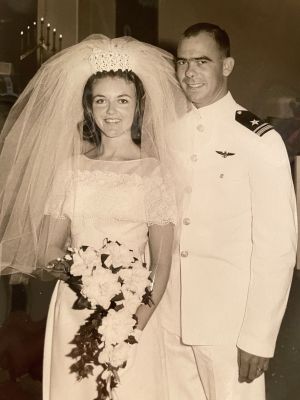 Soon after Richard “Dick” Norwood joined the Navy and was sent to Pensacola, Fla., for flight training, he met Susan. Dick and Susan, pictured, hit it off and married in 1966, just 2½ years after he started his 31-year Navy career. During that time, he flew P-3 Orion aircraft as a submarine hunter and later traveled throughout the world as a military attaché, often accompanied by Susan. After he retired from the Navy as a captain, Dick worked for aerospace companies, and he and Susan eventually settled down in Wichita, Kan., where he retired from his civilian career.
[APPLY NOW: Join MOAA’s Surviving Spouse Advisory Council]
As a long-time military spouse, Susan knew she would be eligible for several survivor’s benefits after Dick died. Always a planner, Susan held onto the contact information for Roy Yenchesky, a surviving spouse liaison for MOAA’s Air Capital Chapter in Wichita, after hearing him speak about the steps for claiming survivor’s benefits.
“Dick had been hospitalized for a month when he died,” Susan said. “When it became clear he was nearing the end of his life, I texted Roy, asking if he would be willing to help me when needed. Roy assured me he would, and I am eternally grateful to him.”
Dick died in May 2022 at age 80, and Susan contacted Yenchesky to start the process for collecting survivor’s benefits. About a week later, he set up several appointments for Susan at nearby McConnell AFB, where she could complete the process rather than having to travel miles to the nearest naval base. (Notably, there are ways to file completed paperwork remotely, either by mail, fax, or online.)
Yenchesky retired from the Army as a lieutenant colonel after 26 years and had a post-military career in financial services. When the Air Capital Chapter needed a surviving spouse liaison, he volunteered for the role. Although he is not a surviving spouse himself, he is known as one of the best guides through the system.
[RELATED: Kansas Chapter Member Honored for Guiding Surviving Spouses Step-by-Step]
He helps surviving spouses navigate the administrative procedure of collecting their military benefits, and he offers to join them during appointments.
After informing Susan of the documents and information she should gather, he literally walked her through the process from office to office at the base.
“I knew enough to take the DD Form 214 and the death certificate,” Susan said. “If you don’t get anything else hammered in your head as a spouse, make sure you have a copy of the DD Form 214. Make a bunch of copies, and make a number of copies of the death certificate.”
Their first stop was an office dedicated to casualty assistance, followed by a family readiness support center, where she completed the paperwork to start receiving the Survivor Benefit Plan (SBP). (Not every installation has these divisions; in some areas, a retiree affairs office would handle such cases.) Dick had enrolled in SBP when he retired, which let Susan receive monthly annuity payments after he died.
[MOAA MEMBER PUBLICATION: Preparing for the Loss of a Military Spouse]
But let’s start first with the final month of the retiree’s pay: Survivors are only eligible to the amount of retired pay up to midnight on the day the retiree passed, said Capt. Paul Frost, USN (Ret), an accredited financial counselor and MOAA’s program director of financial and benefits education, counseling, and veterans services.
“Generally, if alerted prior to the 20th of the month, the pay center has enough time to withhold that month’s pay, and the family can apply for the arrears of pay. After the 20th, the last month’s pay is sent, then recouped, and the family then applies for the arrears of pay,” Frost explained.
Back on base, Susan also stopped by the ID office to update the Defense Enrollment Eligibility Reporting System (DEERS) file and to receive her new military ID. Those steps also updated the TRICARE records so she could continue to receive TRICARE For Life coverage to supplement Medicare.
“Because of the filing of the other paperwork, the DEERS program just switched it over to me, and that was seamless as well,” Susan said.
[RELATED: ID Card Resources From MOAA]
But it’s not enough just to tell DEERS of the spouse’s death, said Lila Quintiliani, a chartered financial consultant, accredited financial counselor, and MOAA’s program director of financial and benefits education and counseling. “If the spouse dies or if there’s a divorce or remarriage, let the Defense Finance and Accounting Service know, too. You’ll need to fill out forms to suspend SBP in the case of death or to change the beneficiary from ‘spouse’ to ‘former spouse,’ or to a new spouse in the case of remarriage.”
The procedure for updating the rest of the Norwoods’ financial accounts went smoothly because Susan and Dick openly communicated about their finances and estate planning through the years.
“It hurts my heart when I hear of people whose spouse didn’t share the information and there are accounts tucked away that the other spouse didn’t know about,” she said. “Throughout the 30-some years with the military and being deployed, it was always an open discussion, and that way I was not surprised. I knew where everything was, I knew we had made plans for any financial accounts we had, I knew how to get them, and I knew the passwords.”
[MOAA MEMBER BENEFIT: Save on Estate Planning Tools Through Everplans]
Susan also emphasized the importance of discussing funeral plans with Dick. “Do it now because it’s the hardest thing to do when you’re in the middle of an emotional state and you don’t know whether you should spend the money for this or that,” she said.
The couple had also reviewed the beneficiary designations on their life insurance policies and financial accounts every few years, in addition to ensuring their wills matched their current wishes.
“It’s never an easy time, and it’s never going to be absolutely perfect,” she said, “but the more you can smooth out the rough edges, the easier it is.”
Benefits for Surviving Spouses
A major part of Yenchesky’s volunteer role involves establishing relationships with veterans service officers (VSOs), which is helpful when he’s assisting eligible surviving spouses with veterans’ benefits. An accredited representative can help with filing claims or an appeal of a decision
One of the most valuable benefits for eligible surviving spouses is Dependency and Indemnity Compensation (DIC), which can provide a tax-free monthly stipend if the servicemember died on active duty (including active duty training or initial active duty for training) or the veteran died from a service-connected illness or injury or was rated totally disabled for a specified period of time.
“If spouses are unsure if their veteran may have died from service-related issues, seek the advice of a VA-accredited veterans service organization, especially if their veteran served in locations known for presumptive toxic exposures,” Frost said, citing such examples as post-World War II radiation, exposure to Agent Orange in Vietnam or other areas, and locations including Camp Lejeune, N.C., and Southwest Asia.
[JUNE 2 MOAA WEBINAR: Understanding Your Earned VA Benefits]
Spouses could receive this benefit even if their spouse left the military decades ago. Indeed, the 2022 PACT Act made more veterans and spouses eligible for benefits, even if they had been denied in the past.
During a September 2023 MOAA meeting, a woman whose husband died in 1992 asked Yenchesky if there had been any changes to survivor’s benefits. “As a matter of fact there have been,” he told her.
The woman’s husband had served in Vietnam and was in a group newly eligible for benefits under the PACT Act. She and Yenchesky met with a VSO and submitted the paperwork, after which she began receiving monthly DIC payments.
“It’s 30 years later, but she’s collecting DIC,” he said.
How to Plan Ahead
There are several steps you should take while your spouse is alive to help the financial transition go smoothly after a death.
“I would say half of the things that need to be done could be done prior to a spouse’s death. That’s really important,” Yenchesky said. He recommends keeping a folder with key information for the survivor in an easily accessible place, as opposed to a safe deposit box, which can prove difficult to get into after the veteran dies.
[RELATED: Links to Surviving Spouse Resources]
Yenchesky and other MOAA surviving spouse liaisons recommend taking the following steps ahead of time:
Know where to go. If you don’t live near a base, find out where you can go to complete the paperwork to collect SBP, update the DEERS file, and get a new ID card.
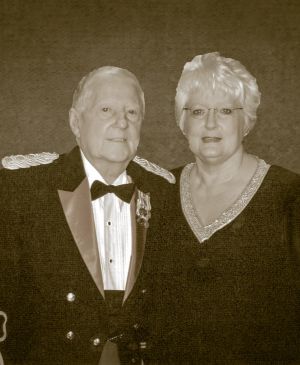 Anne Hartline’s husband, Col. James Hartline, died 14 years ago after a 36-year career in the Army. The couple, pictured, had retired to Birmingham, Ala., which wasn’t near an Army base. Still, she knew from MOAA meetings that there was a National Guard unit at the nearby Air Force base where she could complete SBP paperwork and update her ID card after James died. The ID office updated the DEERS file so Hartline could continue to receive TRICARE For Life to supplement her Medicare coverage.
The survivor’s benefits have made a significant difference in her finances.
“I did not realize how fortunate I was that he [enrolled in] SBP, and TRICARE is major,” she said. “TRICARE pays all of the copays if you have a hospital bill, and it covers medications, too.”
Hartline now shares her knowledge as a surviving spouse liaison for MOAA’s Greater Birmingham (Ala.) Chapter and as a member of the Surviving Spouse Virtual Chapter.
[JOIN TODAY: MOAA’s Surviving Spouse Virtual Chapter]
Find a veterans service organization. To be sure, the eligibility criteria for survivors’ veterans’ benefits, such as DIC, and the application procedure can be, as Hartline described it, “overwhelming.” But local, state, and national veterans service organizations can help. Find out ahead of time which ones were most helpful to others.
Talk about burial options. Most veterans are eligible for burial in a state or national military cemetery. The VA can help determine eligibility for burial at a national cemetery other than that in Arlington (there are extra requirements for Arlington National Cemetery).
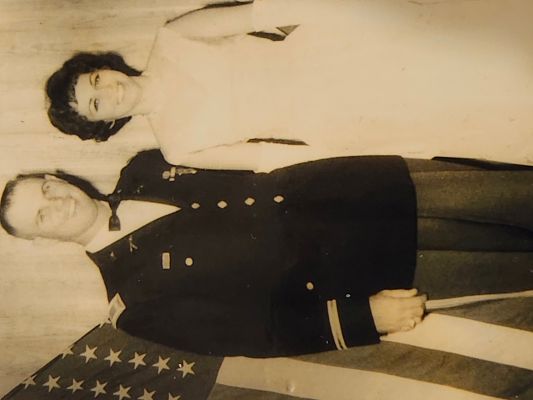 “That gives you an opportunity to choose where you want to be buried and is one less thing that needs to be taken care of later,” said Gail Joyce, chair of MOAA’s Surviving Spouse Advisory Council and a founding member of the Greater Granbury (Texas) Chapter. She’s pictured with her husband, Larry, a retired Army lieutenant colonel who died in 1999 of acute lymphoblastic leukemia; the VA determined exposure to Agent Orange during two tours in Vietnam caused the cancer.
[MEMBER PUBLICATION: Your Guide to Military Burials]
If you want full military honors, find out which organization in the area will handle that. “Put that in your final folder for your loved ones so they can say: ‘Here’s the point of contact for an honor guard,’” Yenchesky said.
Speak to funeral directors, too, as most are well versed in veteran burials. Notably, spouses are eligible to be buried with their veteran.
Update your will and beneficiary designations. Make sure the beneficiary designations on your life insurance policies, Thrift Savings Plan, and other retirement accounts are up to date. Your beneficiary designations usually supersede the information in your will, and if it isn’t up to date, someone other than your intended beneficiary could inherit the money. This is especially important if you have a second marriage or a blended family, as your wishes might have changed.
Know about financial accounts. It helps if your bank accounts and investment accounts are jointly owned with rights of survivorship or another method of ownership so the money transfers smoothly to the surviving spouse.
“Make sure you have two names on your bank account,” Hartline said. And if you have a safe deposit box, she added, include both spouses’ names on the lease agreement —perhaps even an adult child, too.
Both spouses should know the contact information of each other’s financial advisor, stockbroker, accountant, insurance agent, and the like.
Check your access to credit cards. Joyce recommends each spouse have at least one credit card account in their own name. Sometimes a spouse is an authorized user on the card but the account is in the other spouse’s name, often the husband’s.
“When he dies, the bank shuts that credit card down immediately and the wife is left without a credit card at a time when she probably needs credit help more than any time in her life,” Joyce said.
That’s what happened when Susan Norwood’s husband died. “There were at least two credit cards that I was no longer able to use,” she said. “One of them said you can reapply if you’d like, but you can’t have this number, and we’ll need a copy of the death certificate.”
[SURVIVING SPOUSE CORNER: Avoid These Surprises During Your Time of Loss]
Gather key documents. Know the location of DD Form 214 copies, life insurance policies, and other key documents. Joyce didn’t have a copy of the DD Form 214 when her husband died, and she went to the veterans’ service office for Hood County, Texas, where she lives, to find out what paperwork she needed to fill out.
Copies of the death certificate are required to complete the administrative steps to receive survivor benefits and update the DEERS fi e. The VSO Joyce worked with was so helpful that she now sends other surviving spouses there for help.
Write your obituary. When a close friend of the Hartlines died, they noticed the obituary excluded many things they knew were important to him. That’s when they realized it would be helpful to write their own obituaries and keep them updated.
“One thing I tell people is write your own obituary. Our adult children don’t always know what’s important to us,” Hartline said.
Get help from MOAA resources. Some MOAA chapters have surviving spouse liaisons who can help with the process for receiving survivor’s benefits. MOAA’s Surviving Spouse Virtual Chapter has more than 200 members and meets virtually each monthly via Zoom. The group recently expanded its rules so spouses can join before they’re a surviving spouse, giving them time to prepare.
“One piece of advice I would give to new survivors: If you are not involved in your local MOAA chapter, join it and get involved and get that information,” Hartline said. Her husband was a Life member of MOAA, which she inherited when he died.
Kimberly Lankford is a financial expert based in Virginia and the spouse of a retired Army colonel.
Military Officer Magazine
Discover more interesting stories in MOAA’s award-winning magazine.