
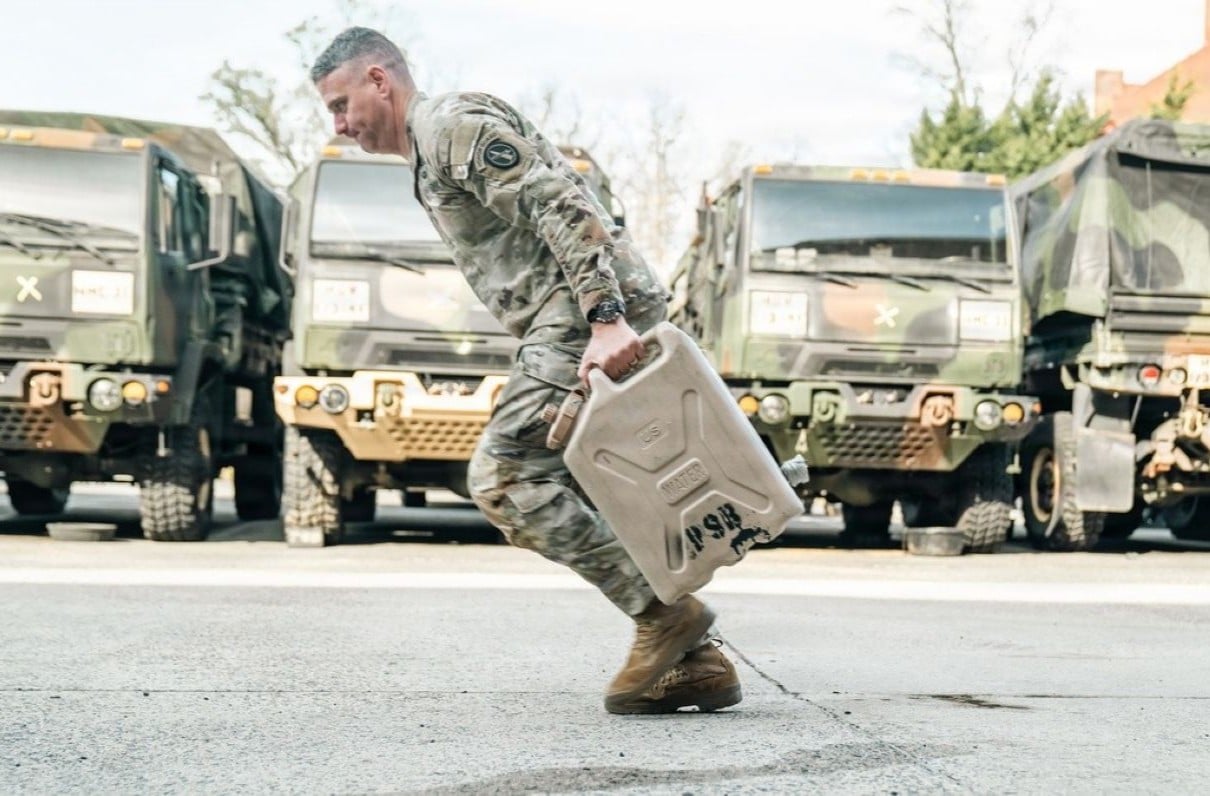
Soldiers in two dozen combat specialties will take a new seven-event test designed to ensure they can “dominate the modern battlefield,” the Army announced in an April 22 press release.
The Combat Field Test (CFT) will roll out this month and will be required for active duty and reserve-component soldiers in combat specialties – those on active duty (or reservists on active duty orders) must pass the CFT and the Army Fitness Test (AFT) each year, while other reservists in those specialties will alternate fitness tests every calendar year. A full list of combat specialties is available in the Army directive outlining the CFT; new to the list are diver (12D), explosive ordnance disposal specialist (89D), and explosive ordnance disposal officer (89E).
Test-takers will have 30 minutes to complete the seven-event sequence:
- One-mile run.
- 30 dead-stop push-ups.
- 100-meter sprint.
- 16 lifts of a 40-pound sandbag onto a 65-inch platform.
- 50-meter carry of two 5-gallon Army water cans weighing 40 pounds each.
- 50-meter movement drill (25-meter high crawl and 25-meter 3-5 second rush).
- Another one-mile run.
[RELATED: Army Officer Communities Face Cuts in Servicewide Restructuring]
“The Combat Field Test is a critical step forward in ensuring our soldiers serving in the most physically demanding specialties have the specific fitness required to dominate on the modern battlefield,” Secretary of the Army Dan Driscoll said in the release. “This is about readiness, lethality, and the well-being of our soldiers.”
More Specs
Soldiers who fail the test during an “initial diagnostic period” – 365 days for active duty members and reserve-component members on active duty orders, 730 days for other reserve-component members – will not have “adverse administrative actions,” according to the release. Soldiers in combat specialties may request reclassification if they don’t believe they can meet the standard.
Other facts to know:
- No Substitutions: CFT events will not be altered for soldiers on a physical profile.
- Single Standard: All test-takers will have 30 minutes to complete the pass/fail CFT regardless of age, height, weight, or gender.
- Gear Up: Test-takers will wear the Army Combat Uniform, combat boots, and a brown T-shirt.
- Test Timing: Soldiers must wait four months between AFT and CFT testing (eight months for reserve-component members not on active duty orders, though these soldiers may take another AFT sooner as part of promotion or schooling protocols).
- Retakes: Soldiers have 90 days to retake a failed test (180 days for reserve-component members not on active duty orders). Those who do not pass a CFT within the prescribed timeframe will be subject to “reclassification or utilization actions” unless they have an approved waiver, per the directive.
The Army CFT directive offers more details on the waiver process, including information on temporary and permanent waivers.
The AFT replaced the Army Combat Fitness Test as the service’s test of record in June 2025. It is still in the rollout phase, with new scoring standards taking effect in January 2026 for some active duty soldiers and scheduled to take effect in June 2026 for some reserve-component members.

Resources for Currently Serving Officers
MOAA can help you succeed in your military career and beyond.