
Military spouses seeking employment don’t need charity.
But some of their prospective employers might need a nudge to say “you’re worth it.”
That simple message, at the core of an opening-day presentation at the inaugural TotalForce+ conference in National Harbor, Md., yields an approach for advocates and other stakeholders combating the persistently high military spouse unemployment rate, which has sat at 20% or higher since at least 2006.
The proposal: Expand the Work Opportunity Tax Credit (WOTC) to cover military spouses along with other targeted groups, including veterans, who face barriers to employment. Companies would get $2,400 (more in some cases) per eligible new hire, helping to offset onboarding costs, through pre-existing WOTC processes.
[TAKE ACTION: Ask Your Lawmakers to Support Military Spouse Employment]
It’s not a new proposal, but with the WOTC set to expire in December, changes to the structure are likely. That’s why MOAA has been at the forefront in pushing the Military Spouse Hiring Act; it would make spouses eligible for the credit, give them a way to offset frequent PCS moves and other service-related challenges, and help them secure what they’re truly after: A chance.
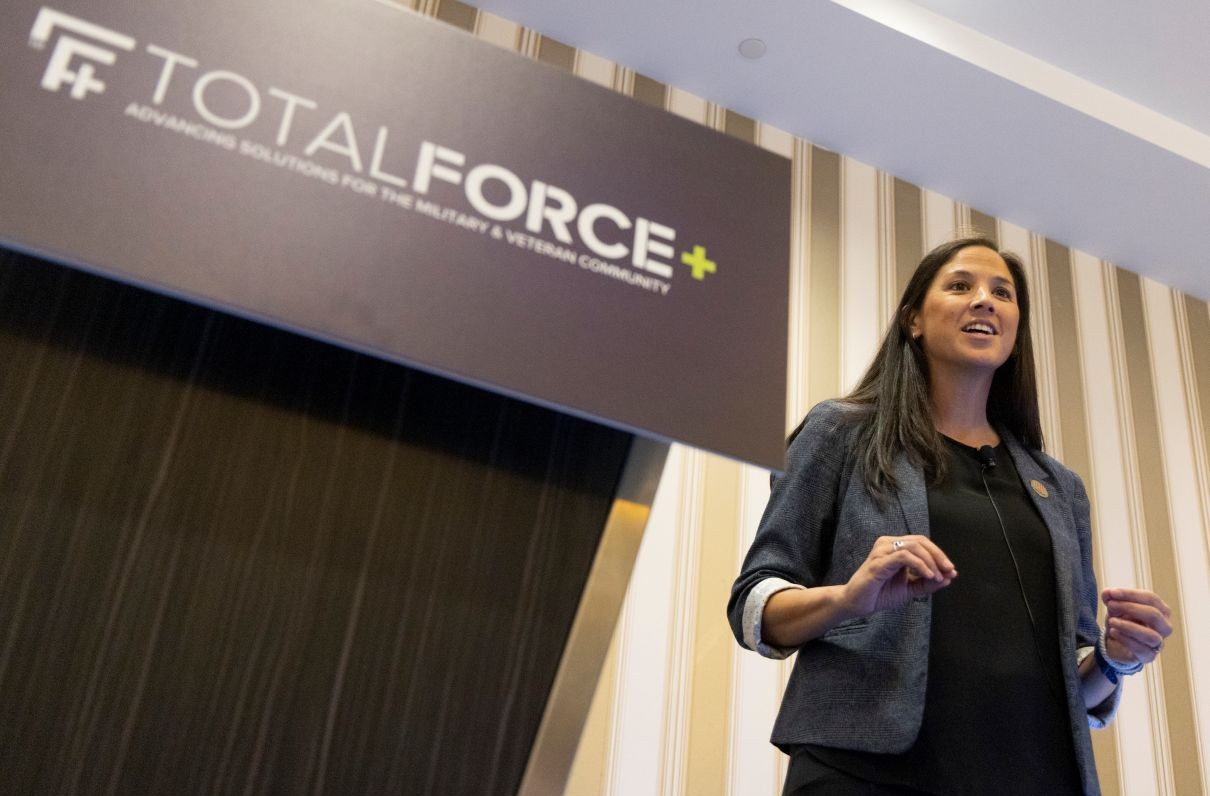
“Getting that foot in the door, getting that employer to say, ‘Yes, you’re worth it – that’s the sticking point,” said Jen Goodale, MOAA’s director of Government Relations for Veteran and Retired Affairs, during her Oct. 28 presentation at the Gaylord Hotel and Convention Center.
A Proven Track Record
When veteran unemployment surged during the post-9/11 era, additions of WOTC veteran categories gave companies a clear, immediate incentive to hire these capable prospects, Goodale said. Larger employers, familiar with the WOTC process, established veteran-centered workflows, which became talent pipelines. Nonprofits worked to connect qualified candidates with veteran-friendly companies.
While veteran WOTC classifications became law in 2009, they were not fully realized until a 2011 expansion. Veteran unemployment peaked above 9% that year, but fell sharply in the years to come, falling below 3% prior to the pandemic and returning to those low levels In recent years.
A similar approach would help military spouse knock over their own “unique barriers” to employment, Goodale said.
The Military Spouse Hiring Act (H.R. 2033 | S. 1027) has bipartisan support in both chambers, with more than 100 cosponsors in the House and another 35 in the Senate. Because the bill involves tax legislation, it cannot move forward through the National Defense Authorization Act (NDAA) alongside other MOAA priorities; the Senate version is in that chamber’s Finance Committee, while the House version sits in the Ways and Means Committee.
While the path to passage may be different, the goal is the same: Strengthening the total force by ensuring military families can build a financial future.
“Family financial stability translates directly to military readiness,” Goodale said.
Visit MOAA’s Legislative Action Center to make your voice heard on this issue and other key legislative priorities – personalize your message to your lawmakers to make even more of a difference.

Resources for Currently Serving Officers
MOAA can help you succeed in your military career and beyond.