

(This article by Hope Hodge Seck originally appeared in the August 2025 issue of Military Officer, a magazine available to all MOAA Premium and Life members, who can log in to access our digital version and archive. Basic members can save on a membership upgrade and access the magazine.)
Lt. Col. Aric Raus, USA, traces the dream that launched his 26-year career as an Army helicopter pilot to his years spent as a teenager in Civil Air Patrol (CAP), an Air Force auxiliary program. CAP inspired Raus to earn his pilot’s license and led him to earn a ROTC scholarship that launched him into service. So when he moved to the Kansas City area in 2019 and saw signs advertising the program, he knew he wanted to get involved again.
Raus, who is also a member of MOAA’s board of directors, began as a volunteer and is now a group commander for his region, leading and mentoring young cadets who are nurturing their own dreams of flying in a military or civilian capacity. His teenage son is a CAP cadet and is beginning the process of obtaining a private pilot’s license. As an active duty servicemember and a volunteer instructor, Raus appreciates the opportunity to give cadets a chance to experience the realities of military life, even finding ways to stay connected during his deployment to Egypt in 2021.
“I was able to go ahead and keep in touch with them and let them know about the different things that were happening there with flying,” he said.
Military-affiliated youth programs like CAP have in many ways never been more critical to education and recruitment than now, as the Pentagon reports about 3 in 4 Americans between 17 and 24 years old don’t meet fitness or academic qualifications for service, and only about 1 in 10 say they’re likely to join the military. While leaders emphasize that values such as volunteerism, citizenship, and discipline are the goals of these programs rather than recruitment, data shows a strong correlation between participation and future military service. About 30% of Young Marines members — another youth service program — go on to join the military, according to its leadership. And the U.S. Naval Sea Cadet Corps reports up to 60% of its sea cadets will serve.
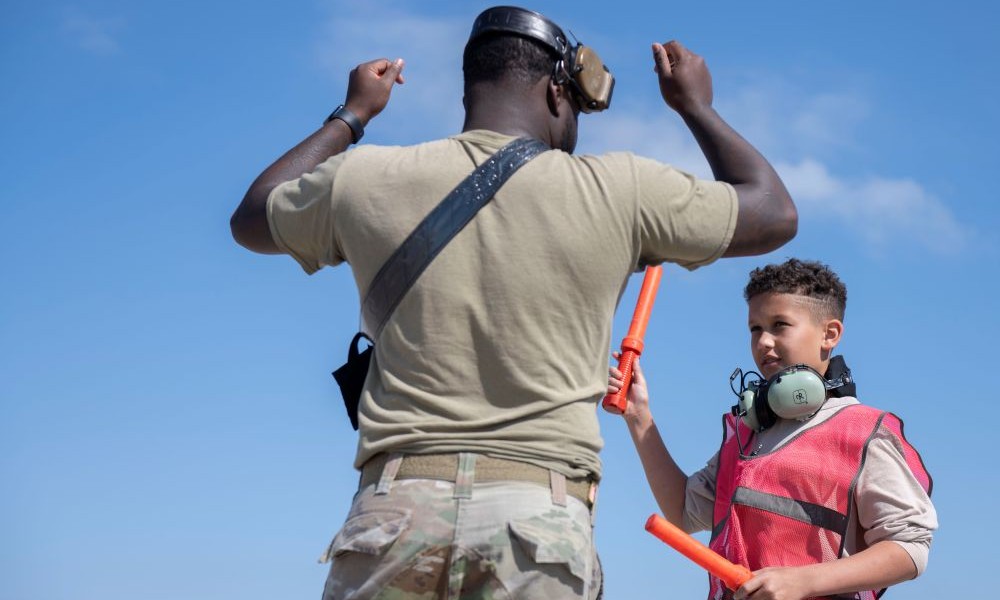
Jayden Sims, right, a Civil Air Patrol cadet, practices marshaling at
MacDill AFB, Fla., in February. (Photo by Staff Sgt. Lauren Cobin/Air Force)
Group Spotlight: Civil Air Patrol (CAP)
This congressionally chartered Air Force auxiliary program maintains 52 wings and 1,428 squadrons nationwide, encompassing more than 69,000 youth and adult members. Youth CAP cadets, ages 12-18, have opportunities to experience aviation in ways not accessible to many students. They’re entitled to five orientation flights prior to turning 18 and can opt to participate in powered aircraft and glider flight academies that offer cockpit experience at a fraction of the cost of civilian lessons.
Justin Holt, a rising senior at George Washington University, is on track to secure a commission in the Air Force as a pilot — a career dream he developed in CAP.
“I learned that flying is my escape … when I would go up in the air, I would be in a different place, it would be peaceful,” Holt said. “It provided me with a forum to talk to Air Force pilots.”
CAP chapters accept adult volunteers to fill support roles. Pilots with a Federal Aviation Administration-provided certificated flight instructor certificate can also become qualified as a CAP instructor pilot.
In Junior ROTC (JROTC), officials describe a broader positive effect, in which a high school’s participation in the program yields a greater proportion of students going on to serve in the military — even if those students did not participate in the program.
Lt. Col. Casey Geist, USA (Ret), who serves as deputy director of the Army’s JROTC program, said 44% of active duty soldiers previously participated in a JROTC program, and ZIP codes containing a JROTC high school produce twice the enlistments of ZIP codes without a program.
“It’s about us being in the community,” he said. “It’s being in the schools. … So we’re just taking a little oil dropper and dropping it on the surface of the water as many places as we can, and let that little oil spot grow and expand.”
Recognizing these benefits to recruitment, the Army, with congressional support, is eyeing significant expansions to JROTC beyond the current growth plan of 10 new schools per year.
About 300 interested high schools are on a waiting list for their own JROTC program. Pressed by longtime JROTC advocate Sen. Roger Wicker (R-Miss.) during his January confirmation hearing, Army Secretary Dan Driscoll committed to giving the matter special attention.
“[T]hese are the kind of lineages and relationships and chains that we can build into communities that can get us not just one future soldier but get us generations of soldiers,” Driscoll said.
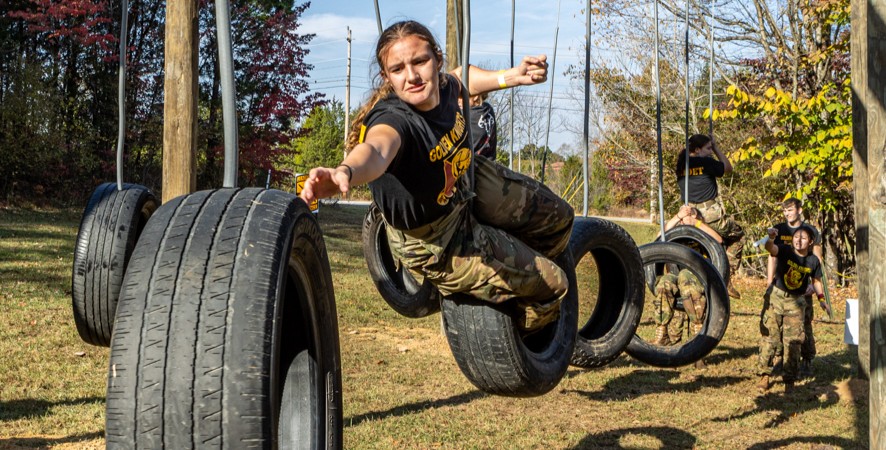
Junior ROTC (JROTC) students compete in the organization’s National Raider Challenge at Fort Knox, Ky., on Oct. 25, 2024. (Army Cadet Command photo)
Group Spotlight: Junior ROTC (JROTC)
While all the military services, including the Space Force and Coast Guard, maintain JROTC programs, the Army’s program is by far the largest, operating within Army Cadet Command and making up about half of all JROTC units.
Lt. Col. Casey Geist, USA (Ret), deputy director of the Army’s program, said the service is working to align the program more closely with Army ROTC, giving high schoolers a broader taste of the military and more access to interactions with recruiters.
While JROTC is known for drill competitions and JROTC Postal — a shooting tournament administered by the Civilian Marksmanship Program — the junior corps is also adding new events and activities designed to capture students’ interests.
Recent additions include archery and robotics, Geist said, with expansions planned in esports.
JROTC instructors must have completed honorable Army service of at least 10 years. They are paid by the school. Other adult volunteers support the program in various ways.
But JROTC, like many volunteer-supported programs, suffers from a critical shortage: well-qualified and trusted instructors who can lead cadets. With more than 1,700 programs nationwide, Army JROTC reported about 500 instructor vacancies last year, prompting Army Cadet Command to adjust instructor eligibility retirements, allowing recently separated officers and noncommissioned officers with at least 10 years of service to hold the position rather than just retirees.
And while JROTC, which the military services administer, is the largest of the programs by far, with more than 300,000 cadets in the Army program alone, the smaller programs also fill critical roles, sometimes operating where JROTC cannot and offering unique and specialized experiences.
Col. Bill Davis, USMC (Ret), executive director of Young Marines, said the program is able to enter high schools where only a handful of students expressed interest. In contrast, JROTC requires 100 students and a school-paid instructor to launch a program. The former’s flexibility, he said, allows students in places JROTC can’t reach to experience the benefits of a similar program.
“We don’t pay the instructors; they’re volunteers. But we have a program of instruction,” Davis said. “Here’s the guidebooks, do your background check, follow the rules. Execute smartly.”
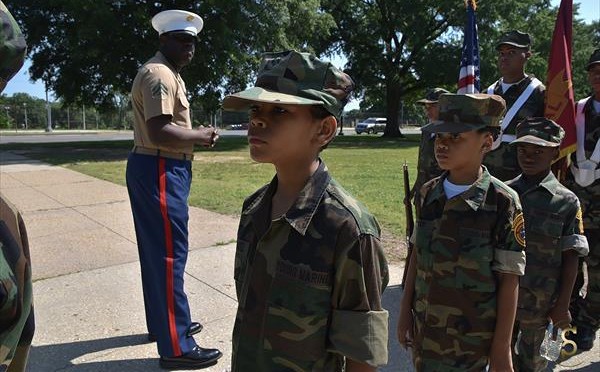
Young Marines participate in a ceremony. (Photo courtesy of Young Marines)
Group Spotlight: Young Marines
Organized in 1959, Young Marines is an independent nonprofit focused on developing American youth in leadership, teamwork, and discipline from age 8 through high school graduation.
One of the smaller programs, with 4,600 youth members and about 1,800 volunteer staff members, Young Marines is now seeing a period of accelerated growth and plans to open about 10 new units per year, said Col. Bill Davis, USMC (Ret), executive director of the organization. Focal points include reducing the demand for drugs, volunteering in local communities, and improving fitness.
“Parents and kids see these young people that have a certain amount of personal pride — they just carry themselves well, they know how to interact with others,” Davis said. “And so parents, adults, [and] volunteers see it and say, ‘Wow, what a great group of kids. How do I get involved?’”
Many, but not all, volunteer leaders are veteran or retired Marines. Those interested in volunteering can contact their local chapter. A background check is required.
Notably, MOAA members can be found in the senior leadership of virtually every military-affiliated youth program. The executive directors of U.S. Naval Sea Cadets and Young Marines are Life members. The Civilian Marksmanship Program, which runs a prestigious JROTC competition, is also run by MOAA Life members, and MOAA Chief Financial Officer Regina Chavis is on its board.
Further exemplifying the organization’s commitment to developing young Americans as leaders and outstanding citizens, MOAA councils and chapters sponsor awards recognizing top local cadets.
For Hunter Gomez, 17, an encounter with Young Marines at a YMCA event promoting healthy kids led to 10 years in the program, during which he rose to the rank of master sergeant, developed a love for fitness challenges, earned the President’s Volunteer Service Award four times, and became inspired to join the Air Force after receiving a near-perfect 92 on the Armed Services Vocational Aptitude Battery military entry test.
“The Young Marines definitely changes your view on the world as a whole,” said Gomez, a Glendora, Calif., native. “We teach the values of direct demand, reduction, leadership, discipline, teamwork, courage, self-improvement — basically everything that has to do with confidence.”
That holistic experience of strengthening the whole person is a hallmark of many youth programs, even when there’s emphasis put on particular skills or disciplines. In the Civilian Marksmanship Program’s JROTC competition, which begins with a field of about 7,000 cadets and culminates in an awards ceremony in Camp Perry, Ohio, with the final 224 competitors in attendance, program Chairman and CEO Col. Gerald O’Keefe, USA (Ret), said the value far exceeds the competition itself.
“I never get from the JROTC cadets … ‘This program is teaching me to shoot better,’” he said. “I get, ‘I’m a better person. I’m more patient. I know how to persevere.’ ... So that’s the fascinating part to me, is the life-skill component that derives directly from this.”
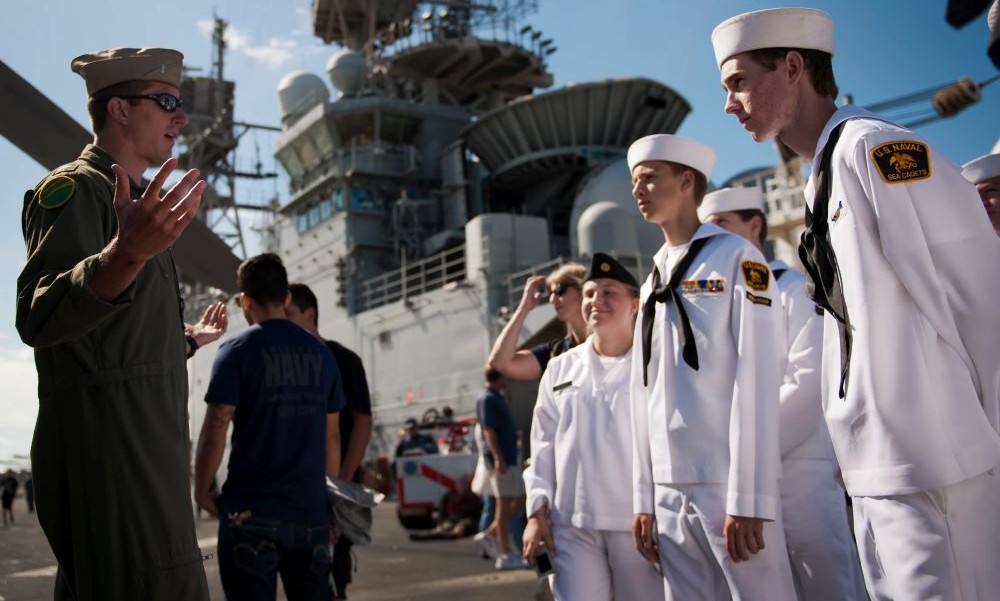
Sea Cadets visit a Navy ship. (Photo courtesy of U.S. Naval Sea Cadet Corps)
Group Spotlight: Sea Cadets
The Navy’s youth development program, Sea Cadets is open to youth ages 10 through high school graduation who are interested in the sea services — including the Navy, Marine Corps, Coast Guard, and Merchant Marine.
Summer programs expose cadets to a wide range of maritime experiences such as shipbuilding, naval special warfare, underwater robotics, and navigation.
According to Rear Adm. Andy Lennon, USN (Ret), Sea Cadets’ executive director and a MOAA Life member, up to 60% of participants will go on to wear a uniform after graduating high school. With such a high military conversion rate, Lennon prioritizes practical readiness and fitness.
“It’s my intent that any cadet who finishes Sea Cadets is fully capable of passing boot camp,” he said.
About 2,500 volunteers facilitate the Sea Cadets. Adults can reach out to their local chapter to serve as an instructor, join its officer corps, or become part of the auxiliary to make a limited-time contribution.
Those who volunteer to lead youth programs — and there are many opportunities to do so — say the experience is transformative for them as well as for the cadets they mentor and inspire.
“I was really glad when I had an opportunity, upon retirement, to get a role that allowed me to use my leadership skills in the service of our country,” said Rear Adm. Andy Lennon, USN (Ret), Sea Cadets’ executive director and a MOAA Life member. “The mission really aligns with my values, and preparing the future of America is just so critically important. So I’m glad to have a role in … a program that is giving young Americans the skills, knowledge, and confidence they need to become productive.”
Hope Hodge Seck is a writer based in the Washington, D.C., area.
Military Officer Magazine
Discover more interesting stories in MOAA's award-winning magazine.