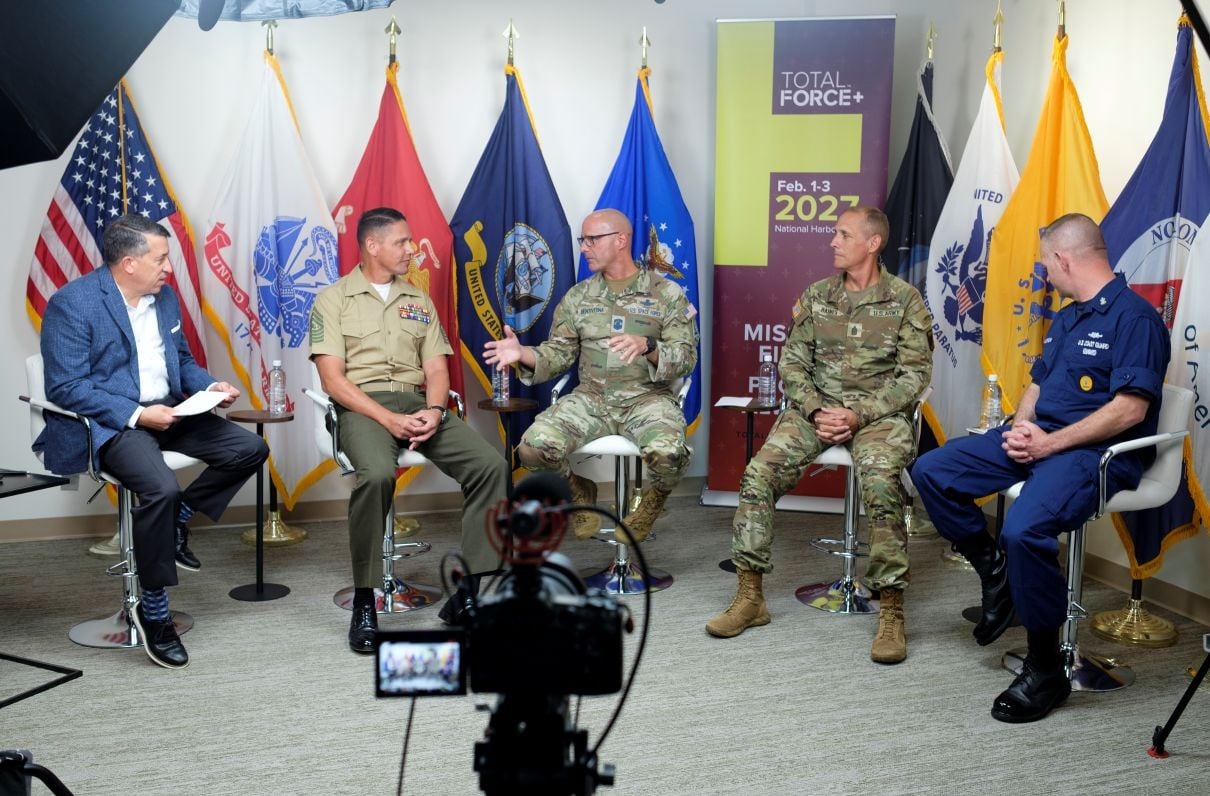
From the proper use of artificial intelligence to ongoing health care and family readiness challenges to the need to prepare servicemembers for life after uniform, Senior Enlisted Leaders offered their thoughts and priorities on the total force July 8 as part of a MOAA-hosted forum.
The discussion featured Sergeant Major of the Marine Corps Carlos Ruiz; Chief Master Sergeant of the Space Force John Bentivegna; Senior Enlisted Advisor to the Chief, National Guard Bureau, John T. Raines III; and Master Chief Petty Officer of the Coast Guard Phillip Waldron. Moderated by MOAA President and CEO Lt. Gen. Brian T. Kelly, USAF (Ret), it served as a follow-up to a May 8 panel of Army, Navy, and Air Force leaders, alongside Senior Enlisted Advisor to the Chairman of the Joint Chiefs of Staff David Isom.
[WATCH THE PANELS: Register and Receive a Link to Recordings From May 8 and July 8]
Both gatherings kept people-focused readiness topics at the forefront. Personal readiness is “the foundational cornerstone on which unit readiness and service readiness is really derived from,” Waldron said, “and that’s probably been our key talking point with our own folks of the past year – you and your family have to be ready.”
The panelists agreed ongoing operations showed the need for continued readiness, with Raines spotlighting the rapid deployment of National Guard forces as part of Operation Epic Fury and Ruiz stressing the importance of being prepared at all times.
“When the call goes out … there’s no more time for you to get more fit,” said Ruiz, who also participated in a readiness and leadership discussion during the inaugural TotalForce+ conference. “There’s no more time for you to get a little smarter on whatever technical expertise, no time to build more character. There’s no time for anything.”
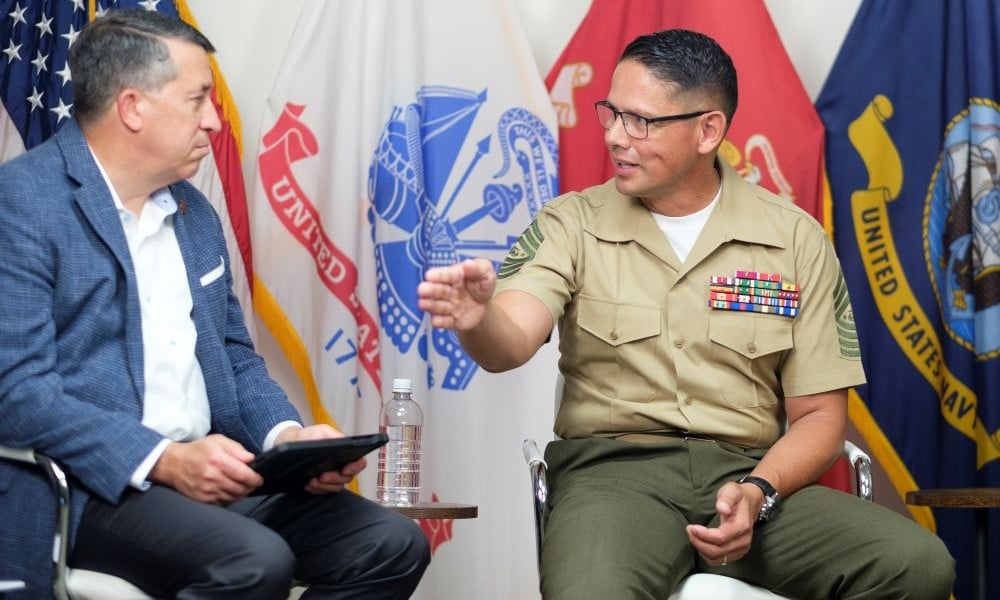
Sergeant Major of the Marine Corps Carlos Ruiz, right, addressed a series of readiness-related issues as part of MOAA's Senior Enlisted Leaders forum July 8 in Alexandria, Va.
Needs of the Force
The leaders highlighted the need to address ongoing issues with a shortage of medical providers – an issue even more critical to National Guard and Coast Guard members, many of whom serve far from large installations with military treatment facilities. Many providers in rural areas have reached their maximum level of patients, Raines said, and some that haven’t may have stopped taking TRICARE beneficiaries for other reasons … yet may remain listed in official provider databases, leading to confusion and concern from servicemembers and families.
“How do we sweeten the deal to get more providers onto our network?” Raines asked. “That would help all of us.”
Other family concerns raised by the panel included the need to support spouse employment efforts, and to ensure federal programs involving license portability and other spouse benefits are understood at the state and local level.
[RELATED: More Lawmakers Join Fight to Restore Employment Support for Veterans, Expand It to Military Spouses]
Expanded telework options should also be a consideration, Bentivegna said.
“Military spouses bring a lot to the table,” he added. “There are life experiences. We’ve all PCS’d, right? Moving kids, schools, everything – talking about the critical thinking, planning, hard decisions that have to be made. If I’m an employer, I want somebody who can do that at the drop of a hat. Military spouses bring that to an organization.”
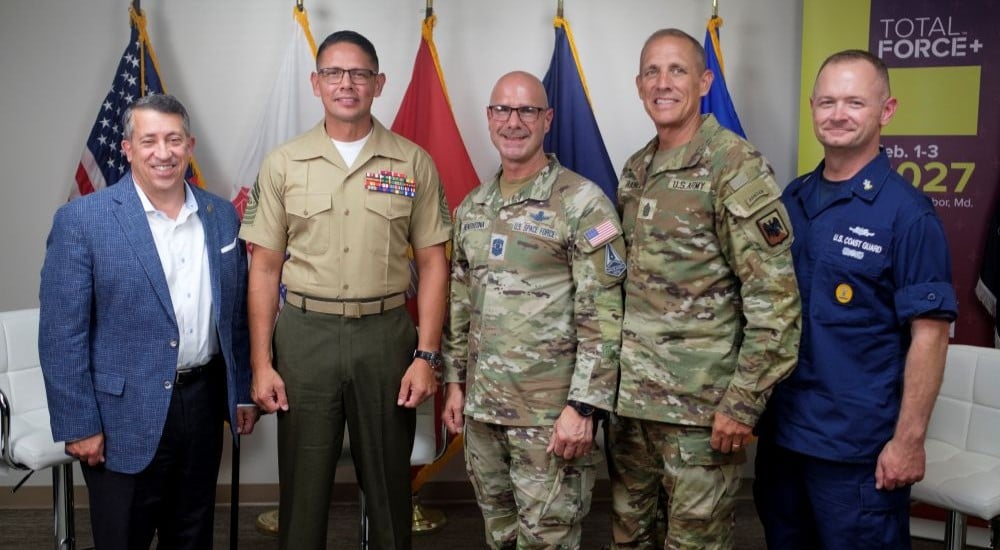
Panelists pose after the July 8 event at MOAA Headquarters in Alexandria, Va.
AI and Readiness
All of the panelists welcomed the use of AI as a tool on multiple readiness fronts, but they cautioned against it being a standalone solution to any specific needs of the force.
Possible uses included everything from helping Marines build a human performance and fitness plan to assisting Space Force analysts in interpreting mounds of data to anticipating and solving National Guard pay issues to streamlining all manner of administrative work. But panelists stressed the need for a “human in the loop” as progress continues, and made clear that some tasks simply can’t be automated.
“Nobody has ever been inspired by AI,” Waldron said. “Plenty of people have been inspired by senior [noncommissioned officers].”
[FROM TOTALFORCE+: Can AI Help Bridge the Military-to-Civilian Gap?]
Potential time savings from AI and other technology could allow Guardians to spend more time on higher-level analysis and “think through problems,” Bentivegna said. Waldron and Raines agreed, adding that the time saved on administrative tasks also could prove beneficial beyond additional service responsibilities, allowing overtaxed members to take earned leave and achieve a better work-life balance.
Recruiting, Retention, and Transition
While the services have seen a successful recruiting stretch in recent years, the panelists highlighted changes and improvements to their processes designed to keep the numbers of new recruits up while targeting needed retention:
- The Space Force will lean into longer enlistment contracts, Bentivegna said, a move the Marine Corps also will consider.
- The Coast Guard will expand its efforts in areas where the service is lesser known, Waldron said, hoping to tap inland talent.
- All of the services will consider personality tests as supplements (or potential alternatives) to the Armed Services Vocational Aptitude Battery (ASVAB).
[RELATED: Navy Hits 45,000 Recruits 3 Months Ahead of Schedule]
When it comes to leaving service, panelists offered branch-specific perspectives on the needs to improve transition support. Technical aspects of the Marine Corps’ transition program appear solid, Ruiz said, but more work needs done on the “emotional part” of leaving uniform, as well as setting reasonable expectations for those looking for civilian careers.
“You’re going to have to start from the bottom, at times, just like you had to work from private to sergeant,” he said. “Maybe the expectation of starting off with a $200,000-a-year job is not reality.”
Waldron praised the SkillBridge program, which offers internship opportunities to servicemembers to about to leave uniform, but stressed the need to make it more available and visible to all ranks, not just senior enlisted and officers. Raines said reframing the National Guard’s approach to transition is a key priority, as the service’s one-size-fits-all system may not serve the needs of members in various stages of civilian careers.
[SPONSORED BY MOAA: July 22 Los Alamos Virtual Job Fair, Featuring SkillBridge Positions]
What’s Next
The virtual forum is part of a series of events designed to continue the people-focused conversations from TotalForce+, MOAA’s inaugural conference held last October in National Harbor, Md. The conference returns in February; learn more about the event online, and save your seat for the second-annual conference.
Connectivity issues prevented a live broadcast of the forum, but registrants will receive a link to the full video.

Resources for Currently Serving Officers
MOAA can help you succeed in your military career and beyond.