
By MOAA Staff
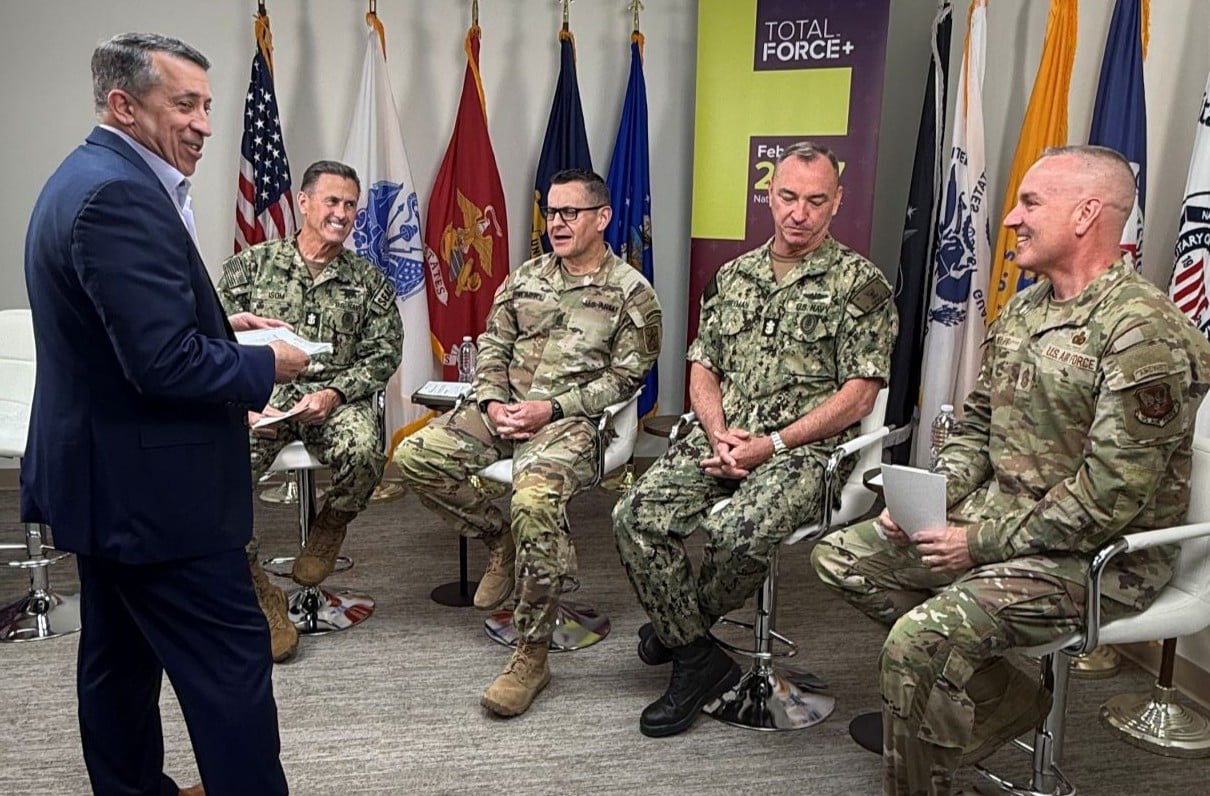
Four senior enlisted leaders gathered at MOAA headquarters outside Washington, D.C., on May 8 for a wide-ranging webinar covering a series of readiness-related topics. One common thread: No matter the issue, there is room to improve.
“We are incredibly hard on ourselves because we have to be,” Senior Enlisted Advisor to the Chairman of the Joint Chiefs of Staff David Isom said during the 90-minute event. “If you want to be a professional fighting force, and you want to be the best on the planet, you have to be ruthlessly brutal on yourself. And so we are. … We are going to keep getting after the things that aren’t perfect.”
Isom was joined by Sergeant Major of the Army Michael Weimer, Master Chief Petty Officer of the Navy John Perryman, and Chief Master Sergeant of the Air Force David Wolfe for a panel moderated by MOAA President and CEO Lt. Gen. Brian T. Kelly, USAF (Ret). It’s the first of two senior enlisted sessions designed to continue the conversation from MOAA’s inaugural TotalForce+ event, which will return to National Harbor, Md., in February.
[FROM THE WEBINAR: Epic Fury Has Navy Rethinking Carrier Deployment Tempo]
Supporting Spouses
Gathering for the panel on Military Spouse Appreciation Day, the panelists all stressed the importance of improving the military spouse unemployment rate, an issue pushed to the forefront by an April 1 memo directing “maximum use” of spouse employment support tools throughout the department.
Air Force spouses are often faced with a demotion or a lower-paying job after a PCS move, Wolfe explained, calling it a decision “we don’t want our spouses to have to make.”
Along with short-term financial struggles for military families, such decisions have far-reaching effects, often preventing spouses from establishing stable retirement plans, Wolfe said.
[RELATED: MOAA’s Currently Serving Advisory Councils Ensure Servicemembers, Families Are Heard]
One solution: Incorporating more spouses into department positions where there is a need for civilian support. Wolfe cited mental health providers as an example.
“If we can create that pipeline where we’re training our own people,” Wolfe explained, “they’re already on the team. “They know the culture. … They seem to be the right people to go into some of those provider positions that are helping our people stay in the fight.”
Combating ‘Friction’
From financial concerns to health care to housing issues to food insecurity, Perryman discussed multiple “friction points” facing servicemembers and families, especially in the junior ranks.
“A big part of what we’re working on in the Navy is, I can’t remove all friction. It’s the military. But how do I reduce the friction in sailors’ and families’ lives?” he asked.
Those pain points can be found both on and off duty, Perryman added, from maintenance issues in base housing to a lack of spare parts or equipment problems that complicate the mission.
[RELATED: Can You and Your Family Access the Health Care You’ve Earned?]
“We’re the richest country in the world and we’re the most powerful military in the world, and yet when you drive around our bases, those two facts are not obvious,” Perryman said. “We say things like ‘People are our most important asset’ … we’ve got to after the totality of their experience of coming to work every day to make that real to them.”
Building the AI Advantage
Some of those operational challenges may be countered with increased use of artificial intelligence, the leaders noted. Multiple services have established rapidly growing teams to review and implement new AI programs and strategies with the goal, Clarke said, being “we take our already awesome people and we just level them up.”
The Air Force leader called the technology the greatest advancement for the total force since the distribution of desktop computers and email addresses, and said it could play a role in promotion boards. Perryman said the Navy is working to put the power of large-language-model AI programs in the hands of more sailors, who will be able to improve productivity after a limited amount of training.
[FROM THE WEBINAR: Air Force Experimenting with Using AI for Promotion Boards (Military Times)]
“The benefits of getting more people to use the technology, we’re just beginning to scratch the surface of that,” Perryman added.
The Big Picture
“Readiness isn’t about Excel spreadsheets,” Weimer said. “We put a lot into measuring readiness … it’s really good to have the lessons we’re learning from our recent experiences to really evaluate ourselves. There’s some stuff to be super-proud about … there’s some stuff that we need to get a little bit better at.”
There is forcewide momentum toward addressing those issues, said Clarke, who pointed to support from both inside and outside of the department.
“MOAA does such great work for us all over the world, helping our airmen and families. … Organizations like yours, they’re indispensable. There are some things that you can do that we have limitations on, and you’re able to bridge those gaps for us.”
Find out about upcoming MOAA webinars by bookmarking our events page or following us on social media. Keep up with the latest from TotalForce+ by saving your seat today.
Resources for Currently Serving Officers
MOAA can help you succeed in your military career and beyond.