By Kristin Davis
Twenty-eight years ago, Cheryl Glang found herself seated before Congress, speaking on behalf of a service many Americans had never heard of — the National Oceanic and Atmospheric Administration Commissioned Officer Corps, the nation’s smallest uniformed service, where her husband served.
It marked her first role advocating for military families. It wouldn’t be her last.
When Glang and a small group of NOAA Corps spouses decided to lobby lawmakers at the time, they met Bob Norton, a retired Army colonel and former deputy director of Government Relations with MOAA.
Norton was with them every step of the way.
Their efforts succeeded. The proposal was shelved, and the NOAA Corps remains active today.
The experience launched Glang into a broader world of military-family advocacy. In the years that followed, she continued to support NOAA families across the country before serving for seven years on the board of directors of the National Military Family Association, all while working full-time in the fitness industry.
Then in 2017, Glang was diagnosed with breast cancer. Treatment and recovery dominated much of the next two years. In 2019, she and her husband talked about what was next.
“I really wanted to return to service. I needed to serve again. A lot of NOAA Corps retirees are members of MOAA because they know how much MOAA has done to help and advocate for us,” Glang said. “I contacted Bob [Norton]. He was very gracious to invite me to a meeting.”
[GET INVOLVED: Find a MOAA Chapter | MOAA Virtual Chapters]
When Glang was later asked to serve as the surviving spouse liaison for MOAA’s Maryland Council of Chapters, she accepted.
The role immersed her in a new set of issues facing surviving spouses. She began tracking legislation, attending VA and MOAA webinars, building information networks for surviving spouses, and educating herself on the benefits — and gaps — affecting families across Maryland.
And once again, Glang found herself speaking before lawmakers.
She has testified before the Maryland General Assembly on legislation affecting surviving spouses, including measures tied to tax exemptions and veterans’ benefits — returning, decades later, to the same kind of advocacy work that first brought her before Congress.
During a MOAA session led by a surviving spouse on what to do after the death of a partner, Glang was struck by how many attendees — even retirees in their 70s and 80s — admitted they were unprepared. The realization stayed with her.
In 2024, Glang began developing presentations of her own, a program she continues refining. She’s given nine so far.
“A lot of people don’t know where to start. I give them a place to start,” she said. Participants receive three-ring binders, checklists, and references to help organize critical documents and information.
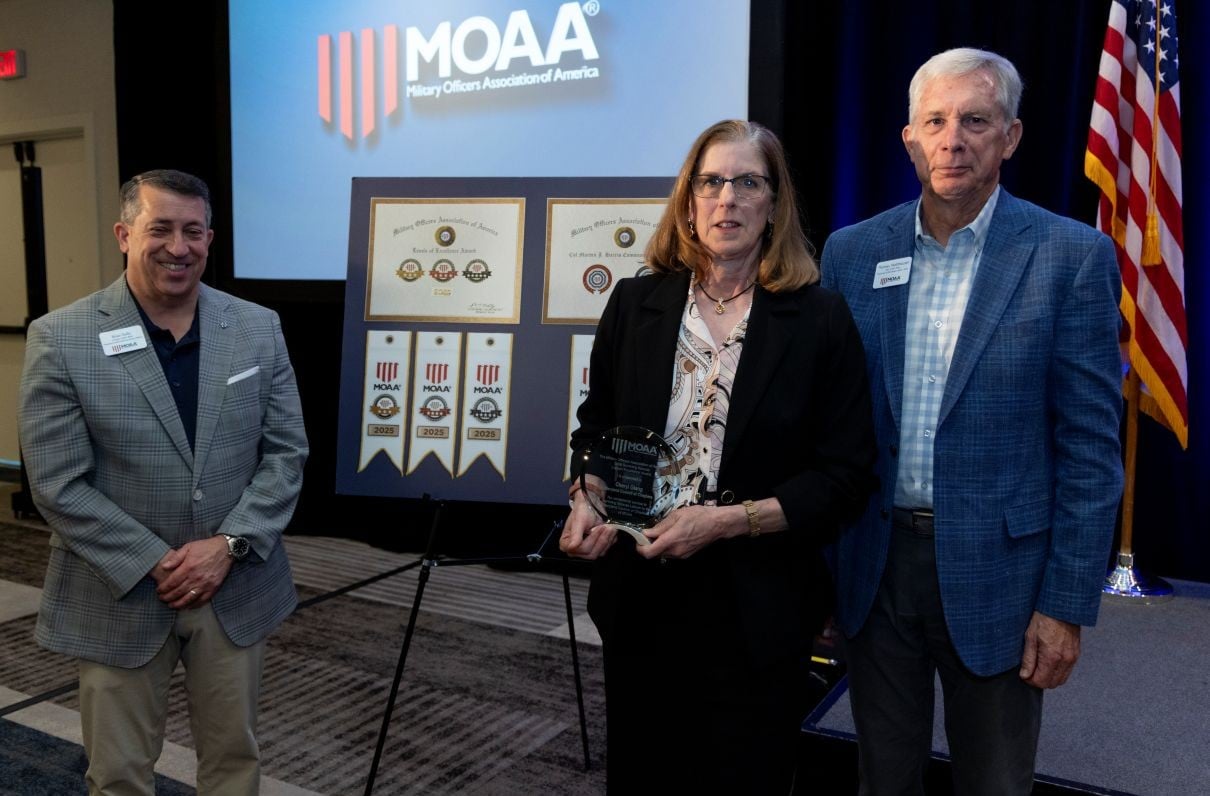
For her efforts, Glang recently was named 2025 council-level recipient of MOAA’s Surviving Spouse Liaison Excellence Award.
She has found that her presentations sometimes lead to much more.
One military spouse told Glang her husband had suffered a stroke shortly after the couple relocated. Unable to leave the house, he had fallen into bureaucratic limbo while paperwork needed to access benefits sat buried in storage boxes after the move.
Glang connected the woman with a veterans service officer in her area. Six months later, she followed up.
“They had occupational therapy and physical therapy coming into the house,” Glang said. “Financial assistance had started coming through.”
“Sometimes the issues are relatively simple,” she said. “But if you don’t know where to start, it can feel impossible. It’s not a lack of services. It’s a lack of knowledge about how to access them. That’s where I key in.”
Kristin Davis is a writer based in Virginia.
Want to Help Servicemembers in Your Community?
Learn how you can make a difference with your local chapter.