By Kristin Davis
Revived during the Army’s 225th birthday celebration, Spirit of America — a large-scale, live-action theatrical production — proved so popular in 2000 that a year later, it was taking the show on the road.
First stop on the tour in September 2001: Columbus, Ohio. The show would open in Washington, D.C., on Sept. 13, with performances scheduled over three days, before embarking on a regional tour.
Col. Richard Breen, director of public affairs and communications for the Army Military District of Washington, headquartered at Fort Leslie J. McNair, D.C., which produced the show, knew things were about to get busy. He flew to Ohio for what he called an “advance recon” prior to its opening in the nation’s capital.
On the morning of Sept. 11, as he readied for a flight back to D.C., Breen caught a live broadcast on The Today Show. As a tightly framed shot showed smoke pouring from a hole in the north tower of the World Trade Center in New York, a second plane struck the south tower.
“I grabbed everything I had,” Breen recalled. “I jumped in my car, drove to the airport, and turned in my car. I was walking up to the boarding area when a plane hit the Pentagon.”
[RELATED: Sept. 11 Through the Eyes of National Guard Officers Who Were There]
Breen had served in the military since the waning days of Vietnam. Nothing could compare with that day or the weeks that followed. And nothing ever would.
In the airport, “I watched people dropping drink glasses, crying, screaming. They were petrified,” he said.
Breen went back to get his rental car. “All the roads in Columbus were jammed with traffic, but I was able to get back to my hotel.”
He spent the rest of the day operating from a makeshift command center in his room, staying in regular contact with the 30-person communications staff responsible for, among other things, media relations for the Army’s largest organization in the National Capital Region.
At 2 a.m. on Sept. 12, he drove from Columbus to Reagan National Airport. “The airport was a ghost town. It was really eerie. Like a scene from the Twilight Zone,” he said.
[RELATED: Bill Would Expand PACT Act Benefits to Those at the Pentagon in the Days After Sept. 11]
Back in Washington, he headed for the Pentagon, where he would serve as the senior spokesperson for the command on the ground for the next three weeks. In a small, isolated area, Breen marshaled hundreds of journalists from around the world for multiple media interviews with soldiers from his command.
One day after the attacks, amid the chaos, a conversation was had between Breen, Army Maj. Gen. Jim Jackson, then the Military District of Washington commander, and Jackson’s chief of operations, Col. Egon Hawrylak.
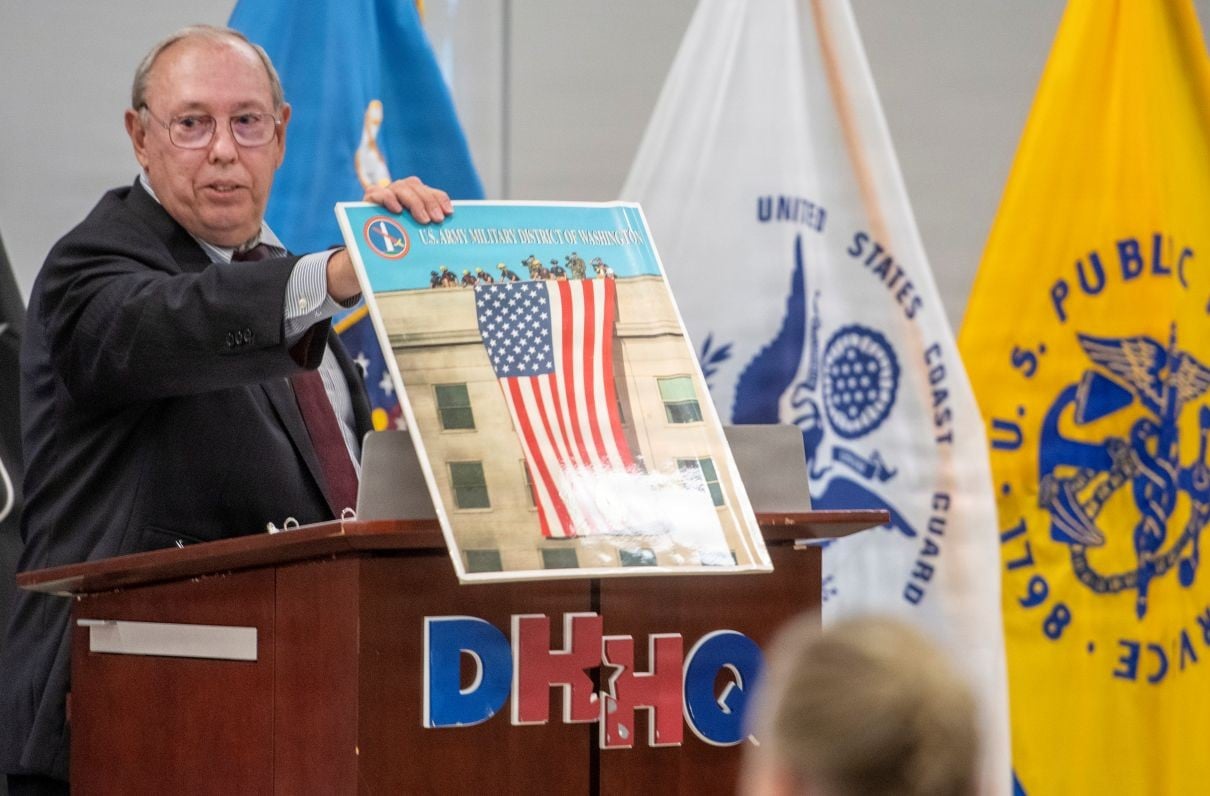
“We needed a symbol,” Breen said, something that would send a message to a watching world: America was still standing. Jackson knew of a garrison flag at Fort Myer, Va. It was enormous. And it would do. That afternoon, the flag was unfurled over the side of a scarred and smoldering Pentagon.
In the aftermath of the attacks, Breen would also travel to New York to provide media training to National Guard soldiers. And he watched, with tremendous pride, as soldiers of the 3rd U.S. Infantry Regiment, known as “The Old Guard,” put aside their ceremonial duties and returned to the combat roles for which they had trained.
“Everyone was a warrior,” he said.
His career would go on to include senior communications roles in the Army and federal government, including as director of strategic communications and public affairs for the Military Health System, as well as induction into the U.S. Army Public Affairs Hall of Fame. He retired in April 2026.
“Nothing can come close to my experience on 9/11,” he said.
This summer, Breen returned to the Pentagon as a volunteer docent at its 9/11 memorial. He also remains close to the members of the communications team he led through the crisis, many of whom still gather to this day.
Twenty-five years later, the story — and the people who lived it with him — still brings Breen back to that monumental day in our nation’s history.
Kristin Davis is a writer in Virginia.
Want to Help Servicemembers in Your Community?
Learn how you can make a difference with your local chapter.