
(This article by Lt. Col. Patrick J. Chiasson, USA (Ret), originally appeared in the September 2026 issue of Military Officer magazine.)
The terrorist attacks of Sept. 11, 2001, remain a watershed moment in American history. Twenty-five years ago this month, members of the extremist group al-Qaida hijacked four passenger jets, deliberately crashing two into New York City’s Twin Towers and another into the Pentagon. The fourth aircraft went down in rural Pennsylvania “after passengers heroically rebelled,” the FBI concluded.
Nearly 3,000 people died, while thousands more were injured.
In response, the U.S. and its allies launched a military campaign designed to root out and destroy the terrorists responsible for the 9/11 attacks.
Since then, more than 3 million American servicemembers have participated in the global war on terror, which included combat operations in Afghanistan and Iraq.
[FROM MILITARY TIMES: VA to Mark 9/11 Anniversary With Volunteer Opportunities at National Cemeteries]
The conflict would eventually involve all branches of the U.S. armed forces, including its most elite warfighters. Yet, few today recognize that some of the first American troops to respond on Sept. 11 were part-time soldiers.
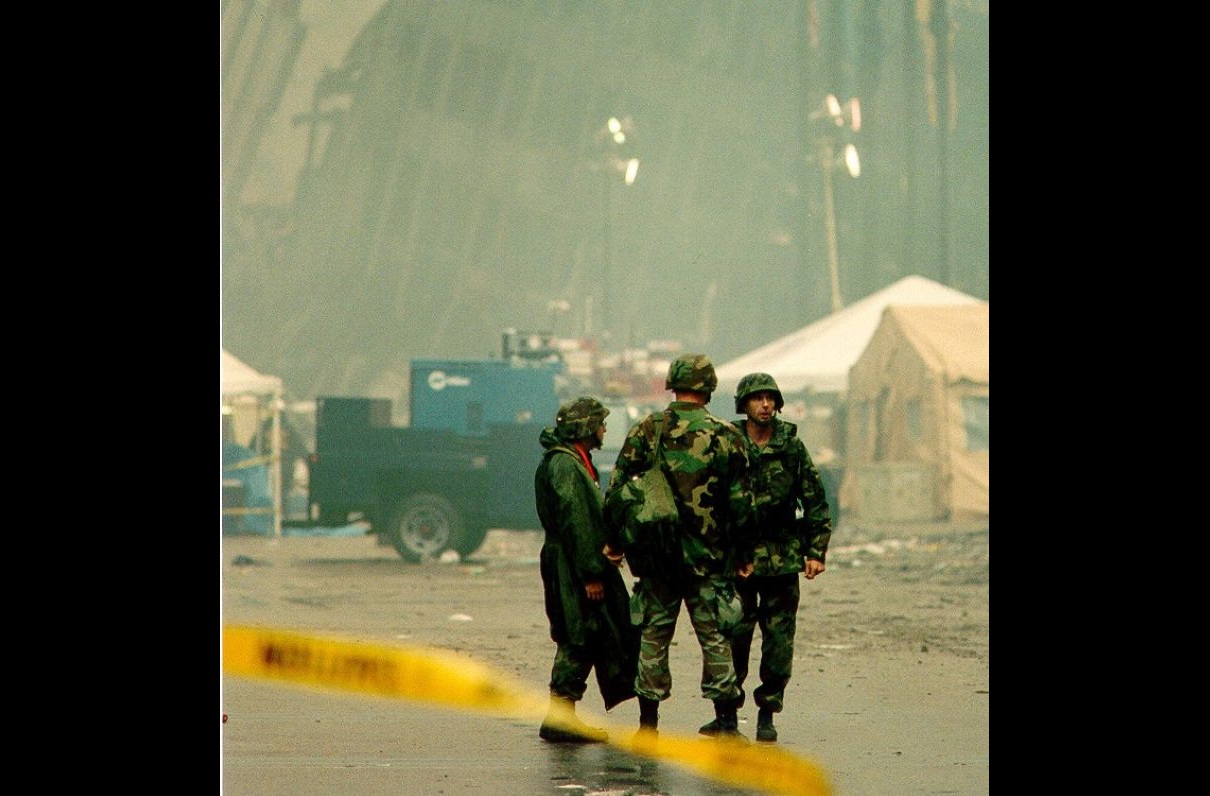
This story details what members of the New York Army National Guard (NYARNG) saw and did at the World Trade Center’s Twin Towers that day. It is told in the words of several officers, whose firsthand memories of the attacks remain fresh even after two and a half decades.
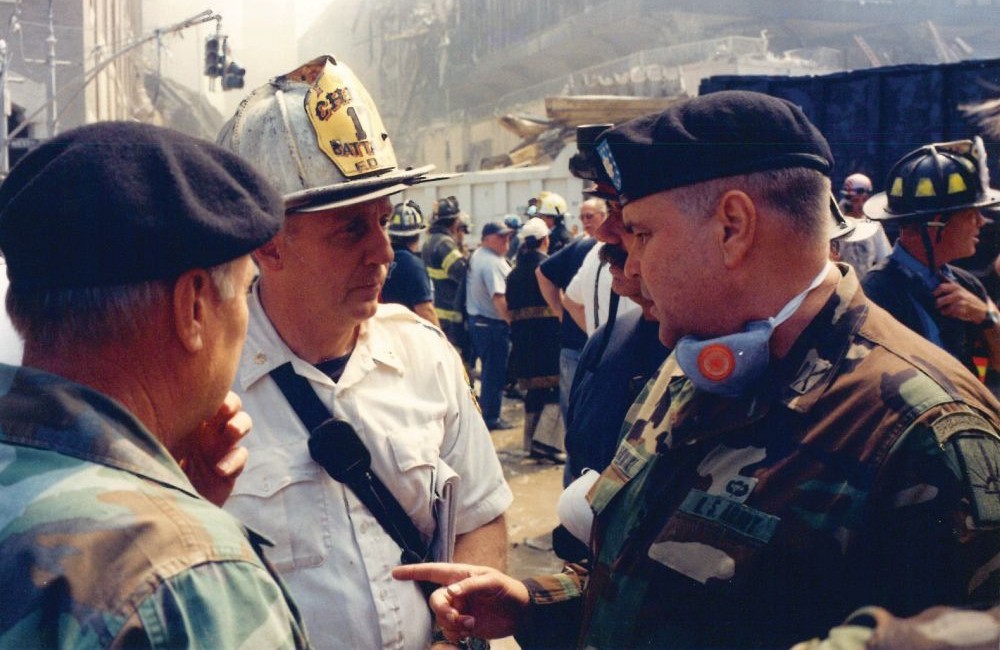
Then-Brig. Gen. Edward Klein, left, and Maj. Peter Petrowsky, right, speak to a fire chief in a New York City street, where most interactions took place before a command center was stood up. (Courtesy photo)
Into the Chaos
In 2001, Maj. Gen. Edward Klein, USA (Ret), led NYARNG’s 53rd Troop Command with the rank of brigadier general. He told Military Officer that, on the morning of Sept. 11, he was working in his civilian occupation when Maj. Gen. Thomas Maguire, USAF, called.
Maguire, New York state’s adjutant general, asked Klein to investigate reports of an aircraft going down in Manhattan. Stopping off at home to “pick up a [military] uniform, cot, and duffel bag” of field gear, Klein then drove into New York City. En route, he saw black smoke rising from the Financial District. His car radio also delivered news of a second plane crash.
In Lower Manhattan, Klein learned from officials with the New York City Police Department (NYPD) and the Fire Department of the City of New York (FDNY) that large airliners had struck the World Trade Center’s north and south towers.
The casualty count was unknown but likely very high. Could the Guard assist?
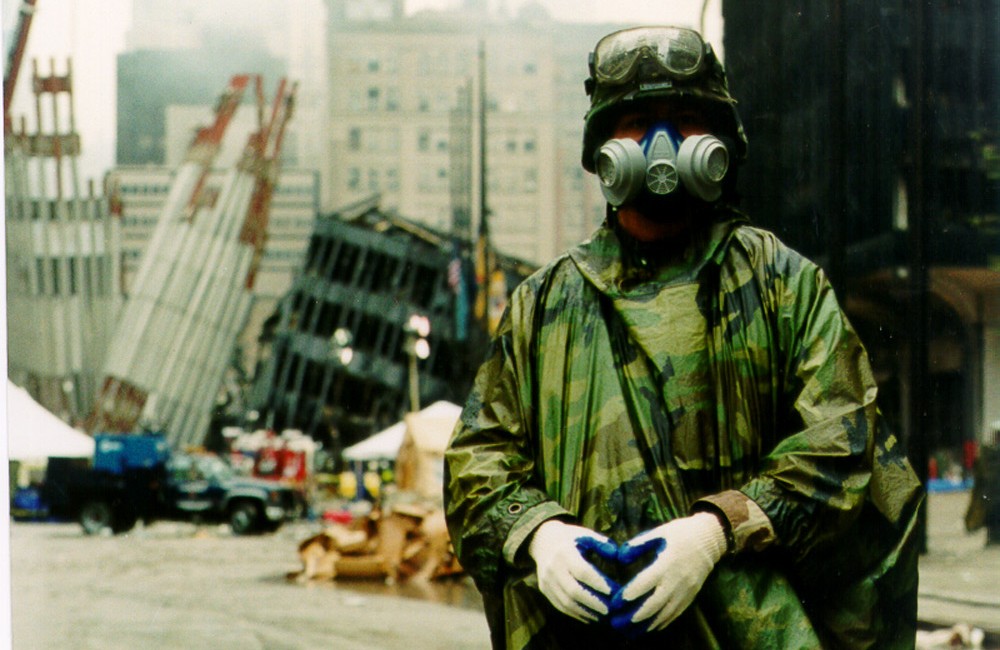
A masked soldier stands at ground zero in New York City. (Photo via New York Division of Military and Naval Affairs)
Klein, currently a MOAA member, was able to offer assistance thanks to the National Guard’s dual federal-state role. When activated by the governor, its guardmembers are allowed to support civilian authorities amid domestic emergencies.
This situation, he knew, certainly qualified.
‘We’re at War’
Col. Mario Costagliola, USA (Ret), was home that morning when his brother, Thomas, who worked in the World Trade Center complex, called.
“They’re bombing us,” Tommy shouted just before the phone disconnected.
Costagliola turned on his television in time to see the second jet crash, and remembered thinking: “We’re at war.”
Tommy escaped before the towers fell.
At the time, then-Lt. Col. Costagliola commanded 1st Battalion, 101st Cavalry, on Staten Island. Arriving at his headquarters, he found many current and former unit members as well as reservists and active duty servicemembers on leave, already assembled and awaiting orders.
[MORE FROM MOAA: Stories From Service at Ground Zero]
Costagliola, like so many New Yorkers, grappled with a major challenge that morning: communications. The attacks had severely crippled landline, cellular, and internet services across Manhattan and the outlying boroughs. And when the towers eventually collapsed, they obliterated the city’s Office of Emergency Management. Without direction from the city’s disaster response experts — most of whom were now dead — Costagliola and his fellow NYARNG officers had to estimate the situation and plan a response almost entirely on their own.
‘Walking Around Like Zombies’
The local Lexington Avenue Armory, home to 1st Battalion, 69th Infantry, occupies nearly an entire city block in Midtown Manhattan, about 3 miles north of the World Trade Center. There, on Sept. 11, Lt. Col. Jose Obregon, USA (Ret), worked through communications issues to alert his soldiers, dialing numbers over and over until he got through and sending personnel in military vehicles to key leaders’ homes.
Obregon, a Premium member of MOAA and at the time a major serving as executive officer of the “Fighting 69th,” took charge of implementing the unit’s mobilization plan until his battalion commander, Lt. Col. Geoffrey Slack, arrived.
Later that afternoon, Slack and Obregon conducted a leaders’ reconnaissance of ground zero — the disaster site.
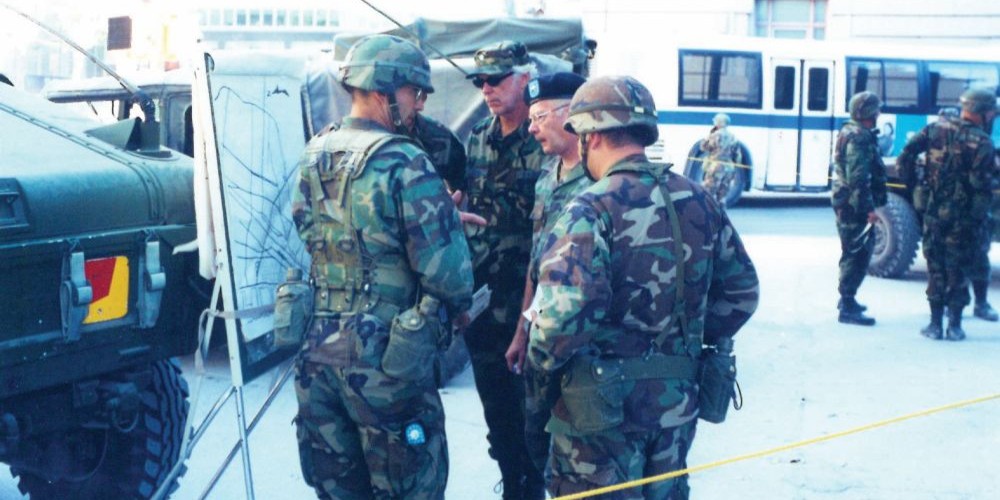
From left, Lt. Col. Geoffrey Slack participates in a security briefing for ground zero with Brig. Gen. Edward Klein, Maj. Jerome Becker, and Maj. Jose Obregon. (Courtesy photo)
“It was surreal,” Obregon said, “like being in the twilight zone.” He recalled seeing “dozens of dress shoes left behind” by people running to escape the catastrophe. Everywhere, he said, were stunned civilians covered in ash and “walking around like zombies.”
Nothing in either officer’s experience or training could prepare them for the scene they now beheld.
Surveying the devastation, Slack turned to Obregon and said: “The world has changed forever.”
Fighting to Communicate
On Staten Island, NYARNG medics helped firefighters set up a triage center and temporary morgue at the nearby ferry terminal. Other unit members readied tactical vehicles for duty at ground zero, including fuelers, water trailers, and mobile generators.
Costagliola said a nearby home improvement store donated gloves, chainsaws, hand tools, and protective gear to the troops preparing to enter Manhattan.
Another NYARNG officer, Lt. Col. Elizabeth Condon, USA (Ret), a Life member of MOAA, helped address the communications challenge. A first lieutenant working in the state’s surface maintenance office at the time, Condon discovered the armory’s fax machine could still send and receive messages.
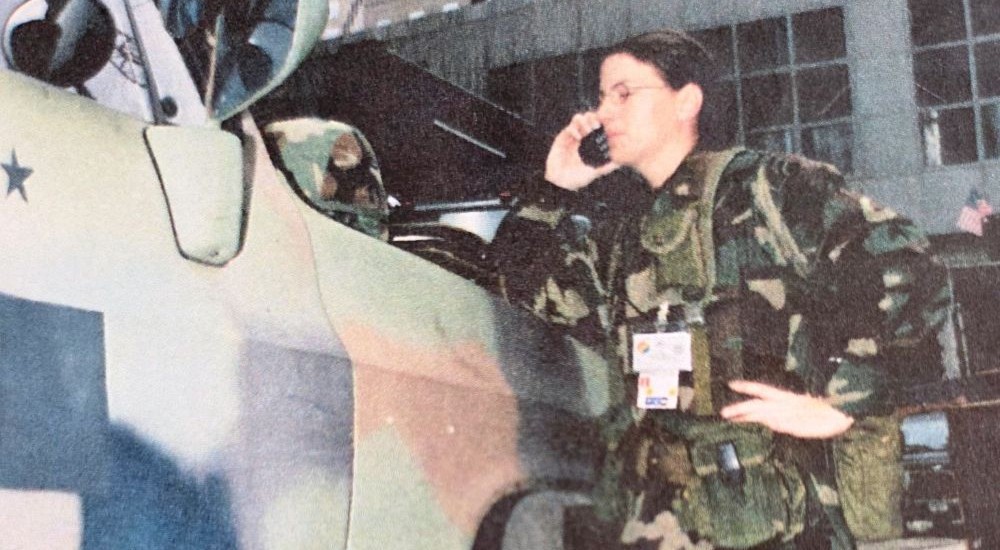
1st Lt. Elizabeth Condon helped work through communications challenges following the 9/11 attacks. (Courtesy photo)
It was after this revelation that Klein began sending couriers via the Staten Island Ferry to Condon’s data terminal, where soldiers transmitted his reports to the Guard’s headquarters near Albany. Slowly, a clearer picture of the conditions at ground zero began to form.
Klein also assigned senior NYARNG officers to coordinate with city administrators. He later noted how these guardmembers — many of whom worked for or were retired from the NYPD, FDNY, and public works departments — provided invaluable service in the absence of a functioning emergency management office.
“If you get any reasonable request from a city agency,” Klein recalled telling his liaison officers, “do it.”
Costagliola remembered this conversation a bit differently, saying Klein ordered him to “do what you can do to help — and if you do nothing, you’re fired.”
On Guard
After dark on Sept. 11, Klein and his on-scene battalion commanders gathered at a nearby NYPD mobile command post to discuss an important task he’d received. Police officials, he told them, wanted guardmembers to augment security around ground zero’s mile-long perimeter.
Those present were Klein; Costagliola; Slack; Obregon; Lt. Col. Frank Candiano of the Queens-based 1st Battalion, 258th Field Artillery, and a MOAA member; and NYARNG liaison officer Maj. Robert Manganini, a Premium member of MOAA. Using a scrounged tourist map, the group divided its objective into sectors.
Starting at sunrise, Costagliola’s 1st Battalion would assume responsibility for the triangle-shaped perimeter east of Church Street, while Slack’s Fighting 69th was to take the western half.
At night, when things were quieter, Candiano’s 1st Battalion would crew all checkpoints.
Before dawn the next day, several hundred NYARNG soldiers entered ground zero’s smoldering hellscape of mangled fire trucks, aircraft debris, and abandoned hot dog stands. Although shocked by the scenes they witnessed, they maintained a professional appearance and demeanor that greatly reassured both the public and the first responders who worked alongside them.
More than 4,500 guardmembers would eventually support recovery efforts at the World Trade Center. Many later joined other Guard, Reserve, and active component units to take the fight overseas.
The global war on terrorism, which began 25 years ago, has left an indelible mark on a generation of American servicemembers. Many still recall an inspirational motto first uttered in New York City during those dark days of 2001: Never Forget.
Lt. Col. Patrick J. Chaisson, USA (Ret), is a writer and historian in Scotia, N.Y.
Military Officer Magazine
Discover more interesting stories in MOAA’s award-winning magazine.