
(This article by Heather Kuldell-Ware originally appeared in the October 2026 issue of Military Officer magazine.)
Sean Gobin first saw the Appalachian National Scenic Trail as a kid, traveling through Virginia in a recreational vehicle with his parents. Somewhere along the way, he noticed the iconic white blazes and a sign explaining that the path stretched from Georgia to Maine. Hiking most of the East Coast struck him as a cool idea.
At one point, he had planned to go between his time as an enlisted Marine and an officer. But when the 9/11 attacks happened, that window closed.
After 12 years in the Marine Corps as an infantry rifleman and later an armor officer, Gobin had a short window before starting graduate school.
He decided it was time. In 2012, he grabbed his military-issued gear and drove to Springer Mountain, Ga., the trail’s southern terminus. Fresh off a deployment, he hadn’t taken time to prepare. He was in shape, though, so he hit the trail at a conditioning pace. He went full tilt and, within three days, had sore knees, shin splints, strained iliotibial bands, and blisters to show for it.
That’s also when he reached an outfitter in Neel Gap, northeast of his starting point in Georgia, and picked up what turned out to be the most important piece of gear on his hike: a bottle of ibuprofen.
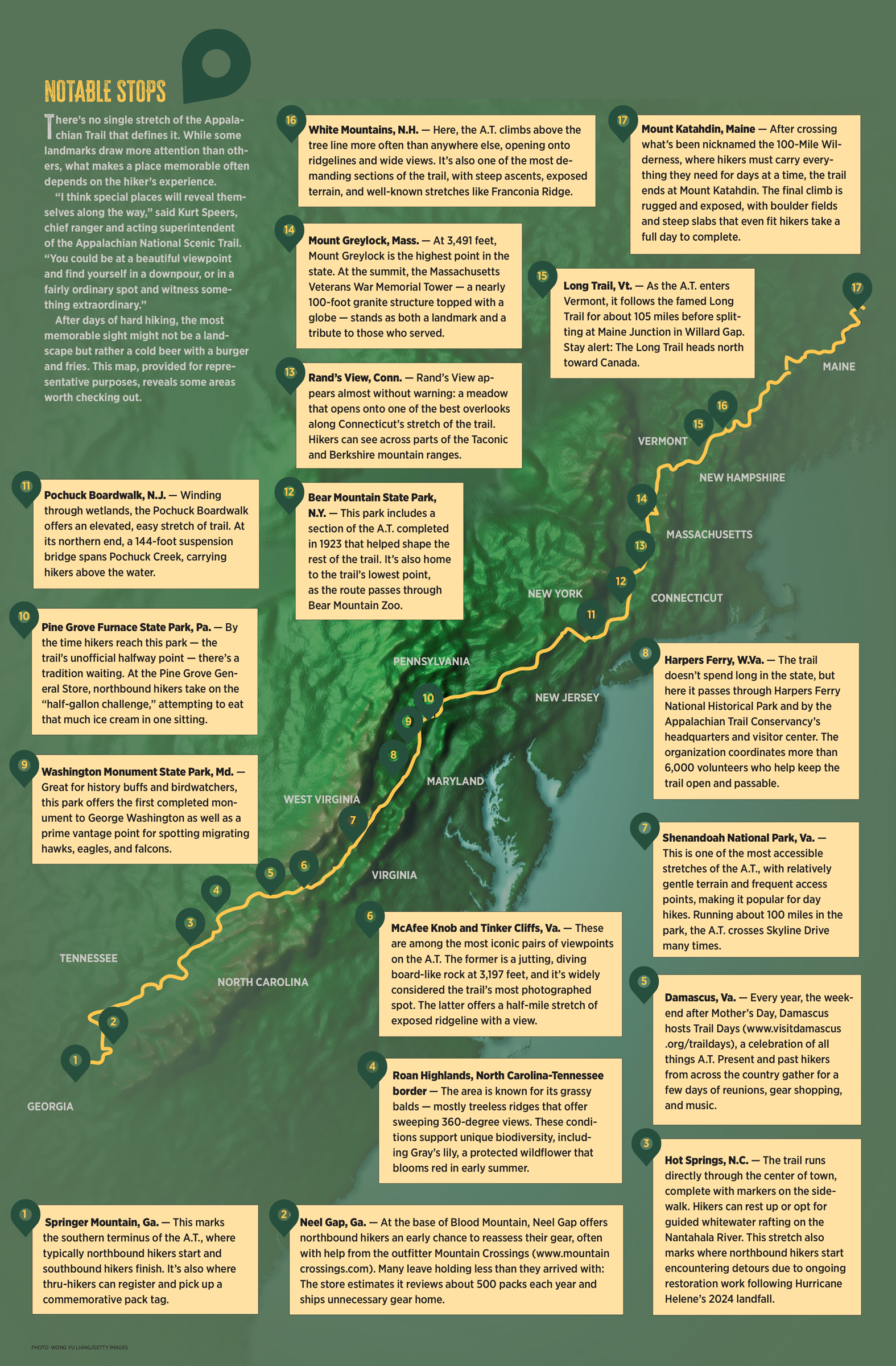
[MOAA MAP: Notable Stops Along the Trail]
‘Walk Off the War’
Part of the appeal of hiking the Appalachian Trail (A.T.) is how enormous the task feels — and how few people see it through. The A.T. runs through 14 states and stretches roughly 2,200 miles, though the mileage shifts slightly each year as sections are rerouted for maintenance or storm damage.
The trail crosses eight national forests, six national park units, and dozens of state managed or municipally owned areas. Maintaining it requires coordination between the U.S. National Park Service, the Appalachian Trail Conservancy (ATC), the U.S. Forest Service, state agencies, and trail clubs; they reroute sections, repair damage, and keep the trail passable for the 16.9 million recreational visits it had in 2025.
Only a few thousand attempt the full trail each year, according to the ATC. A thru-hike typically takes about six months, and those who complete it — all at once or in sections — are known as “2,000-milers.” Most thru-hikers start in Springer Mountain and follow white blazes painted along the trail north to Mount Katahdin in Maine, though some do it the opposite way.
Those who complete the trail are part of a tradition.
In 1948, Army veteran Earl Shaffer set out to become the first person to hike the entire trail in one continuous journey; it took him four months.
He later said he had wanted to “walk off the war.”
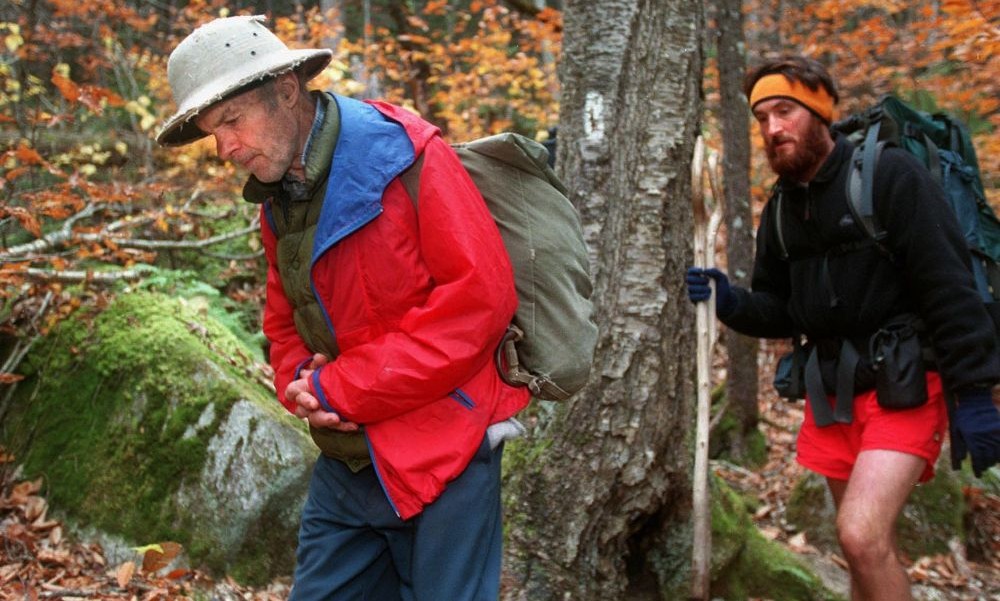
Earl Shaffer, left, and David Donaldson are seen near the end of their journey on the Appalachian Trail in 1998. Then 79, Shaffer became the oldest at the time to hike the entire trail 40 years after becoming the first to do it. (Photo by John Ewing/Portland Press Herald via Getty Images)
That idea has stuck. For many veterans, the trail has become a way to move between chapters — a stretch of time spent outdoors before figuring out what comes next.
Field Adjustments
Gobin hit an early setback, but he made two quick course corrections: He swapped his military-issued gear for proper thru-hiking equipment and boots, and he slowed his pace to let his body recover while he continued hiking. Taking a day off wasn’t possible, as he only had four and a half months to finish the trail before graduate school began.
That process isn’t unusual on the A.T. Most hikers get something wrong at the start. Some move too fast; others carry too much. A lot of it gets sorted out in the first few days — usually the hard way.
That even applied to Andrew Brown, a lifelong outdoorsman with planning skills reinforced during his service in the Marine Corps and in graduate school. With a background in medical microbiology and immunology as well as a doctorate in molecular and systems pharmacology, he approached the A.T. with a scientific mindset.
He tested gear on weekend trips, tracked weight in spreadsheets, and prepared 140 dehydrated meals with detailed instructions for his girlfriend (now wife) on what to include and when to send it. He planned every day of the trip, down to how many miles he would cover and where he would stop.
“I would say that plan lasted about 10 days,” said Brown, a Life member of MOAA and currently a USPHS lieutenant commander.
[RELATED: Here’s Where You Can Board a World War II German U-Boat]
Indeed, most A.T. hikers arrive with at least an outline of a plan. For northbound hikers, that usually means starting sometime between mid-February and mid-April with the aim of reaching Katahdin before it closes for the season in late October.
That creates a narrow window when hikers funnel onto the trail all at once, and Georgia Appalachian Trail Club (GATC) volunteers are there to help manage the surge.
“We want to give people the information they need to make their trip successful and help them understand how to minimize their impact on the trail,” said Rear Adm. Scott Deitchman, USPHS (Ret), a Life member of MOAA and an at-large member of GATC’s board of directors. “There are obvious things like pack out your trash; use an established campsite; don’t create a new one.”
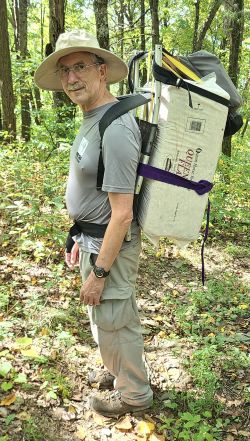 Volunteers like Deitchman, pictured, maintain the A.T. year-round, building and repairing with longevity and conservation in mind. They install steps along eroded sections, trim vegetation that encroaches on the path, and maintain composting privies.
During peak season, GATC volunteers cover the practical realities of life on the trail, from campsite etiquette to the indelicate subjects of going to the bathroom in the woods. They also register thru-hikers and section hikers as well as distribute ATC hangtags to those who attend “Leave No Trace” presentations. Those colorful tags let others know the wearer is aiming for the full trail mileage.
Some volunteers hit the trail to patrol busy sections and answer questions as hikers settle into their first miles. For navigation, some hikers also rely on the Appalachian Trail Thru-Hikers’ Companion, a physical guidebook that maps out mileage and resupply points.
Others opt for apps like FarOut, which work offline and offer crowdsourced updates on water sources, campsites, and trail conditions.
When choosing what to carry, most hikers get it wrong. They tend to fall into one of two traps: packing like they’re going to the moon or packing like the trail is what it was in the 1960s. In reality, much of the A.T. runs close enough to towns that hikers can resupply every three to four days.
What matters is carrying the essentials: enough to navigate, stay warm, eat, and handle the unexpected.
Back to Baseline
Gobin served three combat deployments — two in Iraq and one in Afghanistan. He was in a bad headspace when he left the military.
“After three very kinetic deployments, your brain starts to get rewired,” he said. “You view people in a bad light because you’ve been experienced in combat for so long, and that’s why a lot of combat veterans with trauma come home and they’ll isolate.”
Gobin decided to hike with a combat buddy, and on the trail, his mind began to heal. A snapped twig didn’t automatically mean danger. Strangers weren’t threats. Day after day, Gobin met people who were generous, open, and willing to help.
“It helps reestablish the basic faith in humanity that you could have lost along the way,” he said.
[RELATED: Veterans Experience Therapeutic Benefits of Spending Time With Horses]
Gobin chose to use his first name as his trail name. Most hikers are given nicknames, but for him, being called “Sean” instead of by rank or last name was something new. It was a simple step toward life outside the military.
That winter, three ATC board members contacted him. They had followed his hike on social media and wanted to create an outreach program for veterans on the A.T., inspired by Shaffer’s hike.
Gobin had been thinking along the same lines.
In spring 2013, they launched what became Warrior Expeditions, supporting the first group of 14 combat veterans on a thru-hike of the trail. The program now includes biking and paddling routes.
Warrior Expeditions now selects 30 to 40 veterans annually from hundreds of applications, focusing on those navigating trauma or major life transitions who are also physically ready for the trail. Participants are fully outfitted with gear refined over more than a decade of past cohorts, then they begin training and receive early support in Georgia before moving at their own pace. Along the way, a network of volunteers offers rides, meals, and shelter.
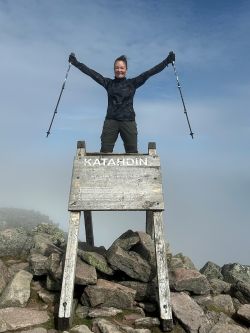 The goal isn’t to replace therapy, but it does give veterans time and space to process. About 80% of participants complete the trail, compared to roughly 20% to 25% of the general thru-hiking population. One of those veterans was CW3 Rosa Cervantes, USA (Ret), pictured, who applied for the 2024 season and found out on Christmas Day she’d been accepted.
After 22 years in the service, she was used to structure. She had built a career that spanned military intelligence, time as a drill sergeant, and flying Black Hawk helicopters.
Her final assignment was at Fort Belvoir. Before arriving, she was diagnosed with breast cancer. She underwent a lumpectomy and radiation, then returned to flying within six months before retiring in 2024.
Cervantes had performed multiday hikes before applying to Warrior Expeditions. But the Appalachian Trail proved different.
“You find yourself out there with a lot of time to think and process,” she said. “That’s not something I ever had. I was always working, always busy. You don’t realize how intense it is until it stops.”
Known Unknowns
The risks on the trail are real. Weather can turn quickly. Wildlife — especially black bears — is a constant consideration, which is why hikers store food away from where they sleep. There’s also the chance of injury and the reality that help might be far.
Cervantes knew all of that going in, along with the additional concern of being a woman on a solo hike, although that subsided thanks to positive experiences on the trail. A sneakier problem, however, was eating enough calories. She would find herself practically asleep while walking. Hikers can burn thousands of calories a day, and dialing in nutrition became part of the challenge.
For others, the concern came from somewhere else. After about eight of his eventual 10½ years in the Army National Guard, including a deployment to Kuwait, Matthew Mawyer was ready for something different. Between the heat, long hours, and constant responsibilities both in uniform and in his civilian job as an engineer, he was burned out.
What he missed most was simple: green.
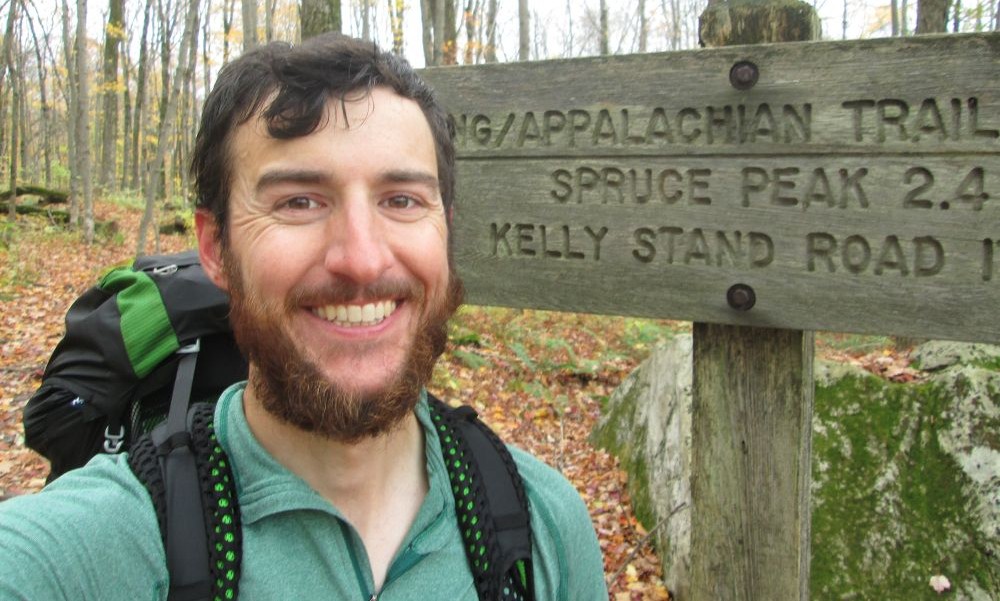
Former Army National Guard Capt. Matthew Mawyer hiked the trail after returning from a deployment. (Photo courtesy of Matthew Mawyer)
When he realized he’d have nearly four months of leave after Kuwait, he decided to use it on the A.T. Mawyer planned only four or five days at a time, adjusting as he hiked. Over time, that added up to roughly 800 miles, from Virginia’s Shenandoah National Park to Manchester Center, Vt.
“My grandmother was more worried about me on the Appalachian Trail than when I was deployed. She was convinced I’d be bitten by a rattlesnake, eaten by a bear, or mugged by some weirdo in the woods,” Mawyer said.
He initially carried bear spray to keep grandma happy but eventually ditched it.
A Family of Hikers
One of Mawyer’s favorite days came on a cold, windy October afternoon atop a fire tower in Vermont. (Mawyer, who left the Army National Guard as a captain, confirmed he was authorized to go up, but readers should know access rules can vary.)
From a few thousand feet up, he could see nothing but mountains. He sat there drinking fresh spring water and eating a peanut butter cup. There was no schedule, no responsibility, nowhere he had to be.
Moments like that stood out. So did the smaller ones: sharing fudge he’d picked up at a New Jersey carnival; spending an afternoon with a farmhand who offered him a ride to a brewery; or sitting down at a diner and talking with a woman about her late husband, a Holocaust survivor. While he often hiked alone, he would perk up if he heard the voices of other hikers as he approached a shelter.
“There were times when I began to get lonely, but there was something that just made you feel like you were at home when you got to a shelter or a campsite at the end of an amazing day hiking,” he said. “It’s like, man, I got family tonight.”
[RELATED: This State Topped a ‘Best for Military Retirees’ Survey for the Third Year in a Row]
Cervantes’ favorite parts of the trail came near the end, where it was the most difficult. In New Hampshire and Maine, the steep, rocky terrain can require more scrambling than hiking. Within this area dubbed Mahoosuc Range, she spent hours working through a mile-long notch, sometimes tossing her pack ahead of her and climbing after it. Earlier in the hike, this challenge might have stopped her. By then, it didn’t.
Other memories were social. “There [are] so many nice people,” Cervantes said.
Brown found his rhythm, too — just not the one he had planned. He came in overprepared: spreadsheets, meal plans, and enough homemade beef jerky to last well beyond what he wanted to eat, though he did find another use for it.
“The beef jerky was the jalapeño cheese of the MRE,” he said. “You could trade anything for that.”
Some of his favorite memories came from that space in between, like nights in Maine with a friend or cooking real food over a fire.
After the trail, he found his way back into service with the USPHS Commissioned Corps. And like the others, what stayed with him was the time he had on the trail to figure out what comes next. One of his friends, still on active duty and nearing 30 years in the Army, is struggling to picture what comes after service. Brown told him to hike the A.T.
“You have a concrete goal every day to accomplish, but you also still have time to think,” he said. “And if you’re worrying too much about your future, you’re really tired at the end of the day, so you have no problem falling asleep.”
Heather Kuldell-Ware is a writer based in Virginia.
Military Officer Magazine
Discover more interesting stories in MOAA’s award-winning magazine.