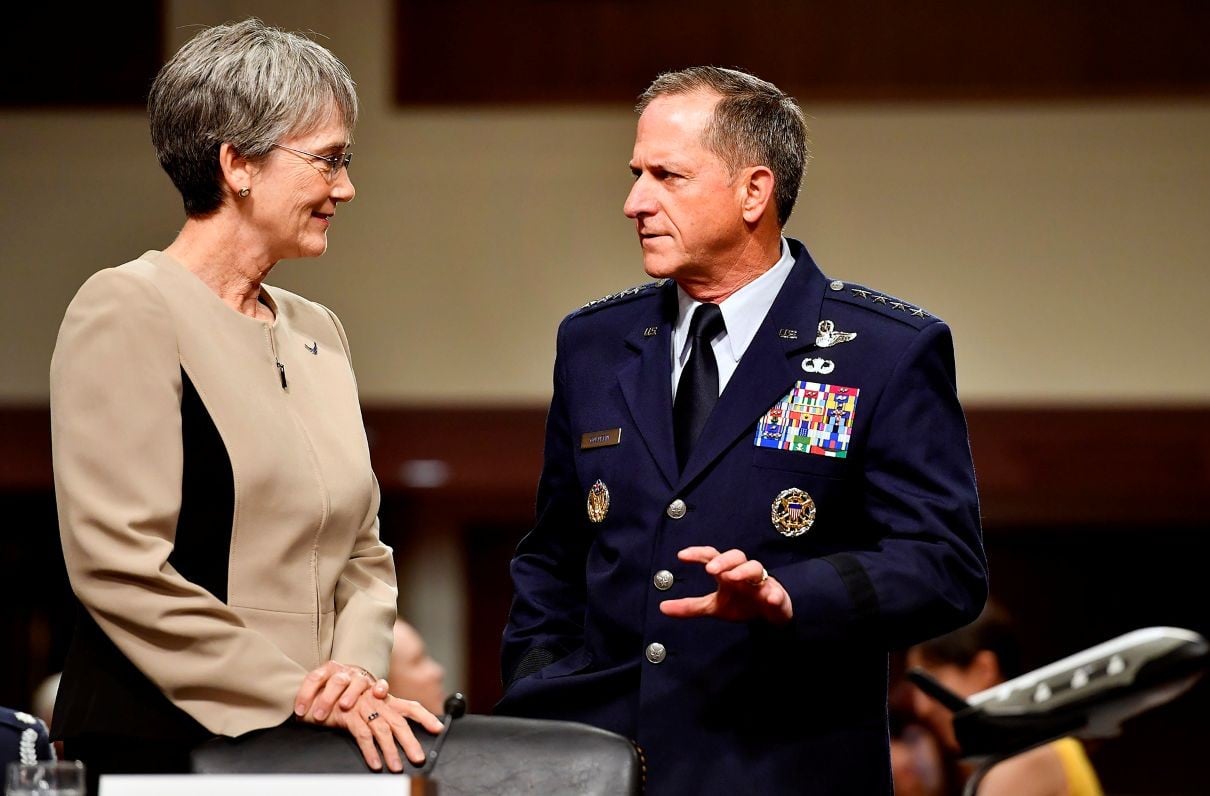
“Dave and I were together in Montana, sitting on a back porch, probably having a beer.”
This is how former Air Force Secretary Heather Wilson and Gen. David Goldfein (Ret), the service’s 21st chief of staff, began writing a book about their time as cadets and their service to the nation, she recalled.
“You know, you have got to get some of these stories down,” she told Goldfein at the time. “They’re good stories, and they’re meaningful.”
Two years later, they completed Get Back Up: Lessons in Servant Leadership.
MOAA recently spoke with the co-authors to discuss their careers at the Pentagon; recovering from failure; and tackling difficult, sometimes violent situations in the U.S. and abroad. This interview was edited for length and clarity.
Q. Who is this book for, and what does it have to offer to readers?
WILSON: We wanted to tell stories that might resonate with younger leaders, particularly cadets, lieutenants, captains — people first starting out in their careers, although it’s not necessarily just for those in the military. The book includes some of the things we’ve learned along the way — maybe some of the mistakes we made that young leaders might be able to avoid. Each chapter is a particular lesson illustrated by a story from one or both of us.
[MORE FROM MOAA: Military Professional Reading List]
Q. Secretary Wilson, you wrote in the book about enjoying your role as a “low-key staff member” in Congress. What changed that led you to accepting increasingly complex roles and eventually becoming secretary of the Air Force?
WILSON: Sometimes I’m still more comfortable being low-key staff. I get tremendous satisfaction of connecting people to each other or getting things done quietly behind the scenes.
I was open to opportunities, but there were things that came up that I never expected would happen. I’ve always been willing to change or take a different course if I felt inspired.
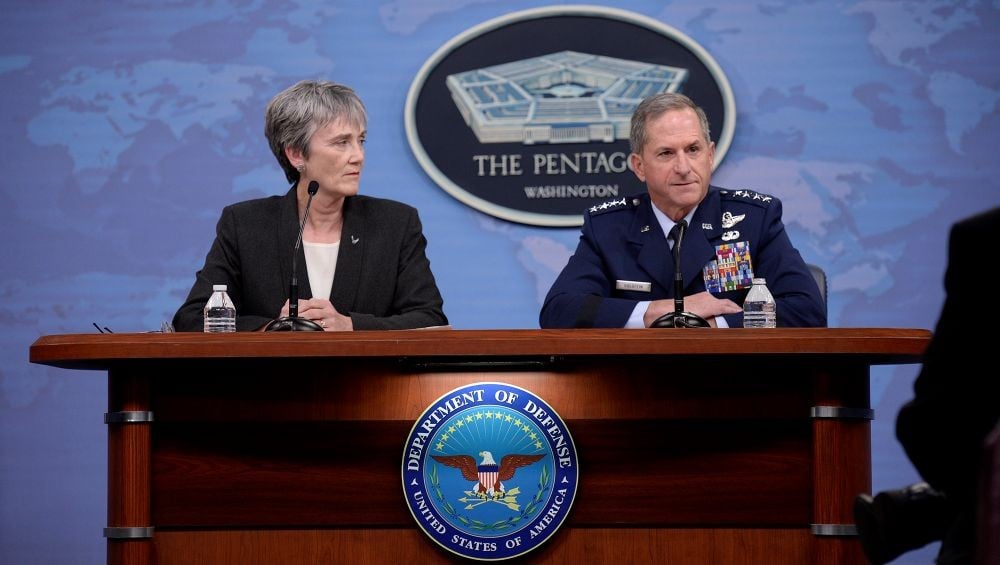
Air Force Secretary Heather Wilson and Chief of Staff Gen. David Goldfein host the 2017 State of the Air Force address at the Pentagon. (Photo by Staff Sgt. Rusty Frank/Air Force)
Q. Gen. Goldfein, you wrote in the book about a time your chief master sergeant shared a useful perspective you would not have organically noticed. But not everyone gets that kind of candor from senior leadership. What advice do you have for those looking to develop their leadership approach?
GOLDFEIN: We get to a point in our lives where we understand through self-reflection what our gifts are and what our gaps are, and we all have both. There’s a bit of humility that goes with leading effectively and being a servant leader — acknowledging the fact that there are certain things we are just not good at.
I am not good at details — never have been, never will be. There are certain things you’re just not good at as a leader, so surround yourself with people who can fill in your gaps.
If you create that environment where they can speak truth to power, and if you surround yourself by people who see the world through a completely different lens, you’re going to be far more effective as a leader than if you just surround yourself with people who look and sound just like you.
[RELATED: Join Leaders of All Types at TotalForce+]
Q. Gen. Goldfein, in 1999 after your aircraft crashed and you were rescued, you insisted on getting right back into the air. What was your thinking behind that, and how did those around you react?
GOLDFEIN: When I got off the C-130 aircraft that brought me back, the first person I met was my high school sweetheart, Dawn — now my bride of 43 years.
Then I met the wing commander at Aviano Air Base in Italy, Gen. Dan Leaf, and I said: “I’m not sure if you had a chance to think about this much, but you know, I’m not a young captain who just got shot down and rescued; I’m a squadron commander, and I have to get my squadron back on the horse, and the best way for me to do that is to get back in the air and get back in the lead. And if it’s OK with you, I’m going to go home, get some rest, and then come fly tonight.”
And he said: “If it’s OK with Dawn, it’s OK with me.”
Well, it was OK with Dawn because she’s such a trooper and she understood how important that was for me. I think our spouses have a very special kind of courage; they not only endure but thrive in an environment where their husband or wife is working long hours defending the nation.
Our daughters were young, and my oldest, who’s now in the Air Force, was struggling with this whole dad-just-got-shot-down thing. Quite frankly, having your family with you when you’re fighting combat missions was not in the squadron commander handbook.
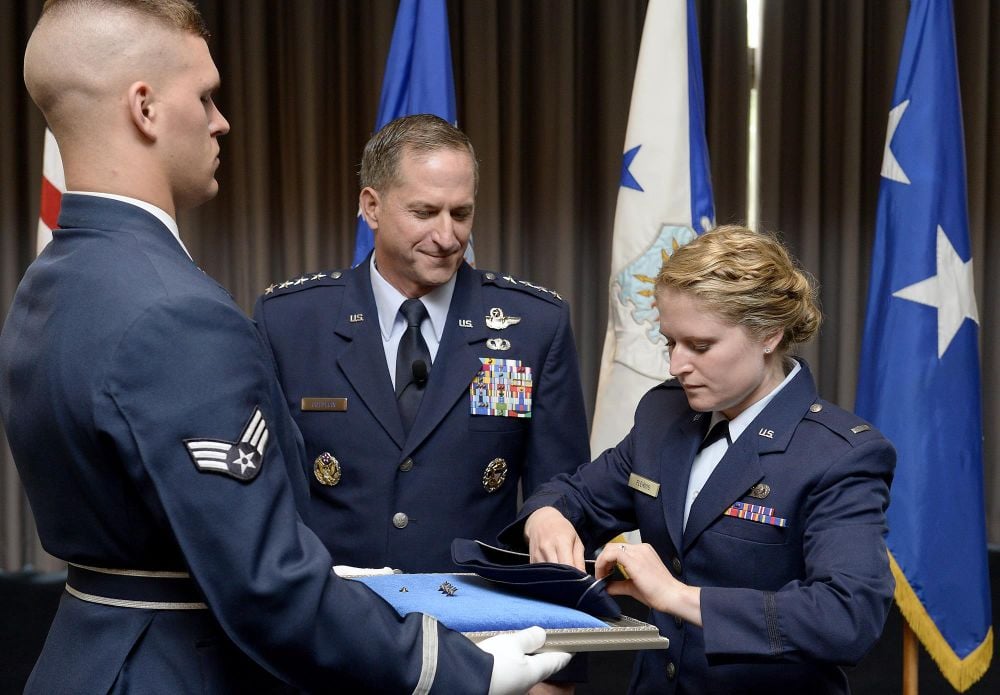
The rank of general is pinned on David Goldfein's flight cap by his daughter, 1st Lt. Danielle Fleming, during his promotion ceremony Aug. 6, 2015, in Washington, D.C. (Photo by Scott M. Ash/Air Force)
So I had a bit of a dilemma: I’ve got an obligation to my squadron to get back in the air, and I have got an obligation as a dad to make sure my kids are OK. So I took a night to spend with my daughters to make sure they were doing OK, and then I flew the next night and every night after that.
Those are some of the challenges you face as a leader in terms of the demands on your time and the importance of family.
Q. Another section in the book was about failure: “When an organization fails, it’s best for leaders to take immediate ownership and responsibility.” What does that specifically look like to you?
WILSON: This comes from our story on Sutherland Springs, which was a terrible situation where a former airman walked into a church at Sutherland Springs, Texas, opened fire, and killed 26 people and wounded a lot of others, and then killed himself. It was just awful.
I was the secretary, and Dave was the chief at the time. We knew within a few hours that [the shooter] had been a former airman. We heard from the inspector general that perhaps [the shooter] had been convicted of a crime that should have required [notification] to the criminal record check system so [the shooter] could be prevented from buying a weapon. In fact, that was the case, and we failed to notify. And even worse, there had been an audit of the Department of Defense systems on this several years before, and there’d been an audit finding saying this is a problem, and we hadn’t fixed it.
Sometimes I think when things go really wrong in organizations, particularly young leaders may be tempted to put it in the bottom drawer, sweep it under the rug, or blame somebody else. But as I became more senior, I realized it was really important to own that failure and focus on fixing the problem.
Problems don’t get better if you don’t own up to them. Initially it may feel hard to do that because nobody wants to feel like they really screwed something up or failed. But in the long run, it’s actually easier because you get to focus on the solutions and not on trying to delay, deny, or deflect from what actually happened.
And that’s what we did in Sutherland Springs; we decided to own it and to say: “We should have notified, and we didn’t. That was what the law required, and we didn’t do it. And now we’re going fix it.” And we did.
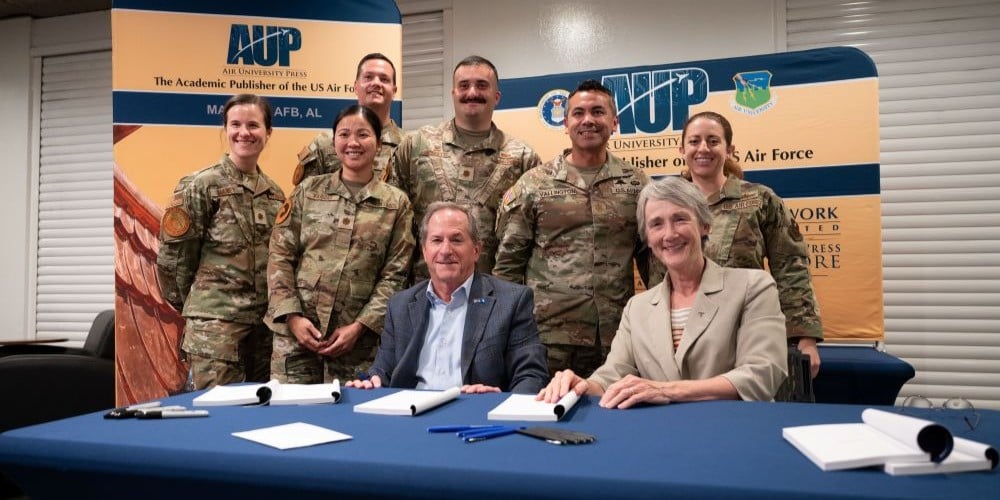
Retired Gen. David Goldfein and former Air Force Secretary Heather Wilson pose for a photograph with servicemembers at the Squadron Officer School on Maxwell Air Force Base, Ala., in September 2025. (Photo by Airman 1st Class Nelvis Sera/Air Force)
GOLDFEIN: The leaders I admire and look up to and try to emulate — not imitate, but emulate — they always shared every success because the success is part of the organization. While as the leader you may often get kudos when things go well, rarely is it the leader who is solely responsible [for that success].
Sharing success is something that is central to servant leadership, but so is owning failure. The question is: How do you handle it at the moment? Every setback that you’re handed has the seeds of a future success that you just can’t see in the moment. A leader [must be able to] sit the team down and say: “I’ll take ownership for it, but now what we have to do as a team is look at this challenge, look at this setback, [and identify] the opportunity here. How do we emerge from this even stronger as a team?”
Leaders that approach it from that perspective are always improving the organization.
[RELATED: Career Resources From MOAA]
Q. Secretary Wilson, you touched on job application processes in the book. What advice do you have for young people entering the job market who might feel overwhelmed by job descriptions?
WILSON: I’ve hired hundreds of people in my life, and usually it’s very rare for somebody to meet 100% of the requirements. If you meet 60% or 70% of the requirements for a job, put your résumé in. Maybe you get a first round interview — you’ll learn something about it, and you’ll learn something about yourself.
You don’t see on my résumé list the jobs I didn’t get. You don’t see on my résumé that Brown University didn’t admit me as an undergraduate. But I would not have done a lot of the things that I have done if I hadn’t taken the shot.
Q. Is there anything additional you wish you had included in the book?
WILSON: We started out with a long list of stories, but we wanted it to be a fairly small volume that a young officer could get through pretty easily in a sitting or two. Even as we’ve been rolling out the book, we’ve thought of other stories along the way.
GOLDFEIN: The next chapter we’d write together would be a chapter on what we learned during the COVID-19 pandemic. How do you lead organizations through a crisis like a national pandemic? At the time, I was chief of staff of the Air Force, and Heather was president of the University of Texas at El Paso, so she had to lead a large university through that. She has [more than] a thousand students that walk across the bridge every day from Mexico to attend school at UTEP. She had to lead through that transition.
At the same time, I had to do a quick assessment looking at missions the nation will not give us a pass on: The nation was not going to live without GPS, so we’re not going to get a pass on space. The nation is not going to give us a pass on strategic nuclear deterrence, so we have got to be able to be down in those silos. It’s not going to give us a pass on global mobility. How do we keep those critical missions going with a global pandemic? Remember, we didn’t know when it was going to end. It was a huge challenge, but it also produced significant opportunity.
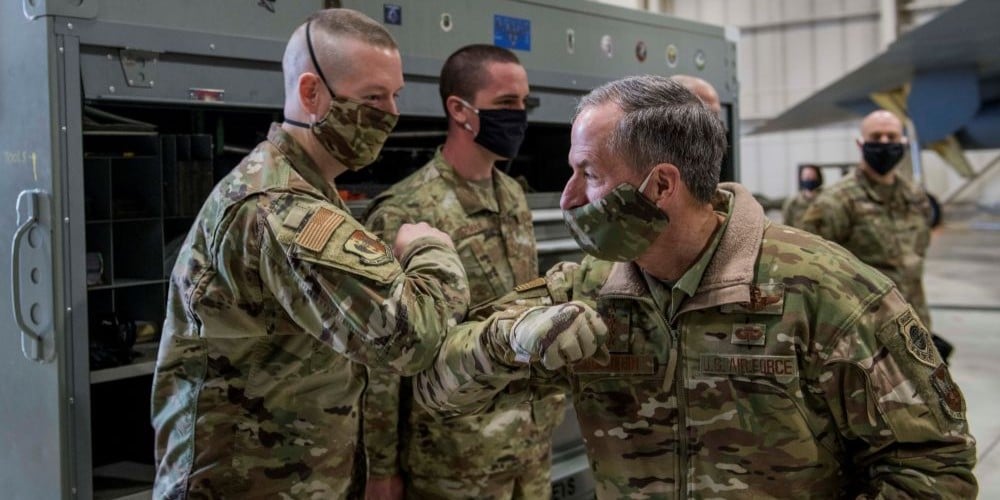
Air Force Chief of Staff Gen. David Goldfein bumps elbows after coining an airman at Minot Air Force Base, N.D., on May 14, 2020. (Photo by Airman 1st Class Jesse Jenny/Air Force)
Q. What did you learn from the pandemic?
GOLDFEIN: No. 1 would be that we had spent time pushing decision authority down to the level where it could be most efficient and most effective. For us, the focus was on revitalizing squadrons because I’d seen that decision authority had bubbled up to higher and higher levels.
When I was a squadron commander, I knew what was best for my squadron, and squadron commanders today know what’s best for their squadron. I had a lot of decision authority as a squadron commander, leading a squadron both in peacetime and in war. My concern was that same level of autonomy I’d been given to be able to run hard, take risks, fall forward on my face, fail miserably, get back up, and be able to learn and lead — I was concerned that we weren’t doing the same thing for the current and next generation of young leaders.
So we had spent two years pushing decision authority down, and then we got into a global pandemic. Probably the biggest payoff of that entire effort [pushing down decision authority] was allowing local leaders to make decisions on what was best for their squadron because Mountain Home AFB ain’t the same as Yokota Air Base, which ain’t the same as Spangdahlem Air Base, which ain’t the same as MacDill AFB. Every base had a very unique local situation.
The first word we put out was run hard, make the decisions that you need to make — we’ve got your back. That approach to handling the pandemic turned out to be quite successful in terms of keeping missions going, keeping people taken care of, taking care of families.
[MORE STORIES: Military Officer Digital Edition]
Q. So what does it feel like for each of you to have come all this way, having shared similar journeys?
WILSON: We started at the Air Force Academy the same day. And then we ended up being chief of staff and secretary together. Nobody in our class would have thought that the class geek and the class clown would have ended up as secretary and chief.
Q. Who was the class clown, and who was the class geek?
WILSON: There’s no question — I was in the library; he was very funny.
I tremendously enjoyed serving with Dave. He made me a better secretary. As a team, we were able to get a lot done.
GOLDFEIN: One of the reasons we made a very effective team is that we both had a good understanding of our roles and responsibilities. We also acknowledged that it was a relationship worth investing in because if we were going to move the service positively in the right direction, neither of us could do it alone.
I joke that one of us graduated in just four years from the academy, went on to be a congresswoman and entrepreneur and secretary of the Air Force, university president — and one of us didn’t. We learned a lot of individual lessons along the way on the two paths that we chose. When we were at the academy together in the same class, I like to remind people that I was part of the group that made the top [academic] half possible — her half.
The Book
Get Back Up is free for servicemembers and veterans through Air University Press and available for purchase through several retailers via www.getbackupleadership.com. The authors also produced an audio version for purchase. Their proceeds will be directed to the University of Texas at El Paso ROTC scholarship fund as well as the nonprofit Leaven Kids.
Check Out MOAA Member Books for More Great Reads!
Visit MOAA's Member Books page to see a list of recent works from MOAA members in a variety of genres.