
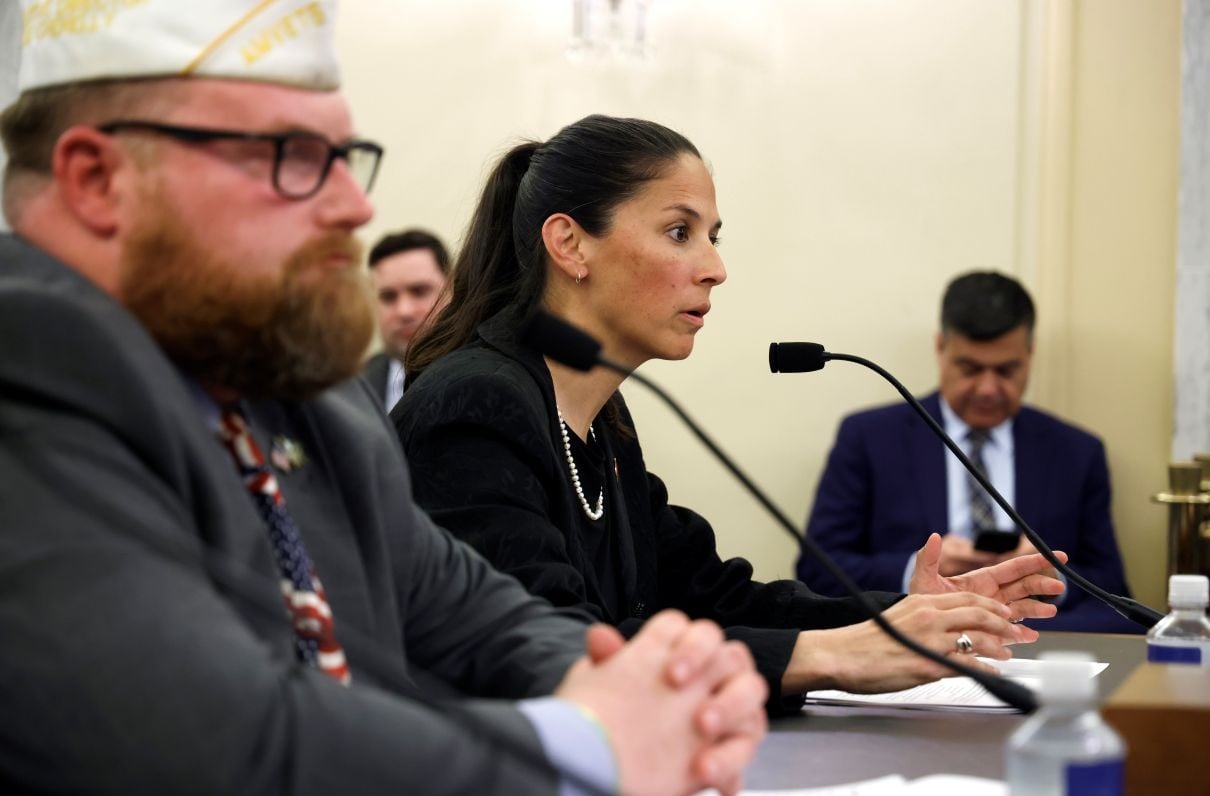
A clear definition of “veteran success” will help lawmakers and the VA align efforts to get veterans the care, benefits, and support they’ve earned through service, MOAA told Senate Veterans’ Affairs Committee members during April 29 testimony on Capitol Hill.
A National Veterans Strategy “can provide a durable, bipartisan framework that strengthens support for the entire veteran community,” Jen Goodale, MOAA’s director of Government Relations for Veterans and Retired Affairs, told legislators in a session addressing more than two dozen veterans-related bills under consideration by the committee.
One of those bills – the bipartisan National Veterans Strategy Act (S. 3726) – would create guidance similar to the National Security Strategy to “articulate national objectives, define shared outcomes, and coordinate efforts across agencies responsible for supporting the veteran community,” according to MOAA’s written testimony. Identifying families, caregivers, and survivors as key stakeholders and building metrics to evaluate government systems and provide for long-term planning would be critical to a successful strategy, Goodale told lawmakers.
[REGISTER TODAY: MOAA's Legislative Action Center]
The two-part hearing included testimony from VA officials followed by remarks from representatives of MOAA, AMVETS, and Wounded Warrior Project.
“Improving the lives of those who have served is not a partisan issue, but a shared mission that involves every member of this committee,” said Sen. Jerry Moran (R-Kan.), the committee chairman. “Whether we are addressing health care, resources, or the efficiency of benefits claim processing, our focus remains on those who served and sacrificed for their nation.”
Along with establishing a National Veterans Strategy, MOAA expressed support for other legislation under consideration, such as:
- The Mammography Access for Veterans Act (S. 3395), which would increase access to mammography services, especially in rural or underserved communities, by making permanent the VA’s tele-mammography pilot initiative. “For women veterans, it’s not that they don’t want to get screenings,” Goodale told the committee in response to a question from Sen. Richard Blumenthal (D-Conn.), the panel’s ranking member. “It’s that it is difficult to make the appointments. It’s difficult to find the place that will support them. [The act] will enhance opportunities ... to get those screenings as necessary.”
- The FRAUD in VA Disability Exams Act (S. 3000), which would require the VA to proactively target fraud in veterans’ disability benefit questionnaires (DBQs). This legislation supports MOAA’s long-standing goal of protecting veterans from predatory actors seeking to collect payment in exchange for manipulating the VA claims process – a practice also targeted by the MOAA-supported GUARD VA Benefits Act.
- The Justice for ALS Veterans Act (S. 749), which would extend increased compensation to surviving spouses of veterans who died of amyotrophic lateral sclerosis (ALS or Lou Gehrig’s Disease) no matter how long they had the disease, removing eligibility requirements that fail to consider the short life expectancy of those diagnosed with ALS.
- The Carlton H. Ingram Veterans’ Benefits Protection Act (S. 4140), which makes clear VA disability ratings should discount the effects of medication and treatment if a baseline condition can be determined. This law comes after the VA’s passage, and rescission, of a disability ratings rule that may have punished veterans for treating an illness or injury.
- The Stuck On Hold Act (S. 3170), which would require the VA to establish a call-back system for its customer service lines, allowing veterans to avoid long wait times.
- The Maternal Health for Veterans Act, draft legislation which would improve funding and expand reporting requirements for VA maternity care.
[RELATED: VA Drops Appeal in Key Court Case, Ending a Threat to Veterans’ Benefits]
MOAA offered conditional support for other legislation, including bills that would create a rolling five-year staffing plan for the VA and improve VA care and benefits connected to toxic exposure. Goodale pledged to work with the committee to ensure these bills address concerns from MOAA and the wider veterans community as they move through the legislative process.
The pieces of legislation under committee consideration may “differ in scope, but share a common principle: Veterans deserve systems that are fair, modern, transparent, and worthy of their service,” Goodale told lawmakers. “MOAA appreciates the committee’s bipartisan leadership and stands ready to help advance these proposals.”
When MOAA Speaks, Congress Listens
Learn more about MOAA’s key advocacy issues, and contact your elected officials using our messaging platform.