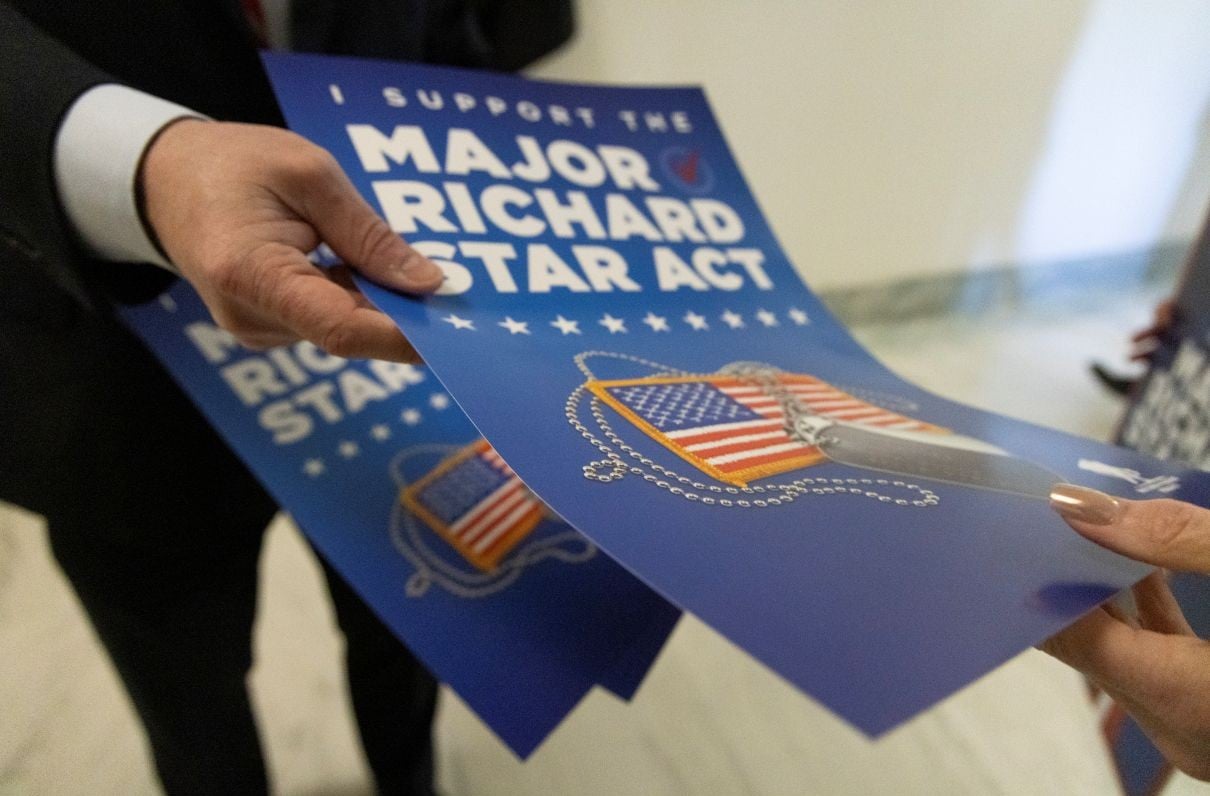
This year, Congress can end the “wounded veteran tax” – a dollar of earned retired pay lost for every dollar of VA disability compensation received by tens of thousands of military retirees – and momentum has never been greater to do so.
But precious few weeks of floor time remain to pass the Major Richard Star Act, either as standalone legislation (H.R. 2102 | S. 1032) or as part of an omnibus package, before the 119th Congress ends.
The bill had 81 cosponsors in the Senate and 341 in the House, nearly 80% of Congress, as of Nov. 2. That support stems from the work of MOAA members across the country and partner veterans and military service organizations who have pressed their lawmakers to sign on. MOAA’s team of registered advocates has also worked with leadership and members of both parties to build a path that brings the long-sought fix to the floor.
The House is scheduled to be in session for just 20 more days before the end of the year. The Senate will be in session for 22 days. There are two ways the bill could cross the finish line during that window.
Take Care of America’s Veterans Act (TCAVA)
As MOAA has covered extensively, TCAVA is an omnibus package introduced by the House and Senate Veterans’ Affairs committees. It combines more than 60 provisions, many which are bipartisan, on veterans’ benefits, health care, education, transition, caregiver support, and survivor benefits. All indications are that despite heavy competition for floor time, TCAVA remains a priority for congressional leadership.
[TAKE ACTION: Urge Your Lawmakers to Pass the Take Care of America’s Veterans Act]
The package includes more than 20 MOAA-supported pieces of legislation. Along with the Major Richard Star Act, it has two other long-standing MOAA priorities:
- The Veteran Caregiver Reeducation, Reemployment, and Retirement (3R) Act, which would help family caregivers return to work and plan for their own retirement after years spent caring for a seriously wounded veteran.
- The Love Lives On Act, which would allow surviving spouses to keep their benefits if they remarry before age 55.
Other MOAA-backed bills in TCAVA include improvements to survivor benefits, veteran health care, claims processing, and more.
Many of these pieces of legislation address the needs of smaller populations within the veteran community. Despite their importance, they often struggle to gain the visibility needed to secure standalone consideration and instead rely on inclusion in larger legislative packages to advance.
While MOAA has reservations about how the bill is funded, the association strongly supports TCAVA as a legislative vehicle. By codifying changes affecting VA sleep apnea and tinnitus ratings that are already underway, the bill allows veterans to benefit from the savings connected to those changes rather than seeing the funds revert back to the Treasury.
House Discharge Petition
A discharge petition allows a majority of the House to bring a measure to the floor without committee or House leadership action. Once 218 members sign, the petition can no longer be withdrawn and the bill moves to a special House calendar.
Rep. Mark Takano (D-Calif.) filed such a petition related to the Major Richard Star Act on May 21. It reached 218 signatures on Sept. 15.
Once the petition receives the required number of votes, it must mature, meaning seven legislative days must pass. The House has not held votes since leaving for the election, but it has held brief pro forma sessions, and each one counts as a legislative day. After the petition matures:
- Any member who signed it can announce on the floor that they intend to offer the discharge motion. The speaker then has two legislative days to schedule a vote.
- The motion is debated for 20 minutes. Opponents cannot table it.
- If a majority supports the motion, and the House adopts the corresponding resolution, the chamber immediately takes up the Star Act for vote.
A discharge motion cannot be offered during the last six days of a session, so the real window is shorter than the House’s 20 remaining days.
Even if the House passes the bill, the Senate has no discharge procedure. The bill would need to be brought to the floor and likely would need 60 votes to overcome a filibuster. It could pass by unanimous consent, but unanimous consent requests can be blocked by a single senator, and multiple requests involving the Major Richard Star Act have been blocked this Congress.
Understanding the Two Versions
MOAA supports any viable pathway to signing the Major Richard Star Act into law. We are encouraging lawmakers in the House to vote yes on both the discharge petition and TCAVA.
The versions differ in how they calculate the military retired pay eligible combat-injured veterans could receive alongside VA disability compensation.
Some veterans would receive the same amount of combined VA and DoW compensation under either proposal; others would receive more under the discharge-petition version. Veterans could retain their existing compensation arrangement if it provides a higher payment. MOAA is pursuing both paths to secure relief this Congress.
What Happens Next
Both bills face an uphill climb. Congress has very little floor time left and a long to do-list. Lawmakers must:
- Finish regular appropriations or pass another continuing resolution before the Dec. 11 deadline.
- Finalize the annual must-pass National Defense Authorization Act.
- Consider other priority legislation and omnibus packages.
MOAA will update members on any news or floor action on the Major Richard Star Act. By registering for MOAA’s Legislative Action Center, you can receive timely email and text message updates and calls to action.
There may be little time between the announcement of a floor vote connected to the bill and the vote itself – a concerted push from constituents now can make the difference between ending an unjust offset for tens of thousands of wounded warriors, or starting over in the next legislative session.
When MOAA Speaks, Congress Listens
Learn more about MOAA’s key advocacy issues, and contact your elected officials using our messaging platform.