
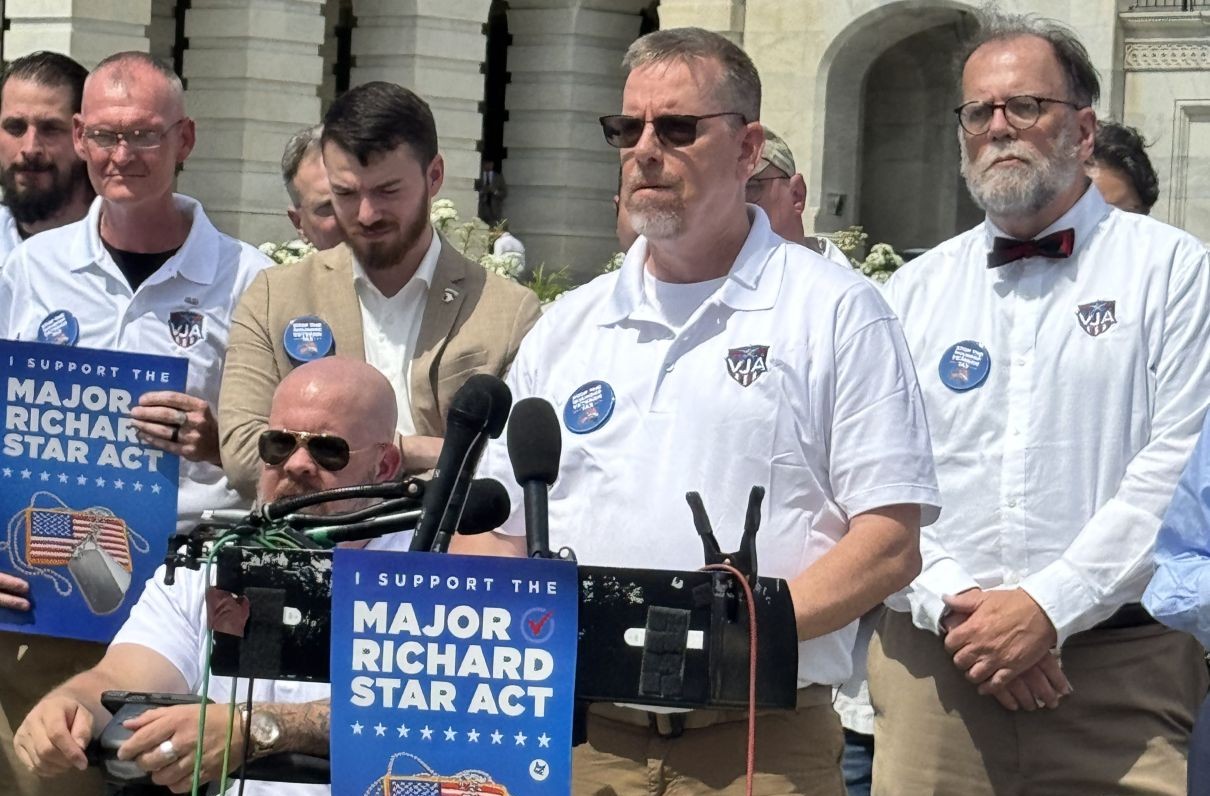
A MOAA-backed omnibus bill would provide millions of veterans, caregivers, and survivors with long-sought support from more than five dozen individual pieces of legislation. And while the Take Care of America’s Veterans Act (TCAVA) has received national attention, yet rarely has the focus been where it should be: On those who have served and sacrificed, and who could see life-changing improvements should the bill become law.
Here are just a few of their stories:
‘Richard Died Waiting’
Retired Army Sgt. David Star called the Major Richard Star Act, a bipartisan bill named in honor of his brother, “the cornerstone” of TCAVA. The omnibus legislation offers a vehicle to provide benefits for nearly 60,000 combat-injured military retirees, some of whom have been waiting decades to see the end of an unjust pay offset.
Crystal Wilson serves as a full-time caregiver for her husband Tyler, who was paralyzed after being shot in Afghanistan. A medical retiree, the offset hits home hard for Crystal, who left her career as a firefighter to care for her husband, she wrote in The Gazette of Colorado Springs, Colo.
“For a family that traded two incomes for round-the-clock care, that offset is not an abstraction. It is money that would help cover the therapies, the equipment and the everyday costs that come with catastrophic injury — support Colorado families have been told to go without for far too long.”
‘We Have Waited Long Enough’
Vanessa Chism serves as a full-time caregiver for her husband, Cody, a medically retired Army combat medic coping with severe traumatic brain injury (TBI) and other ailments. She told her story in the Baltimore Sun – traveling hours to multiple facilities, waiting months for “something as simple as a walking boot,” and enlisting the help of her three children to support Cody’s at-home care: “Our family chooses to keep him home, where he wants to be, and I would make that same choice again tomorrow.”
TCAVA includes the Veteran Caregiver Reeducation, Reemployment, and Retirement Act, which would help caregivers rebuild the financial and professional foundation that’s often neglected or cast aside for other, more pressing duties. Other portions of the omnibus bill would ease the burden of care coordination for caregivers and provide extended support for those caring for severely injured or ill veterans.
“The hard part is not passing this bill. It is explaining to families like mine who have already waited long enough why Washington made them wait longer.”
Karee White became one of the nation’s 14.3 million military and veteran caregivers when her daughter, an Army paratrooper, suffered a brain injury at age 25 that left her in a coma for a year. She told her story to Stars and Stripes, stressing the bill’s support for a range of programs including TBI care, blast injury research, and others.
“Those are not line items to me. Traumatic brain injury care is what my daughter’s week is made of, and across the country other families are living their own version of it. … Waiting has become Washington’s easiest answer, and it is the one answer the veteran community cannot afford.”
‘The Love of My Life … Was Suddenly Gone’
Marcie Robertson’s husband Forrest, father to her three children, died in 2013 while on his fifth deployment to Afghanistan. Marcie told her story of grief and sacrifice in The Kansas City Star.
“The love of my life and father to my three beautiful children was suddenly gone, and I had become a widow,” she wrote. She began to navigate the survivor process and was told of restrictions that prevent surviving spouses from keeping their benefits if they remarry before age 55.
“Remarriage was the last thing on my mind,” she wrote. “All I cared about was supporting my children as we navigated surviving the next day, week, month and year with this massive hole in our lives.”
Six years after her husband’s death, she met someone new. As part of that journey, she’s worked with lawmakers to introduce the Love Lives On Act, a MOAA-backed bill included with TCAVA that would undo the arbitrary age-based restrictions.
“My children were only 6, 10 and 14 when they lost their father. While we are incredibly fortunate to have someone in our lives who loves and supports them as young adults now, this new chapter does not erase our profound loss, nor should it justify losing the benefits we have rightfully earned.”
Show your support for these and countless others who would benefit from TCAVA’s passage. Make your voice heard today.
When MOAA Speaks, Congress Listens
Learn more about MOAA’s key advocacy issues, and contact your elected officials using our messaging platform.