

By Col. William D. Bushnell, USMC (Ret)
From keeping servicemembers healthy to preparing merchant seamen for duty to snapshots-in-time of foreign military culture – the Soviet Union in the 1980s, China in the 1970s, and the submarine forces of Imperial Japan – our latest list of vintage books runs the gamut.
You can purchase the books at the links in the titles below – note that some links may point to updated versions/reprints. MOAA is an Amazon Associate and earns money from qualifying purchases, with the revenue supporting The MOAA Foundation.
Visit MOAA’s Professional Reading List for more great reads.
A Complete Handbook for the Sanitary Troops of the U.S. Army and Navy and National Guard and Naval Militia
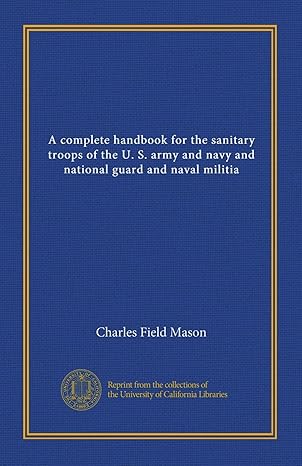 By Charles Field Mason. William Wood and Company, 1917. ISBN 978-1-0153-8973-1 (2021). No audio version.
Col. Mason (1864-1922) of the U.S. Army Medical Corps offers his fourth edition of this medical manual focused on keeping soldiers and sailors healthy, as well as their care when wounded or sick. With meticulous detail, he tells how to set up and staff field hospitals, establish sanitation for field camps, and perform casualty treatment and evacuation.
Chapters include information on anatomy, physiology, first aid, nursing, mess management and cooking, field hygiene, proper use of horse-drawn ambulances, and minor surgery. Modern field medicine has much improved, but this reveals the great efforts of medical service corps personnel to provide for the health care of personnel in camp, in the field, and at sea. Very revealing with much to be learned here.
American Merchant Seaman’s Manual: For Seamen by Seamen
 Edited by Felix M. Cornell and Allan C. Hoffman. Cornell Maritime Press, 1964. ISBN 978-0-8703-3006-3. No audio version
The sixth edition of this book is packed with all the necessary information to guide merchant seamen through their careers (circa 1964). Included are the responsibilities of a merchant seaman, whether able seamen or engineer, steward, or quartermaster. Chapters include wire splicing, cargo stowage, ground tackle, paint, small boat handling, signals, construction and stability, weather, sanitation, rules of the road, and laws of the sea.
The chapter on general information includes weights and measures, visibility at sea, mile distances, and a remarkable table of seamen’s wages. Much has changed in the merchant marine, but its fundamentals remain the same.
Weapons and Tactics of the Soviet Army
 By David C. Isby. Jane’s Publishing Company, 1981. ISBN 978-0-710-60352-4. No audio version.
This is a detailed reference volume of the old Soviet Army. The world has recently seen the Russian army’s organization, equipment, tactics, strengths and weaknesses, but Isby reveals that only the equipment and weapons have changed. He covers Soviet doctrine for the offense and defense, organization for battle, weapons – especially tanks, artillery, and nuclear, biological, and chemical (NBC) weapons – as well as electronic warfare, and command and control. A helpful glossary is supplemented by photos, diagrams, weapons characteristics, and tactical doctrine.
In the chapter “The Soviet Way of War,” Isby shows that the Soviets (and the Russians today) rely heavily on massing overwhelming manpower and firepower to be decisive factors (not surprise, maneuver, or ingenuity). An insightful read.
The Chinese War Machine: A Technical Analysis of the Strategy and Weapons of the People’s Republic of China
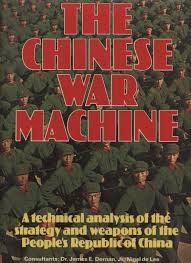 Edited by Dr. James E. Dornan Jr. and Nigel de Lee. Salamander Books, 1979. ISBN 978-0-517-26869-8. No audio version.
American and British editors and contributors have put together an interesting study of China’s military, circa 1979, featuring chapters on history, foreign policy, national interest, force organization, homeland defense, major weapons, air force modernization, naval forces, and “the perceived threat to China’s future” (in 1979, it was Russia). The best chapters are China’s ground forces, its air force, and “China’s Navy – For Coastal Defense Only.”
China’s military capabilities have improved greatly since 1979, but it is instructive to see where China was then and compare it with today’s much-improved capabilities, especially its air force and navy. Excellent historical reference.
Sunk: The Story of the Japanese Submarine Fleet, 1941-1945
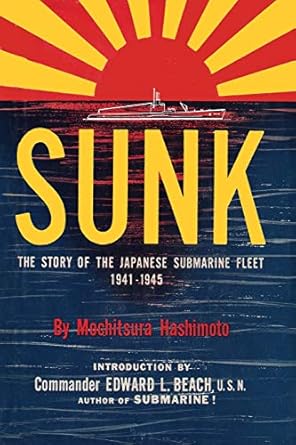 By Mochitsura Hashimoto. Henry Holt and Company, 1954. ISBN 978-1-615-77581-1 (2010). No audio version.
Commander Hashimoto was the captain of a Japanese I-type long-range submarine in the Pacific War (one of the few submarine commanders to survive), and here he tells the amazing story of a wartime submarine force doomed from the outset due to poor equipment, lack of radar, and fatal tactics.
He describes submarine operations at Midway, Guadalcanal, Truk, Saipan, Philippines, and Okinawa, even the end with the desperate employment of suicide submarines. The book gives new insight into the Japanese naval war and the role of its submarines.
Col. William D. Bushnell, USMC (Ret), is a regular contributor to MOAA.org and Military Officer magazine.
Check Out MOAA Member Books for More Great Reads!
Visit MOAA's Member Books page to see a list of recent works from MOAA members in a variety of genres.