
(This article by Hope Hodge Seck originally appeared in the October 2025 issue of Military Officer, a magazine available to all MOAA Premium and Life members who can log in to access our digital version and archive. Basic members can save on a membership upgrade and access the magazine.)
Earlier this year, four tech titans from industry-leading companies made headlines by doing something wildly unexpected: They donned Army camouflage and took the oath of service.
The executives, hailing from the companies Meta, Palantir, OpenAI, and Thinking Machines Lab, were brought into the service as lieutenant colonels in what the Army is calling the Executive Innovation Corps, also known as Detachment 201. And while the senior tech leaders in that special unit won’t ultimately spend much time in uniform — about two weeks per year — the initiative underscores a deeper trend among all the military services, in which emerging high-demand skill sets are prompting planners and recruiters to take unusual steps to woo the right candidates.
[THE LATEST IN RECRUITMENT STRATEGIES: Join Us for TotalForce+]
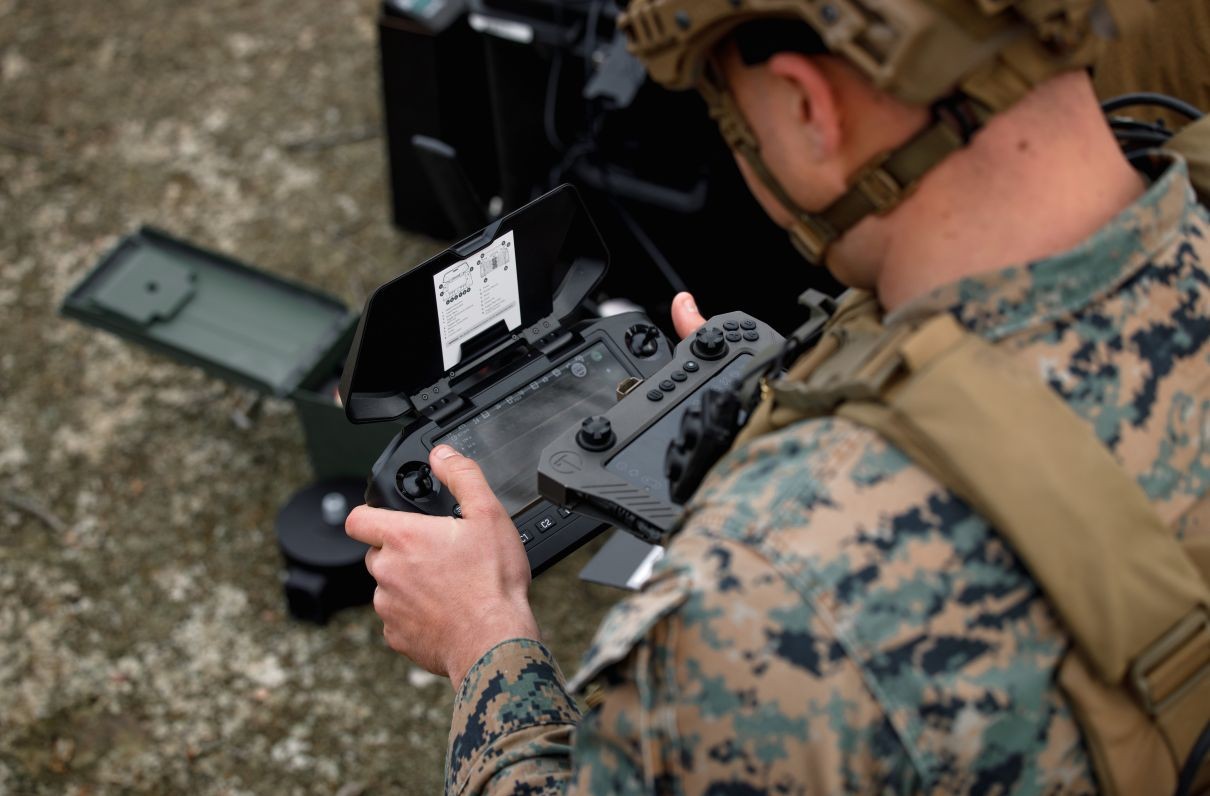
In the last five years, all the services have responded to changes, such as the increasing prevalence of small drones on the battlefield, the emergence of mature uncrewed and robotic technologies, and the world-changing realities of highly capable artificial intelligence. New job descriptions adapted to this changing world include the Navy’s robotics warfare specialist rating; the Marine Corps’ small unmanned aircraft systems operator military occupational specialty (MOS); and the Army’s recently reported AI and machine-learning MOS and career field.
While the new job fields tend to be small compared with more traditional specialties such as infantry and logistics, they can require extra effort to fit the right personnel into available roles. And, officials say, finding talent to fill increasingly high-demand fields such as cyberwarfare can pit military recruiters against civilian headhunters prepared to offer higher pay. The strategies the military is employing to meet this challenge include finding promising talent early; meeting prospective recruits on their turf by embracing technology, including gaming and virtual reality; and cultivating expertise already within the services to fill emerging roles.
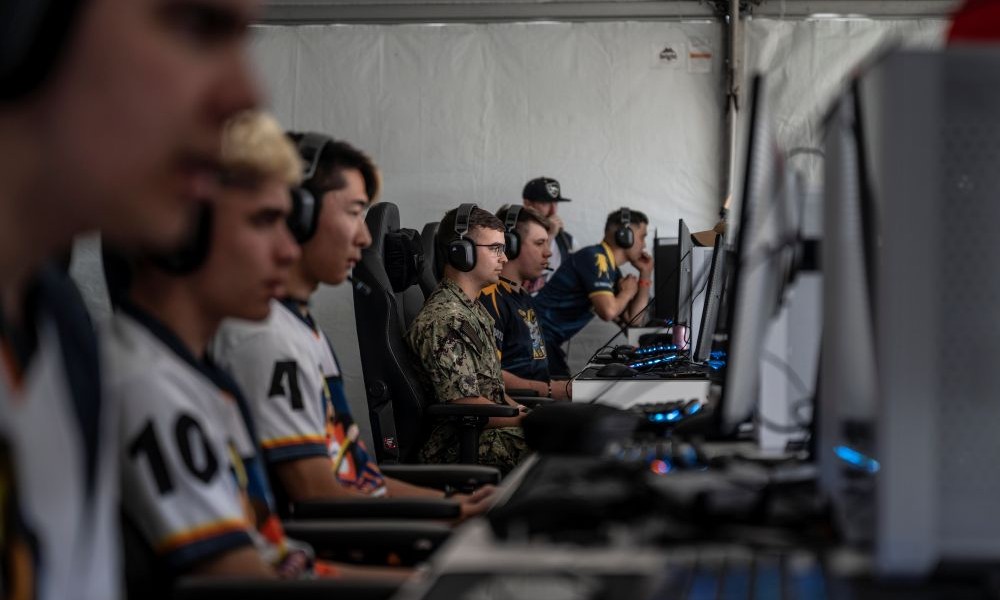
The Army was the first service to launch an competitive esports team, doing so in 2018. Other services followed suit. (Photo by Mass Communication Specialist 2nd Class Thaddeus Berry/Navy)
In the Army, a game of Halo or League of Legends can build a bridge to a young person who might have otherwise never considered a career of service. While all the services now have esports teams, the Army was first, launching its team as a public outreach initiative in late 2018.
It now has about 300 members who participate in about two dozen events every year. Capt. David Hart, the at-large program manager for Army esports, said the approach plays a role in “rehumanizing the soldier” — in other words, engaging their interests beyond the day-to-day aspects of military life.
“We’re not just ones and zeros,” he said. “We’re not just guys and gals in uniform.”
Hart, whose day job for the Army is in cyberwarfare as a cyber protection lead, said he’s passionate about his volunteer role in esports. He noted that gaming helps soldiers connect with civilians who might have a future in the force during the numerous conventions and expos in which the service participates. During those big events, he said, soldiers might interact with thousands of people, some of whom may have never otherwise shown interest in engaging with the Army.
[RELATED: Army Hits Annual Recruiting Goal Months Ahead of Schedule]
“So getting out, interacting and sharing a medium that’s a nonstandard medium that’s away from a range — away from the guns, ammunition, bullets, whatever it is, even the physical activity aspect of it, and sharing in something that is known as a pastime — it’s like breaking bread with people,” Hart said. “We’re just doing that in the digital medium.”
Finding ways to engage with young people outside of conventional recruiting platforms is in itself a future-facing skill set in light of the historic number of youths who Pentagon surveys show have no familiarity with the military or interest in serving. But Hart said gaming can also hone capabilities the Army needs.
He pointed to actions per minute, a metric connected to certain competitive games. It refers to a player’s speed, which can contribute to their success in gaming and beyond.
“That absolutely transitions straight into cyber or any other clerical-based job where you’re going to be on a keyboard a lot,” he said. “If I have soldiers that can type well, type quickly, and they can type effectively and efficiently, then we’re going to be able to get more work done — whether it be through a cyber operation, whether it’s defensive or offensive, whether it be through processing paperwork at a higher level ... understanding menuing, understanding clicking fast, understanding actions on the actual keyboard. … You’re going to see those people prosper in those jobs.”
While the Army doesn’t have a way to track everyone who came to the service through esports, officials said they’re aware of multiple people who started gaming with the Army as civilians and now continue as soldiers.
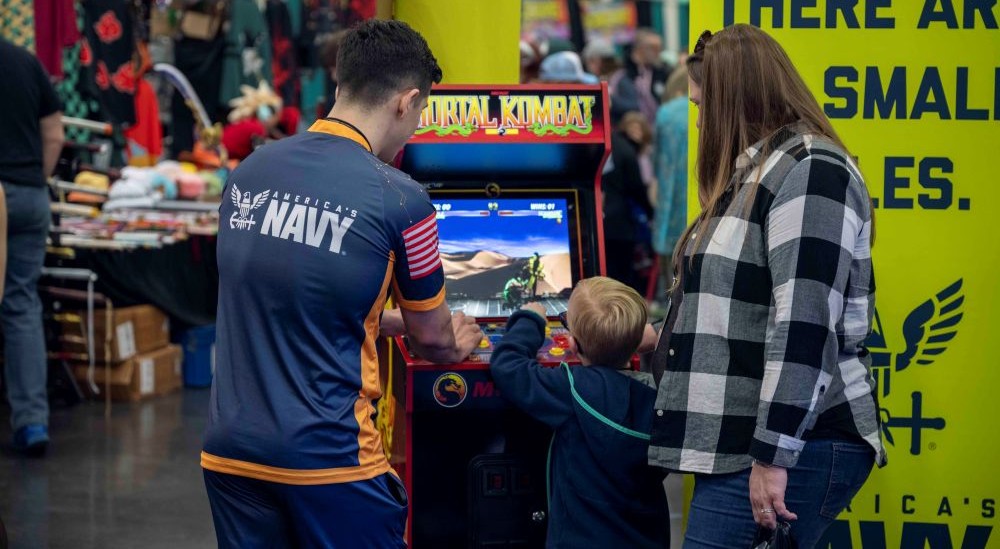
Photo by Mass Communication Specialist 2nd Class Tyler Priestly/Navy
For the Navy, virtual reality and artificial intelligence are giving young people the opportunity to experience the service in new dimensions. The “Strike Group” experience, a recruiting tool that debuted in December 2024 at the Army-Navy football game, places prospective future recruits at the helm of some of the Navy’s most exciting and dynamic missions, with the help of an Oculus headset. Seven different virtual reality experiences range from landing on an aircraft carrier as “Skittles” — the crew members in bright turtlenecks — hustle around the flight deck; to piloting a submarine through the chilly Bering Strait and breaking the ice as you surface.
“We worked with our strategy team to think about the things that would resonate with the Gen Z and Gen Alpha audience because obviously now we’re looking at those audiences,” said Heidi Larochelle, an executive at VML, the company that created “Strike Group” for the Navy. Those two generations — born starting around 1997 and 2010, respectively — refer to the service’s current recruiting prospects.
She said the “pillars” that resonate include the “breadth and depth of careers and how the opportunities are boundless; creative innovation, like how we are in an environment that is leading the edge with technology; and then inclusive teamwork, showing that camaraderie among sailors, and how that might come to life.”
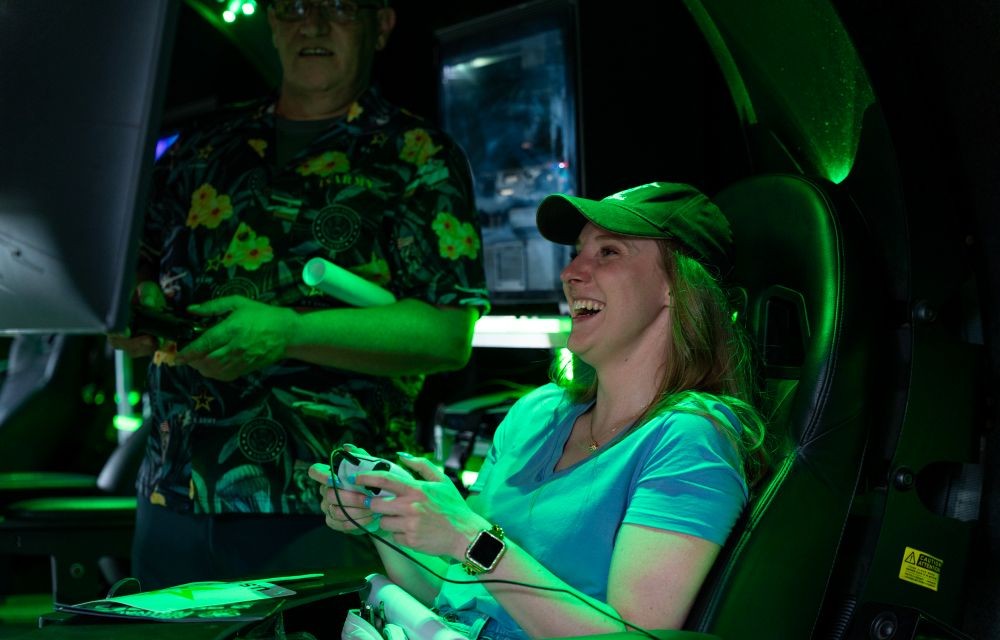
An esports exhibit vehicle was part of Army 250th birthday celebration events in Washington, D.C., on June 14. (Photo by Sgt. Lauren Gajeton/Army)
The AI-powered career selector experience allows users to create an avatar that looks like them so they can picture themselves in the Navy while answering questions to determine the career that might be their best fit.
“Seeing their faces on the [avatars], they get excited: ‘Oh yeah, I could be a crypto tech, I could be IT, or I could be any type of different type of ratings,’” said Chief Petty Officer Horace Henry, community manager for the Navy’s recruiting outreach office. “At the end of the day, the generation is changing. Technology is changing. The Navy has definitely changed as well.”
While the “Strike Group” experience primarily focuses on high schoolers, the services are increasingly aiming to reach promising talent well before it’s time they enter the workforce. For Joy Champion, engineering competency manager at Marine Corps Systems Command, this mission is personal. She recalls a sixth grade career day in which a presenter informed the class that those who were skilled in science and math might find well-paying careers as engineers.
“That day, I knew I wanted to be an engineer later in life,” she said. “So I know from personal impact how catching the interest ... of students at that middle school level can make an impact to their career choice.”
The command’s STEM Outreach Initiative aims to provide that moment of discovery to students near Quantico, Va., with single-day events at local K-12 schools focused on science, technology, engineering and math; and an annual three-day camp for students in grades six through nine. Recent camp themes included robotics and the SeaPerch remotely operated vehicle challenge. Champion said Students who encountered the program in grade school have returned as college mentors. Some, she added, have gone on to fill civilian engineering roles within Marine Corps Systems Command.
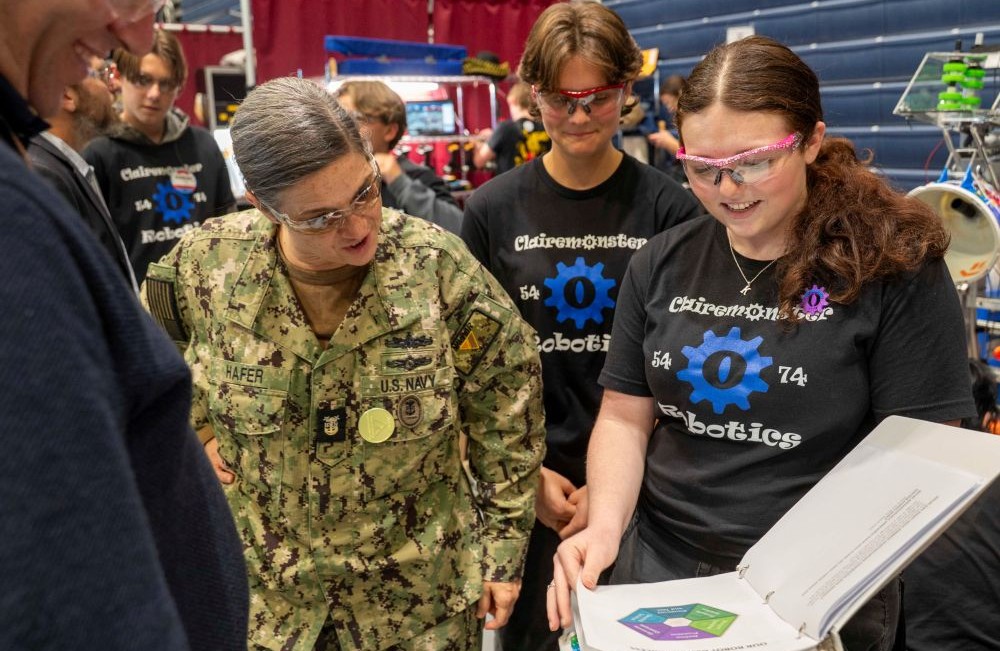
Sailors and students connected at the 2025 San Diego Regional FIRST Robotics Competition at the University of California-San Diego in March. (Naval Information Warfare Systems Command photo)
“The needs of the military are continuously evolving, and we have to stay abreast, we have to stay current,” Champion said. “Those new and novel and fresh ideas, they’re going to come from fresh minds. And so fostering that is of the utmost importance.”
Other recently launched Marine Corps initiatives aimed at capturing high-demand skill sets include the talent acquisition program, which lets recruits for high-demand cyber and signals fields enter service at a higher rank after completing boot camp; and the attack drone team, which brings together operators of small aerial drones to participate in a series of regional competitions. These events demonstrate operator proficiency and will culminate in an April 2026 championship that may result in follow-on job assignments for some Marines.
“This performance-based approach ensures the most capable and lethal [first-person view drone] operators are developed to support the Fleet Marine Force,” according to Maj. Hector Infante, a spokesman for Marine Corps Training and Education Command.
Like the Army’s Executive Innovation Corps, the Air Force is aiming to capture more mature expertise in cyberwarfare through its Cyber Direct Commissioning Program. Since its establishment by congressional mandate in 2018, about 50 hand-selected officers have commissioned into cyber fields at ranks ranging from captain to colonel, said Col. Justin Ellsworth, head of the Air Force’s cyber management division.
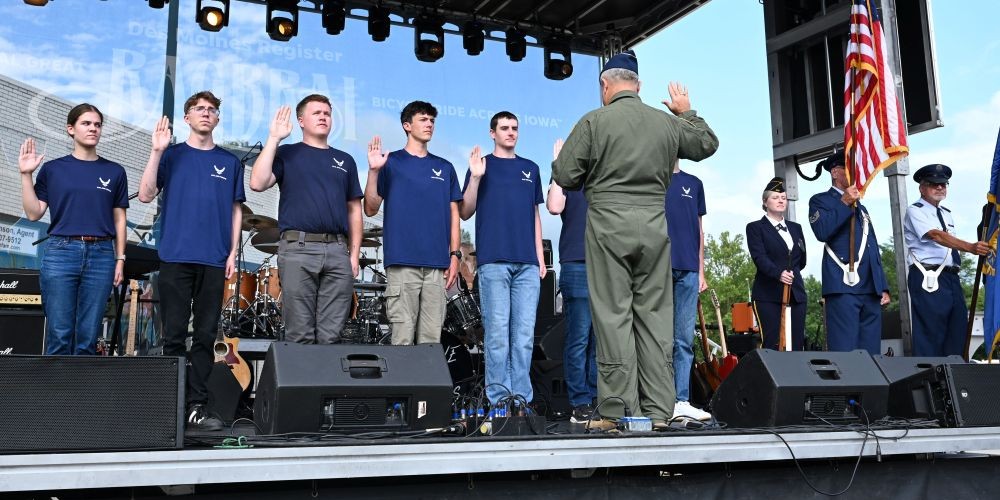
Air Force recruits recite the oath of enlistment during an event in Orange City, Iowa, on July 19. (Photo by Staff Sgt. Jessica Montano/Air Force)
But in the last 18 months, Ellsworth said, program leaders have worked to fine-tune the program, becoming more deliberate in how they target cyber-savvy prospects and where they place the recruits to maximize the benefits for the force.
“Sometimes we bring folks in, but we don’t always give them the authority to really get after some of the problems that we have,” Ellsworth said, adding that he’s closely tracking the Army’s initiative for lessons learned. “That was kind of our goal on the Air Force side: How do I bring someone in that has a certain background? And [how do] I pair them up in the area where we’re having a challenge?”
That careful placement and partnership is already starting to happen, Ellsworth said. He cited an incoming direct-commissioning accession who’s bringing 13 years of cloud experience to the Air Force. After Officer Training School, Ellsworth added, this new officer will be sent to Platform One, the service’s software delivery and cloud-computing powerhouse, to immediately use the person’s specialized knowledge.
Another recent commission, he said, will bring additional expertise to Kessel Run, the service’s Boston-based software factory. Though Ellsworth said he wants “headhunters” to find promising talent for direct commissioning, he still substantially relies on word of mouth.
“We’ll never meet pay parity with the private sector; I think we understand that,” Ellsworth said. “[But] you cannot do what our airmen do anywhere else within the private sector … seeing that mission impact and that sense of duty, that sense of purpose — that’s probably the biggest tool we can use to tell that story.”
Until the recruiting boom that began at the end of 2024, nearly all the services were hard-pressed to make recruiting goals under any circumstances, limiting their ability to be selective. However, that’s not the case for the Space Force. The youngest of the services, the Space Force is also the smallest by far, with fewer than 10,000 active duty personnel.
[FROM SPACEFORCE.MIL: Air and Space Force Exceed Annual Recruiting Goals]
It has no ground troops nor aviators, selecting instead for a small set of job fields including cyber, intelligence, engineering and acquisitions. Seeking that specialized talent was built into recruiting operations from the start. Lt. Col. Jason Cano, recruiter branch chief for the Space Force, said his team of about a dozen people are known as “talent scouts,” underscoring their mission to find the right individuals to fill available jobs. They network with NASA, appearing at places like the Moon 2 Mars Festival, and show up at events like the American Rocketry Challenge finals and FIRST Robotics Competition events.
Cano noted the Space Force has mid-career, direct-commissioned civilians with sought-after experience, much like the Air Force and Army. And now, he said, with more Space Force prospects than available roles, the service wants to fine-tune its scouting and recruiting system. He doesn’t have a complete idea of what the new recruiting and selection model will look like, but he told Military Officer earlier this year that Space Force recruiters were planning to sit down with talent scouts from the Washington Nationals baseball team in September 2025, and at some point huddle with staff in a “highly selective unit” from Cano’s prior work in special operations.
Between learning best practices to screen for future success and understanding what baseball scouting tricks and data metrics are relevant to the Space Force, Cano wants to make the most of the current wave of interest the service is enjoying.
“We’re the silver dollar out there, and it’s shiny,” Cano said, “and people want to talk to us.”
Hope Hodge Seck is a writer based in the Washington, D.C., area.
Military Officer Magazine
Discover more interesting stories in MOAA's award-winning magazine.