
By MOAA Staff
Lawmakers have the opportunity to provide sorely needed support for veteran caregivers, protect service-earned benefits from for-profit “claim sharks,” and shore up critical transition-assistance programs for those leaving service by passing three bipartisan bills already moving through Congress, MOAA’s president and CEO told a joint committee hearing Feb. 24 on Capitol Hill.
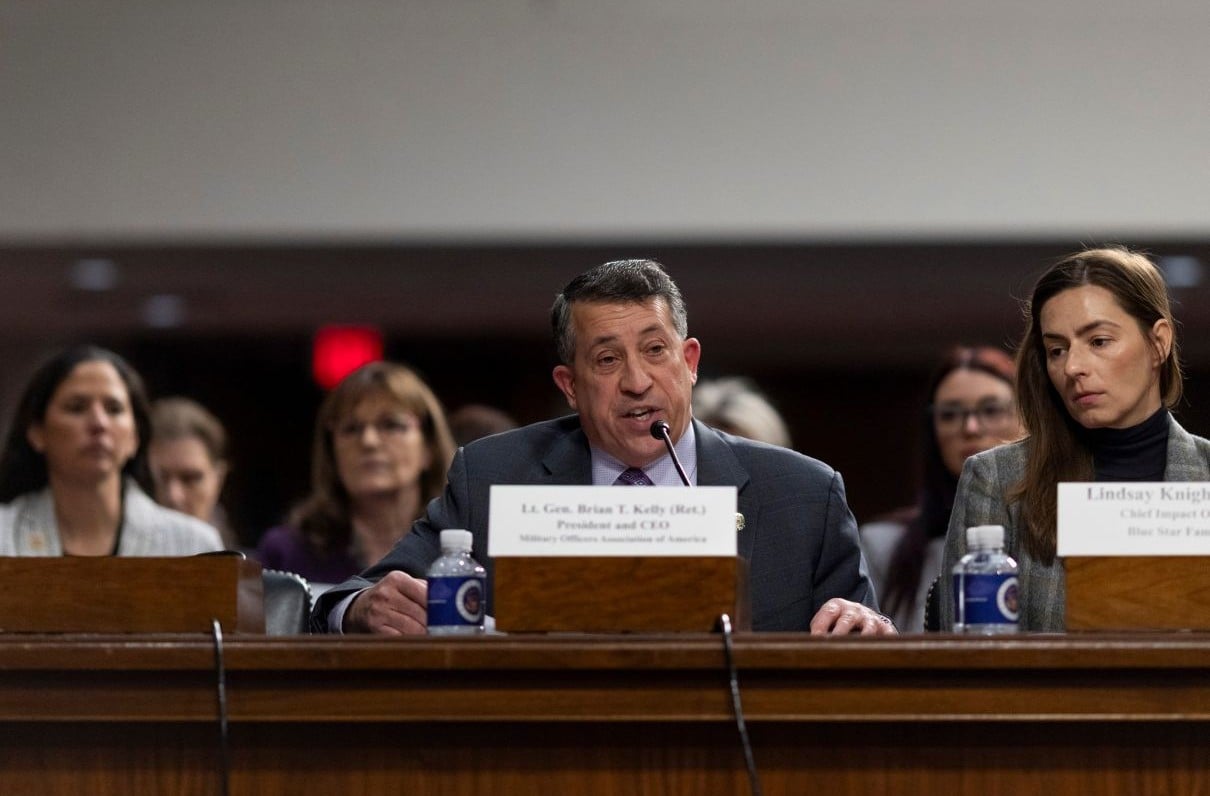
Lt. Gen. Brian T. Kelly, USAF (Ret), testified alongside fellow veterans advocates before House and Senate Veterans’ Affairs Committee members in Washington, D.C., using his remarks to stress the importance of three bills on MOAA’s priority list:
- The Veteran Caregiver Reeducation, Reemployment, and Retirement Act, which offers financial guidance along with career and retirement support that “helps family members avoid choosing between caring for a veteran and securing their own future,” Kelly told lawmakers.
- The Governing Unaccredited Representatives Defrauding (GUARD) VA Benefits Act, which provides tools to stop unregulated companies from charging veterans for help with disability claims and “restores accountability without restricting access to lawful, accredited assistance,” Kelly said.
- The TAP Promotion Act, which allows groups like MOAA to play a more important role in the transition process and “ensures servicemembers and their family members receive timely, accurate information before separation, not after problems arise,” Kelly said. Understanding trusted sources of this information allows veterans to find “the right places to follow up to make sure they can get access to all their benefits,” the CEO added in response to a question from Rep. Nancy Mace (R-S.C.), who chaired the hearing.
[MORE DETAILS: MOAA’s Written Testimony to Congress]
Kelly linked the need for streamlined provision of service-earned veterans benefits with the strength of the all-volunteer force, noting MOAA’s work on behalf of those in and out of uniform, including the development of the people-focused TotalForce+ event.
“From first salute to final honors, how we care for those who serve and those who stand beside them directly impacts who is willing to serve next,” Kelly said.
VA Rule Reversal
Kelly joined representatives from six other veteran advocacy groups – Blue Star Families, Vietnam Veterans of America, National Congress of American Indians, Service Women’s Action Network, Gold Star Wives of America, and Black Veterans Project – on the day’s second panel. Representatives from Disabled American Veterans (DAV) spoke to lawmakers during the first, which covered legislative issues as well as the VA’s recent rule change – and subsequent reversal – regarding the effect of medication on the disability ratings process.
[RELATED: VA Must Rescind, Not Just ‘Halt,’ New Rule on Disability Ratings]
After opposition lodged by veterans and advocates, VA Secretary Doug Collins announced the department would not enforce the Feb. 17 regulation – a rule he said only served to “clarify existing policy” in the wake of recent court rulings. Advocates have said the rule could have unintended consequences, such as encouraging veterans to skip medication prior to evaluations, reducing benefits for those able to control certain conditions via medication, and neglecting second- and third-order effects caused by a medication’s side effects.
MOAA and other groups also raised concerns that the rule was implemented without the customary notice-and-comment process and without VA officials discussing the regulation with veterans associations.
“Transparency in terms of consulting us, giving us information, we think would’ve provided the secretary and the VA with information that may have adjusted the outcome” of the rule issue, Kelly said on behalf of the panelists in response to a question by Sen. Tammy Duckworth (D-Ill.). “This group of people has information to provide and should be consulted.”
[RELATED: Breaking Down the Disability Compensation Process]
The rule had received more than 19,000 comments at the Federal Register website as of Feb. 24.
“We’re pleased Secretary Collins listened to veterans and announced that the VA would not be implementing the rule,” Coleman Nee, DAV national commander, told the committee. “No veteran should be penalized for taking the medication they need to survive.”
For the latest information on these and other MOAA priorities, and to reach out to your lawmakers to voice support for this legislation and other MOAA-backed initiatives, register at our Legislative Action Center.
When MOAA Speaks, Congress Listens
Learn more about MOAA’s key advocacy issues, and contact your elected officials using our messaging platform.