
(This article by Hope Hodge Seck originally appeared in the August 2026 issue of Military Officer magazine.)
For the Air Force, the work of teaming humans and drones will unfold at altitude.
It’s a critical year for the service’s Collaborative Combat Aircraft (CCA) program, meant to pair jet-powered aerial drones with the service’s most advanced crewed fighter jets. The Air Force has said it ultimately wants 1,000 CCAs as part of the manned-unmanned teaming effort.
[RELATED: The Dawn of the Drone Wars]
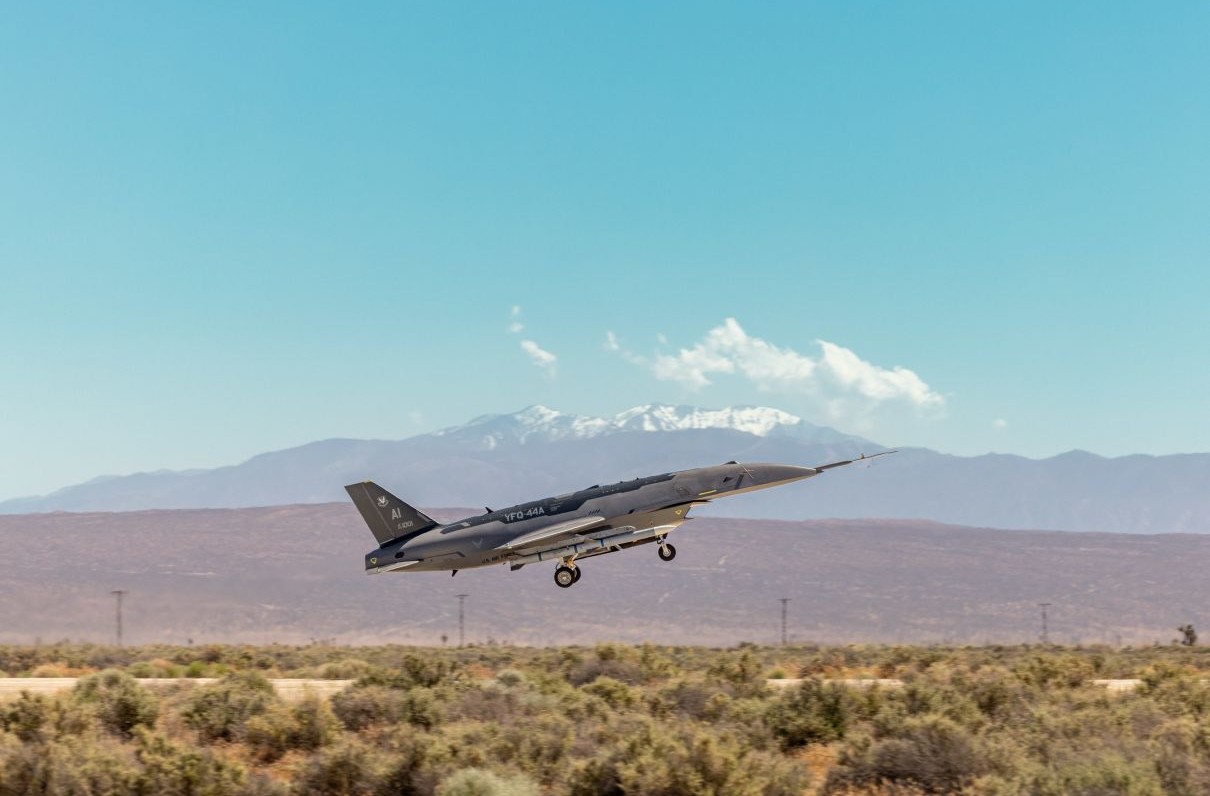
On June 16, the service announced it chose General Atomics to produce the FQ-42 based on the firm’s YFQ-42A prototype, and chose Anduril to produce the FQ-44 based on the company’s YFQ-44A prototype. Officials say they want to begin fielding before the 2030s.
A month earlier, the program had reached a major milestone when General Atomics announced it had paired an F-35 jet with the firm’s MQ-20 drone, using a low-Earth orbit data link to enable the former to control the latter. A similar test took place last year involving the service’s other fifth-generation fighter, the F-22 Raptor.
While CCAs, at roughly one-third the cost of traditional fighter aircraft, could help the Air Force do more with its heavily tasked aircraft fleet, they could also be used to confuse or overwhelm enemy forces by appearing in swarms or flanking crewed jets.
[RELATED: Readiness in Focus for Senior Enlisted Leaders at MOAA Forum]
At a panel discussion this year, Col. Timothy Helfrich, the Air Force’s portfolio acquisition executive for fighters and advanced aircraft, said CCAs will be more agile and adaptable than conventional fighters.
“They will not have to take off and land from the same places that our manned aircraft [do],” he explained. “We will have max flexibility to employ these weapon systems however the combatant commander needs.”
Helfrich added that he had already observed how working with the drone wingmen had helped aviators overcome reservations and embrace the capabilities of the new technology.
“At first, when we first brought pilots in, they wanted every bit of information, and they wanted to control every minute thing that the CCA was doing,” he said. “And as they got more comfortable, they’re like: ‘Nah, I don’t need to see that.’”
[FROM THE MAGAZINE: Teaming Up With AI]
The Air Force also announced June 16 the defense contractors set to work on CCA software.
“Additionally, the Air Force has competitively awarded production options to Anduril, RTX Collins Aerospace, and Shield AI, to accelerate the delivery of critical mission autonomy software,” the service said, adding the contract award will “fund the first of two six-month competitive phases designed to speed the fielding of operational software to the warfighter.”
The Air Force has requested $1.4 billion for the CCA program in its FY 2027 budget, allocated to the research, development, test, and evaluation fund, plus $1.1 billion to purchase the drones.
Hope Hodge Seck is a writer in Massachusetts.
Military Officer Magazine
Discover more interesting stories in MOAA's award-winning magazine.