
(This article by freelance writer Hope Hodge Seck originally appeared in the August 2026 issue of Military Officer magazine.)
The Pentagon has recently requested $53.6 billion for its “drone dominance” initiative, aimed at purchasing unmanned systems and boosting their domestic production in FY 2027. In addition, the department asked for $20.6 billion to counter adversaries’ drone technology. But having the systems in stock is half the battle; training warfighters on how to use them is the other half.
Already, tens of thousands of small attack drones, loitering munitions, and counter-drone weapons are making their way to Army and Marine Corps ground units. These soldiers and Marines understand the technology will feature prominently in the next big fight and might even determine tactical advantage.
Even as they train, decision-makers are working out how to employ and assign the new tech, which comes with a heavy complement of batteries and spares, and then determine which of the available systems are worthy to remain in the services’ arsenals for the long term.
Secretary of War Pete Hegseth first announced the drone dominance effort last year. An initial $1.1 billion was allocated for the purchase of about 300,000 small attack drones by the end of 2027, per the Army, and to train “senior officers to overcome bureaucratic risk-aversion culture in drone procurement and training,” according to the Pentagon.
[RELATED: Air Force Puts Afterburners on Drone Wingman Development]
Indeed, the initiative has helped accelerate ongoing drone acquisition programs, Marine Corps Col. Jeremie Hester told Military Officer. An AH-1 Cobra helicopter pilot by trade, Hester leads the Corps’ aviation combat element for the Combat Development Directorate.
“We were moving in that direction,” he said in regard to bolstering the military’s drone inventory. “Now we’re getting more funding. Now we’re getting assets to really just help us move faster.”
Shortly after the Pentagon announced the drone dominance program, Hester began, as he put it, “moonlighting” as head of the Marine Corps’ newly minted Drone Dominance Task Force, charged with sorting out the thorniest problems for employing small drones and counter-drone weapons.
Among those issues are the development of a handbook of best practices for using the technology; a list identifying acceptable drones for purchase; and signature management training to help troops avoid detection from adversarial drones.
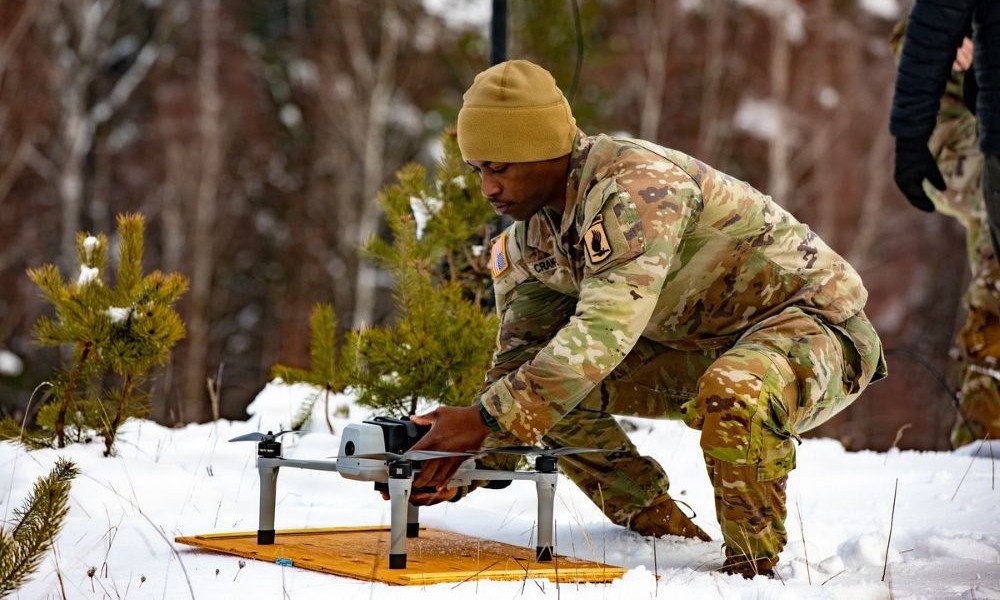
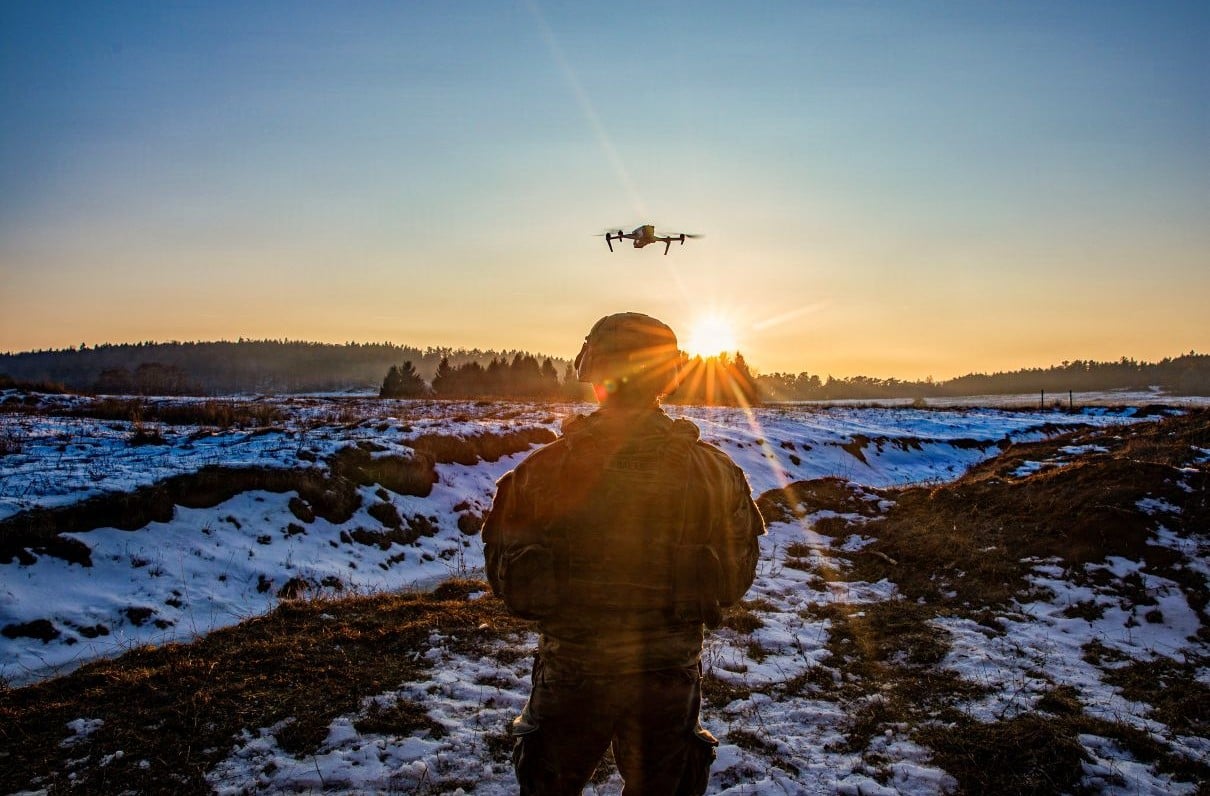
An American soldier prepares for a familiarization flight using a variant of the Bumblebee quadcopter as part of an exercise in Grafenwoehr Training Area, Germany, on Jan. 28. (Photo by Spc. Adrian Greenwood/Army)
Hester dates the Corps’ interest in developing surveillance and beyond-line-of-sight attack capabilities to counterinsurgency operations in Iraq in the early 2000s, well before the service got its first eye-in-the-sky drones. The Russia-Ukraine war, featuring both sides’ canny use of unmanned platforms to cripple or destroy exquisite legacy systems, has pushed drone skeptics to get on board.
“It’s the level of asymmetry that drone technology has brought,” Hester said. “If you look at what Ukraine did … they’re flying these attack drones, they’re giving them 150-kilometer legs and dropping them from weather balloons, right?
“So I think that was recognized by our service,” he added, “and it wasn’t received with open arms initially, but people started seeing the light.”
The Corps’ vision, as articulated by leaders including the head of Training and Education Command, Lt. Gen. Benjamin Watson, is to see every Marine as a competent small-drone operator capable of making a kill shot at 500 meters, similar to how the service has long called every Marine a rifleman.
And the Marine Corps is well on its way: As of the end of May, Hester said, every infantry battalion in the service had received 80 to 90 Neros Archer first-person-view attack drones. Each quadcopter can carry a 4.5-pound lethal payload and, given its reportedly low cost, get lost or destroyed without causing too much heartburn.
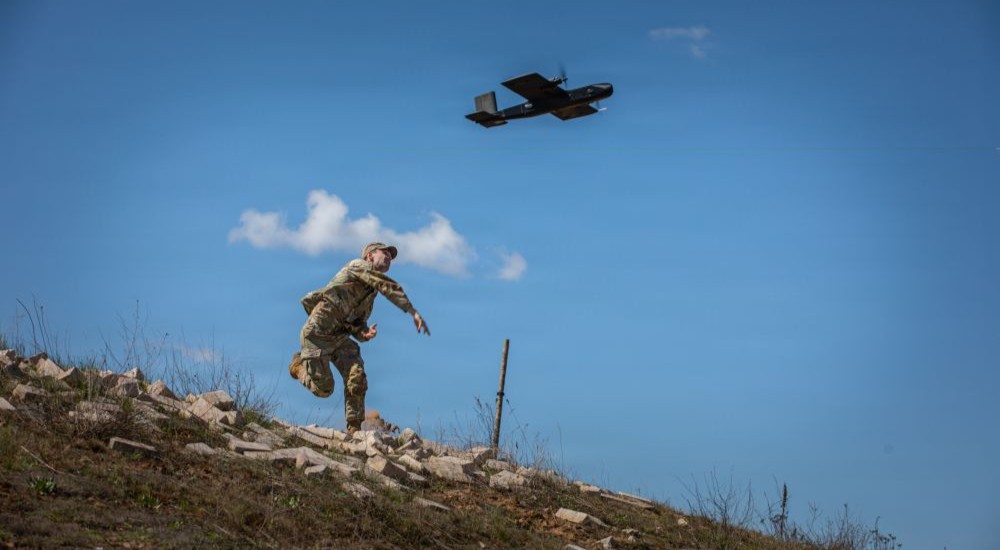
An American soldier launches a Peregrine one-way attack drone during Project Flytrap at Pabradė Training Area, Lithuania, on May 15. This type of expendable system strikes pre-programmed coordinates. (Photo by Sgt. Max Elliott/Army)
Hitting the Books
Meanwhile, another program is delivering a different kind of drone capability to the same ground units. Organic Precision Fires-Light (OPF-L) is now sending three different kinds of loitering munitions — drones that crash into targets and explode upon impact — to two West Coast-based infantry battalions as an early proof of concept before distributing them Corps-wide.
The Department of the Navy is requesting nearly $99 million to buy OPF-L systems in FY 2027. One budget document says the funds would “provide operational and engagement options for the employing units, inert rounds for new system operator training, annual training, and Fleet exercises, and ancillary equipment for fielding to additional battalions beginning in late 2027 based on production lead times.” The document specifically cites Teledyne’s Rogue 1 and Anduril’s Bolt systems as notable options.
So far, multiphase evaluations in which grunts were “left to their own devices” to stress test the technology have been successful, said Travis Bowden, the Corps’ capabilities integration officer for precision fires.
Like attack drones, OPF-L loitering munitions are light enough to carry and are considered attritable — meaning their cost justifies their expendability.
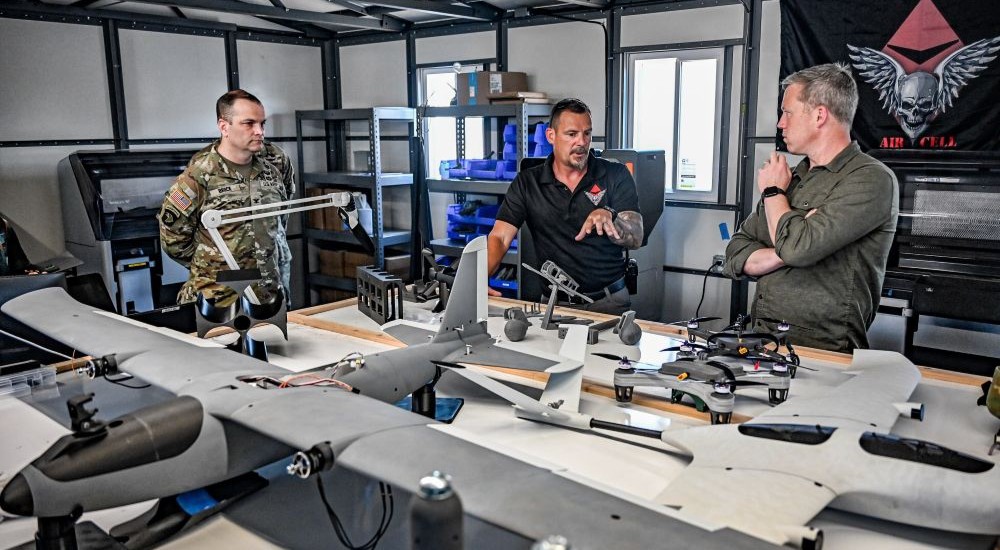
Army Secretary Dan Driscoll, right, receives a briefing on 3D-printing capabilities while visiting the Joint Counter-Small Unmanned Aircraft Systems University at Fort Sill, Okla., in July 2025. (Photo by Sgt. David Resnick/Army)
However, they function more like autonomous missiles, as they can wait for extended periods at a programmed location before hurtling toward an identified target. In the early days of the Iran war, loitering munitions made headlines when the Pentagon acknowledged it attacked Iran with the weapon type reverse-engineered from the Iranian Shahed-136 drone.
Layered together, the first-person-view (FPV) attack drones and the loitering munitions make for a powerful force capable of identifying and targeting the enemy at both close range and at distances of 10 miles or more. The combination also adds significant cognitive load to rifle squadrons and platoons in the form of technical operations, logistics, and radio-frequency spectrum management, among other skills.
While Army and Marine Corps basic training courses on the systems are at least a week long, officials have said basic operational understanding can be achieved in a few hours. But Army veteran Jake Steckler questions the effectiveness of that timeline.
Steckler is a former AH-64 Apache helicopter pilot who observed drone operations in Ukraine while volunteering with front-line organizations there. In an article published on the analysis and op-ed site War on the Rocks, he noted that Ukraine’s military places special emphasis on the development of drone operators’ skills.
“Ukraine has over 30 schools and centers training drone operators, with the head of one school calling it ‘impossible’ to teach certain skills in as short as a month,” Steckler wrote. “Meanwhile, the Army’s Unmanned Advanced Lethality Course is only three weeks long, and its class size last August was just 28 soldiers.”
[RELATED: MOAA Member Assisting With Training, Growing EOD Teams in Ukraine]
Bowden partly acknowledged the validity of this school of thought.
“Here’s a 20-year-old lance corporal just out of high school [or] boot camp, and we’re asking them to do all the things that a Marine Corps rifleman does, and learn and master those skills, and then we’re going to give them this flying robot bomb and say: ‘Hey, just go for it, bro,’” he said. “That’s not always a recipe for success.”
Still, he added, the early rollout of the systems showed Marines were game for the challenge, finding the controller interfaces intuitive and the workload manageable.
“That was good to see, that the time and the money we invested into making these systems easy to use has kind of paid off,” he said.
Army Lt. Col. Wolf Amacker, who leads the Unmanned Aircraft Systems and Tactics Branch at the Army’s Aviation Center of Excellence and helped last year create the service’s three-week advanced lethality drone course, said he sees benefits to the tight timeline of training. The short window to complete the course and the drills involved in the training replicate real-world pressures drone operators will face.
“[B]ecause that time is so truncated and so shortened that they have to get the reps in, it is more beneficial than if we extended that course out and gave them longer periods of time to actually do the planning,” Amacker said.
Ever since the course kicked off in September, three classes of students graduated, with between 20 and 28 soldiers in each.
[RELATED: More Recommended Reads From MOAA]
Deliberate Redundancy
The Army’s journey to acquire and field small drones has mirrored the Marine Corps’ in many ways; they’ve even made separate purchases of some of the same systems, such as the Archer and Rogue 1.
The Army’s loitering munitions acquisition program, known as Low Altitude Stalking and Strike Ordnance, trails the Marine Corps’ OPF-L fielding timeline. But the Army’s FPV fielding goals are aggressive, with Secretary Daniel Driscoll last year announcing the service plans to buy a million attack drones by 2028 — more than two for every active duty soldier now serving.
Both services are also buying a range of makes and models that perform the way they want, rather than selecting a single design that meets precise specifications — an approach they historically took for everything from aircraft to rifles. This is reflective of Hegseth’s acceleration push toward dominating future drone wars. It also gives the services the opportunity to discard systems and add more without losing momentum, Bowden noted.
“If we’re trying to move fast, you don’t want to tie the rope to a single horse, right? So if something happens and that thing falls out, you want to have multiple vendors to fall back on to ensure that you find something that works,” he said. “It also spurs some competition with all those vendors, too, and kind of keeps that whole ecosystem alive.”
[FROM THE MAGAZINE: Teaming Up With AI]
Amacker said the Army has taken a page from the Ukrainian military on how best to conduct small drone operations. For the advanced lethality course’s central event, instructors form students into four-person teams comprising an FPV operator, a navigator, a medium-range reconnaissance operator, and an engineer tasked with designing and building strike packages. Students are briefed on their mission and given a strike list of targets, then offered their choice of any small drone model and payloads for which they’ve so far received training.
With their equipment secured, the soldiers virtually play out their planned mission in a simulator.
Afterward, Amacker added, they’re given the chance to execute the mission live on a range complex, where they must maneuver into a protected position and then complete the strike. If they take too long, he said, instructors will add hostile drones to the mix.
Soldiers are graded not only on whether they successfully strike the target, he said, but also on how well they camouflaged themselves from enemy surveillance; their selection of an operating position; and their choice of platform and payload.
He also stressed that drones will remain just one component of an infantry unit’s battlefield responsibilities.
“Just because we had mounted cavalry didn’t mean the infantry went away,” he said. “So we’re trying to augment it and make that balance and come together, so that again we can be a maneuver force that has all the right capabilities to win the next conflict.”
Playing Keep Up
Likewise, offensive drones are not the only — or even most significant — capability joining the ground arsenal.
“For every minute I think about solving an offensive drone problem, I spend five or six minutes trying to figure out how to counter that offensive drone and what the adversary would do with that offensive drone,” said Hester, head of the Marine Corps’ aviation combat element.
[RELATED: Readiness in Focus for Senior Enlisted Leaders at MOAA Forum]
In August 2025, the Pentagon launched Joint Interagency Task Force 401 (JIATF 401), an Army-led unit tasked with working to “better align authorities” to quickly deliver to the armed services weapons capable of defeating small drones.
The arsenal of technologies under development for this purpose includes kinetic weapons that can be carried by troops or mounted on vehicles, electronic warfare tools that spoof or disrupt radio-frequency signals, and energy weapons such as high-powered microwaves and lasers.
In its early months, JIATF 401 worked to deploy millions of dollars’ worth of counter-drone tech to the U.S.-Mexico border and to identify regulations and hurdles that hindered domestic base commanders from employing effective drone defense.
The task force also inked a $5.2 million contract with Perennial Autonomy for Bumblebee V2, an FPV quadcopter that destroys hostile drones via “drone-on-drone collision,” according to the Army. The service said Bumblebee will undergo an operational assessment before heading to ground forces.
More recently, the Pentagon announced May 18 it awarded Perennial Autonomy a contract with a $500 million ceiling, under which the company would provide “a range of artificial intelligence-enabled counter-UAS,” including Bumblebee quadcopters.
“The Bumblebee is a remarkable tool, and for the first time ever, we will be able to give our troops a dual-purpose, low-cost attritable ISR [intelligence, surveillance, and reconnaissance] platform designed to be used at the tactical edge,” Brig. Gen. Matthew Ross, the commander of JIATF 401, told Military Officer in a statement.
“There is no 100% solution to counter every drone — a silver bullet doesn’t exist. What we need is a layered defense: awareness, different capabilities, and an ecosystem that works together so that we can defeat threats consistently.”
With the addition of each of these weapons comes more training. The Marine Corps rolled out a counter-drone training element for its pre-deployment exercise this spring, and leaders have discussed developing a counter-drone schoolhouse.
JIATF 401, which oversees the Joint Counter- Small Unmanned Aircraft Systems University at Fort Sill, Okla., is seeking an updated doctrine and a new training road map to be put in place by October, said Sgt. Maj. Kellen Rowley, senior enlisted advisor to the task force.
Rowley, who also oversees the development of Bumblebee, said he continually feels tension between the process of updating doctrine and keeping up with a constantly changing battlefield.
“There’s never going to be a day where we like to spike the football and say: ‘That’s it, we’ve reached the doctrinal solution, we’re done,’” he said.
“We don’t want to have half-baked solutions to problems, but there’s a middle where we have to move quickly, and we have to adapt with [tactics, techniques, and procedures]. So a lot of what we train and a lot of what we do doesn’t necessarily nest in with formal doctrine, but we just have to change at the speed of need.”
Military Officer Magazine
Discover more interesting stories in MOAA’s award-winning magazine.