By Capt. Edward Lundquist, USN (Ret)
Retired Air Force Col. Mike Brazelton didn’t have a typical career. He joined the Air Force in 1964 and got the job he wanted — flying jets. He deployed to Southeast Asia with the 357th Tactical Fighter Squadron flying Republic F-105 Thunderchief fighter-bombers from Takhli Royal Thai Air Force Base in Thailand. He had reached a point in that tour of duty that he was still one of the more junior pilots but had more combat missions than most of his squadron mates.
On Aug. 7, 1966, while flying his 111th combat mission of the war, then-1st Lt. Brazelton was shot down over North Vietnam and captured. He remained a prisoner until the POWs were repatriated in 1973.
He recently returned to Vietnam with a delegation from Mission: POW-MIA, representing family members of missing servicemembers still unaccounted for from the war.
[RELATED: MOAA Members Produce Vietnam Film]
The delegation met with U.S. Embassy personnel, leadership of the Defense POW/MIA Accounting Agency (DPAA) Detachment 2 in Hanoi, Vietnamese government officials, and DNA identification labs.
“We were privileged to visit a joint field activity and participate in the excavation of a crash site for an aircraft lost in March of 1968 near the city of Dong Hoi in Quang Binh province, conducted by DPAA in partnership with the Vietnam Office for Seeking Missing Persons (VNOSMP),” he said.
The team used modern excavating equipment and old-fashioned manual labor — with DPAA and VNOSMP personnel, military volunteers, and 45 people contracted locally.
“During our brief visit, we were able to help, carrying dirt by the bucketful, and screening the material,” Brazelton said.
If remains or artifacts are recovered, they will be brought to the DPAA laboratory at Joint Base Pearl Harbor-Hickam in Hawaii, where forensic experts and the Armed Forces DNA Identification Laboratory personnel work to identify the fallen servicemember and return them to their families.
During the two-week trip, Brazelton learned about Vietnam’s efforts to find and identify its own missing servicemembers.
[MOAA PRESENTS: Vietnam Unchronicled]
The itinerary included several battle sites where the search continues for mass graves of Vietnamese soldiers who died in those attacks, as well as cemeteries of fallen soldiers.
The delegation spent several days traveling with a team from Texas Tech University, which is part of the Vietnam Wartime Accounting Initiative and a partner of Mission: POW-MIA. They focus on researching and recovering missing Vietnamese personnel from the war, using archival collections and their collection of 2.7 million pages of documents.
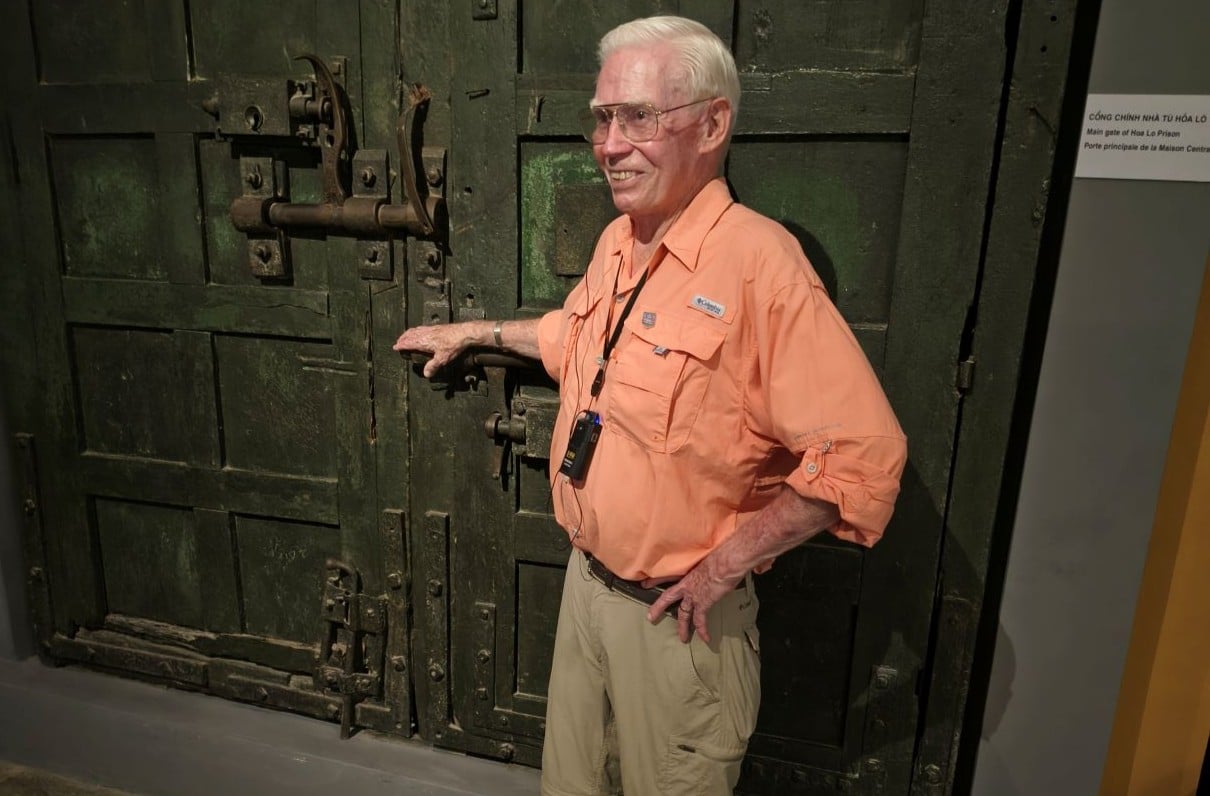
During this visit, Brazelton was able to return to his aircraft crash site in Thai Nguyen province in northeast Vietnam. He then had the opportunity to return to the Hoa Lo Prison, known as the “Hanoi Hilton,” where he was held in captivity.
Staff and tourists visiting the prison museum that day found themselves in the presence of an actual POW, and they took pictures with Brazelton.
After retiring from the Air Force, Brazelton flew for American Airlines from 1989 to 2002.
“I was one of the lucky ones,” he said. “I survived being shot down. I came home at the end of the war in reasonably good health. I was able to fly again and had a full career. I married a very beautiful girl and had three daughters. So I consider myself extremely fortunate.”
Six decades after being shot down, he was a guest speaker at the 2026 Memorial Day Observance at The Wall, hosted by the Vietnam Veterans Memorial Fund.
“We are fortunate that Vietnam and the U.S. are cooperating closely on this common endeavor,” Brazelton said in his remarks. “Our mutual interest in addressing the problem of our missing demonstrates the toll suffered by families regardless of what side you fight for.”
Capt. Edward Lundquist, USN (Ret), is a writer on military topics and travel.
Want to Help Servicemembers in Your Community?
Learn how you can make a difference with your local chapter.