
(This article by Hope Hodge Seck originally appeared in the May 2026 issue of Military Officer, a magazine available to all MOAA Premium and Life members who can log in to access our digital version and archive. Basic members can save on a membership upgrade and access the magazine.)
Stacey Ferguson was on her knees in the dirt, brushing fine, white soil away from human bone fragments, when she was overcome by a moment of reverence and emotion.
A retired Air Force lieutenant colonel with 24 years in aircraft maintenance under her belt, Ferguson knew how to embrace minute, mindful work. She’d let herself reflect on the soldiers whose remains she was helping to uncover — 14 boys and men, mostly from the Continental Army in the Revolutionary War, who’d fallen on this battlefield in Camden, S.C., and were hastily buried in shallow graves. And now, thanks to a fortunate 2022 discovery, they’d get the military honors they deserved.
“It occurred to me that these guys — this guy right here at the other end of my trowel — died to make us free,” Ferguson said. “They’re the ones who did that, and they never got to experience the country that they died to make free. I don’t know, it just gave me an extra reverence for them.”
When the 14 troops were reburied with military honors in 2023, it was Ferguson who wrote the letter laid in each coffin: “Dear soldier, whose name is known only to God,” the note began. “As I lay you with care and love into this coffin, I do not feel worthy of the task. You likely could not fathom what the United States of America would become — from thirteen states to fifty, and 332 million citizens. Our democracy is the oldest in the world — we don’t always get it right, and we have fought amongst ourselves more than I care to think about.
“But, today we are the most powerful country in the world. This is what you paid for with your life.”
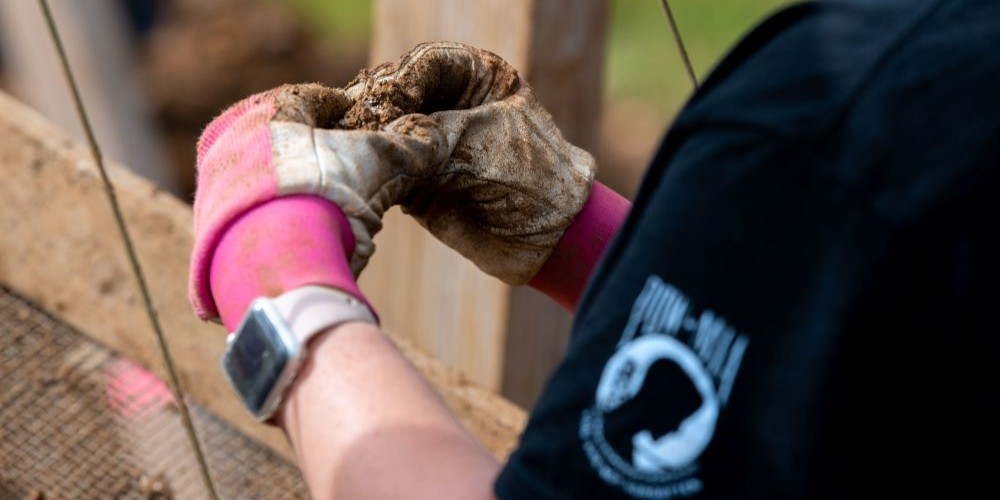
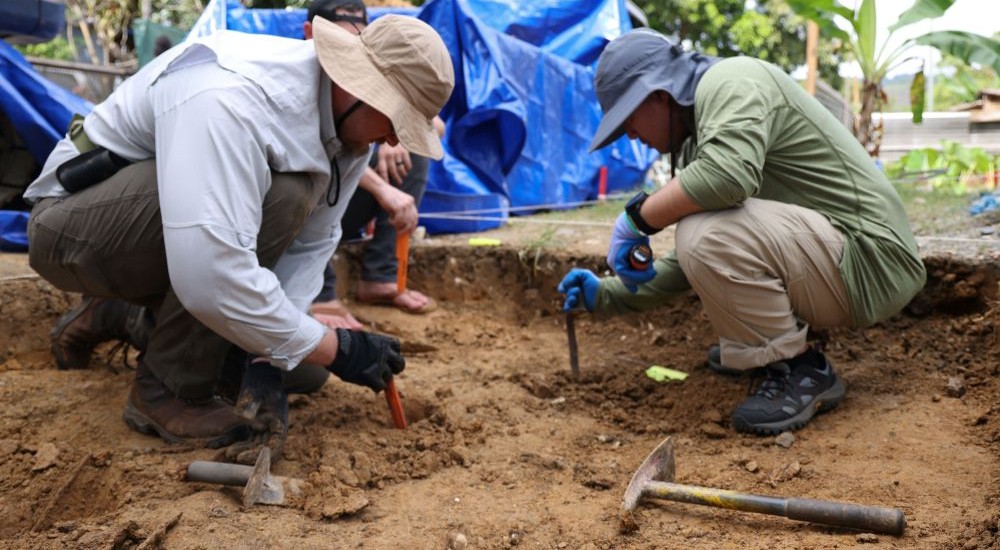
A volunteer with American Veterans Archaeological Recovery searches for remains of fallen servicemembers during an excavation of a B-24 aircraft in Arundel, England, in 2021. (Photo by Airman 1st Class Cedrique Oldaker/Air Force)
Field Techs
Ferguson is part of a small but meaningful contingent of military veterans who are finding meaning — and even post-military career paths — in battlefield archaeology and preservation. For some, the work is restorative and healing; for others, it makes apt use of their military knowledge and understanding of history. For all, it’s a way to give back not only to the nation but to their own military predecessors who fought and died on ground that deserves remembrance.
For those like Ferguson who engaged in this work through the organization American Veterans Archaeological Recovery (AVAR), the city of Camden has served as a schoolhouse for on-the-job training.
The 1780 Battle of Camden was a stunning defeat for American forces, who sustained 1,900 casualties to the British Army’s 324. But it also helped pave the path to ultimate American victory, by leading to a critical juncture in the war: Maj. Gen. Nathanael Greene’s replacement of Maj. Gen. Horatio Gates in command of the American southern forces.
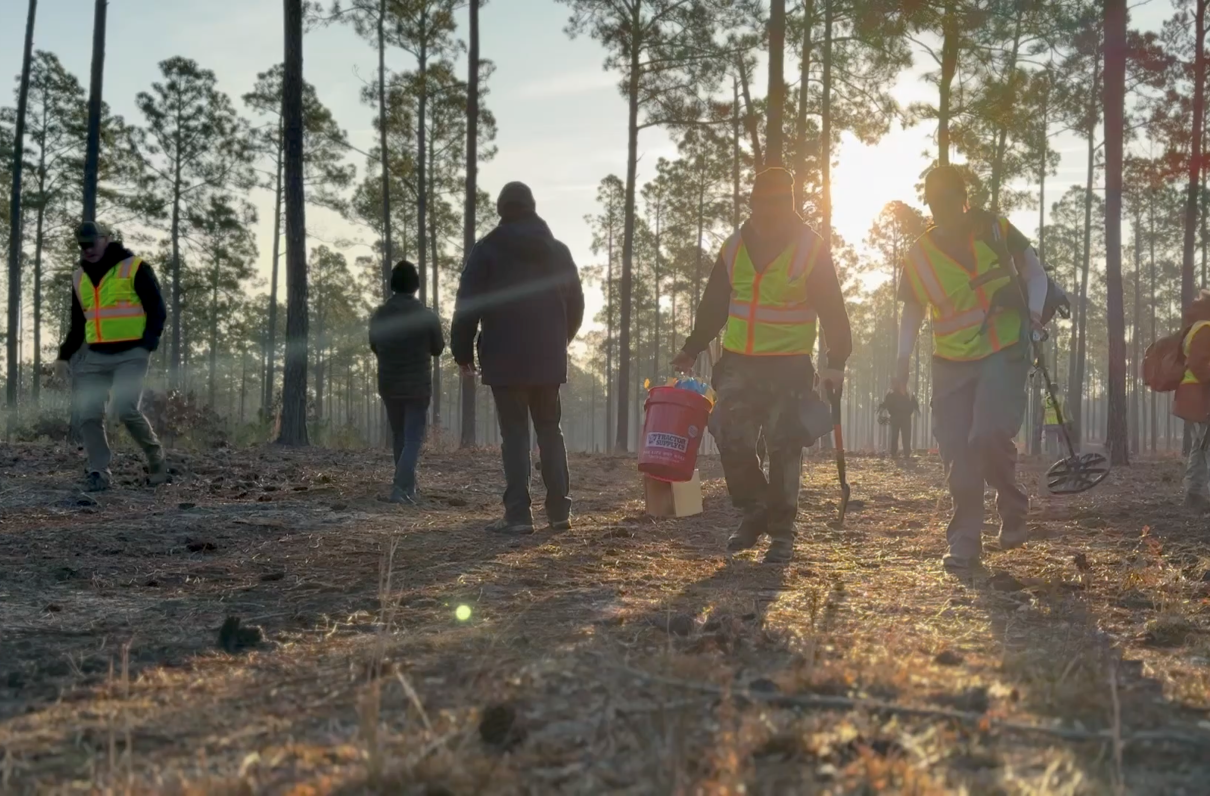
Camden’s grounds remain sown with musket balls and Revolutionary War artifacts, all with clues to the nation’s past. In late 2024, the American Battlefield Trust (ABT) teamed up with the Historic Camden Foundation to bring AVAR to an unexplored section of the 106-acre battlefield and neighboring colonial settlement for a four-week “conflict archaeology field school” where they could learn the tricks of the trade while recovering artifacts and advancing the body of historical knowledge.
Ferguson, who serves as deputy director of the Historic Camden Foundation and had become involved with the exhumation and reburial project after her 2019 retirement, first engaged with AVAR through the field school. She saw the opportunity as a way to get certified as an archaeological field technician in order to advance her work as a preserver and interpreter of history.
“For the first bit of the dig, we were out at the battlefield with a metal detector, learning how to use all that equipment, and we were able to explore an area [in] the battlefield that hadn’t really been metal-detected before. And then for the second half of it, here in town, they brought ground-penetrating radar and magnetometers,” she said. “All those things really make it nice for us to be able to tell the story of 18th century Camden.”
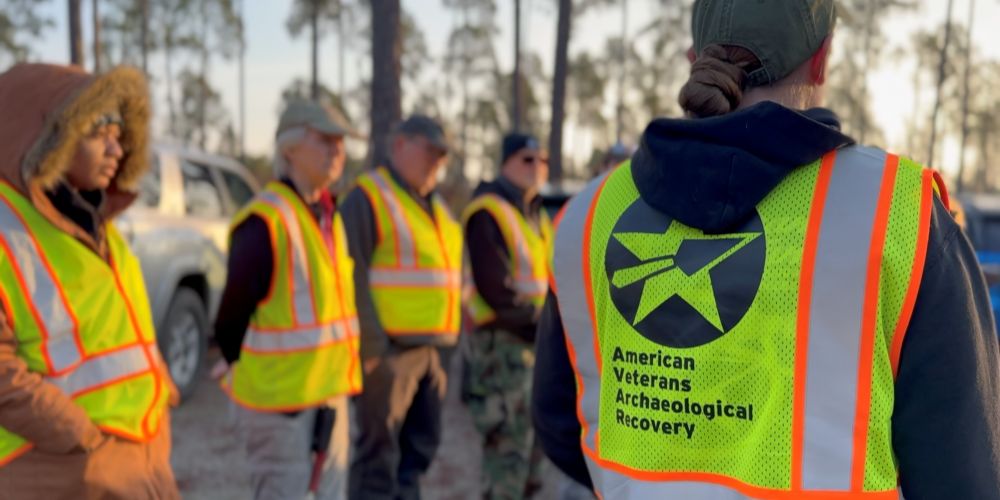
American Veterans Archaeological Recovery has undertaken preservation efforts across the globe. (Courtesy photo)
The work was painstaking, but the team found small artifacts, such as musket balls and belt buckles, at the rate of a few every hour, she said.
“Knowing what your typical GI skill sets are, we don’t mind the elements,” Ferguson said. “We’ll work in the rain or the wind or the hot or the cold and get a job done. We’re trained to have a pretty keen eye for detail, so when someone said, ‘Oh, this program trains veterans to be field technicians,’ well that makes total sense.”
‘Bringing Our People Home’
Stephen Humphreys, the veteran Air Force officer who founded AVAR in 2016, took his inspiration from Operation Nightingale, a British program that brings servicemembers and veterans to archaeological digs. While AVAR in its early years focused on improving veterans’ mental health through meaningful and therapeutic work, he said, the organization has since evolved.
“We saw the mental health benefits: It does decrease symptoms of anxiety, stress, and depression. The research shows that it does that, but those are all short-term benefits. You can’t cure PTSD with archaeology, for example,” Humphreys said. “And we really saw that the veterans wanted to have more career outlets.”
While AVAR has a mental health clinician on staff, Humphreys said, the organization isn’t working with veterans seeking rehabilitation but rather with well-trained professionals who brought, if anything, additional skills to the job.
“We wanted to say: ‘Hey, our guys are just as good at the fieldwork as anyone else out there [and] they can work just as hard, if not harder. They can be trained to do this really, really quickly.’ But if we’re going to do that, you need to pay them,” Humphreys said. “And so we really changed our business model and our operating model entirely toward making the veterans excel in archeology and then getting them compensated for it.”
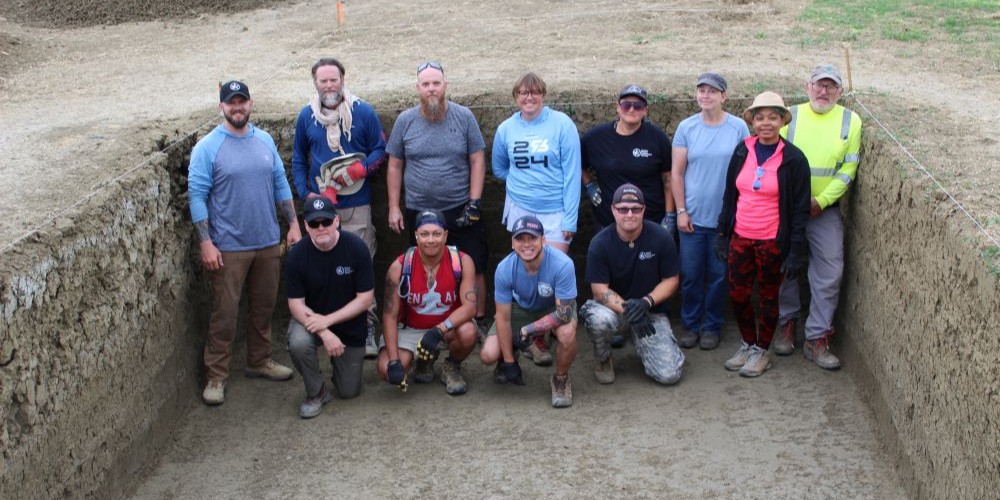
An AVAR team made up of several U.S. veterans poses at the site of a World War II-era aircraft crash in Italy in 2024. (Photo by Mackenze Burkhart/American Veterans Archaeological Recovery)
In its partnership with the Defense POW/MIA Accounting Agency (DPAA), which is responsible for bringing home servicemembers’ remains from past wars, AVAR helps with repatriation efforts for World War II aircrews in England and Italy. AVAR has also collaborated with the National Parks Service to place veterans in paid positions to perform “conflict archaeology” at locations ranging from Fort Necessity National Battlefield in Pennsylvania to Saratoga Springs, N.Y.
Kevin Sullivan has participated in both of those projects through AVAR. After retiring from the Air Force as a chief master sergeant in 2010 and transitioning to a career in engineering, Sullivan stumbled across a story about veterans unearthing a World War II bomber during some “downtime” in 2021. That piqued his interest, and within months, he was on a flight to Sicily to participate in a DPAA project focused on recovering a downed P-38 aircraft.
“It just seemed right along with my interests — the historical sense of going out to a World War II crash site, the sense of mission, sense of purpose, you know, bringing our people home,” he said.
That dig also involved the recovery of a pilot who was declared missing during the war and still had a living sibling.
“My mom’s 96 years old, and she had brothers that served in World War II,” Sullivan said. “And I’m thinking, if one of her brothers didn’t come home, she would want that closure too.”
In the work, Sullivan found a camaraderie with other veterans that he’d been craving, along with a meaningful new mission. When Sullivan spoke to Military Officer in 2025, he was planning his fourth monthlong DPAA project.
Staff Sgt. William Brearcliffe, USMC, left, and Tech Sgt. Lee Cruz, USAF, both assigned to the Defense POW/MIA Accounting Agency (DPAA) search for surface-level metal hits in the Solomon Islands last year. (Photo by Cpl. Adam Fisher/USA)
The Sacrifices
While the work of both recovering those missing and fallen overseas as well as preserving American battlefields is nothing new, the intentional integration of veterans is a more recent development, according to David Duncan, president of the ABT. The nonprofit, whose mission is to preserve battlefields and educate the public on their historical context, began under a different name as an initiative by historians in the late 1980s to protect Civil War sites, particularly those around northern Virginia at risk of disappearing under urban expansion.
In 2014, the organization’s mission grew to include preservation of Revolutionary War and War of 1812 battle sites. The trust took on its current name in 2018.
“We just feel that every acre, every blade of grass, every square inch of soil that we could save helps tell the military history of this country, which is crucial,” Duncan said. “There were people who fought for ideals at all of these places that have resulted in the country that we have today.”
Lt. Gen. Richard Mills, USMC (Ret), vice chair of ABT’s board of trustees, said the work of battlefield preservation itself also serves America’s veterans by emphasizing the meaning of their service.
“I think anytime that we can do things that educate the American public to the role of the military, the sacrifice of the military, and the importance of the military is tremendously beneficial, and that’s what the battlefields do,” he said.
Ferguson, the retired airman whose days at the Historic Camden Foundation include donning an 18th century gown and bonnet to interpret history to visitors, is still participating in efforts to identify two unknown soldiers discovered as part of the Camden exhumation and burials project.
She’s also engaging in archaeology projects further afield with AVAR. She plans to travel to the site of the Battle of Bunker Hill near Boston next year, and she’s hoping to soon take a DPAA trip overseas. For her, it’s all part of the same fabric of honor and preservation.
“I always felt so much more grateful to men like them in the sacrifices that they made to give us this country,” Ferguson said.
Warrior Legacy Project
As part of an effort to showcase “the deep connections that today’s veterans and active duty military retain to their historic forebearers,” the ABT launched its multipronged Warrior Legacy project.
Part of it includes well-produced videos showing Medal of Honor recipients — such as Britt Slabinski (Operation Enduring Freedom) and since-deceased Hershel “Woody” Williams (World War II) — walking Civil War battlefields and speaking poignantly about the intersection of their own battles and those of the past.
In addition, ABT-sponsored staff rides offer active duty servicemembers the chance to encounter interpretive history at sites like Gettysburg, Pa., and Antietam, Md. An app-based “Medal of Honor Valor Trail,” co-developed with the Congressional Medal of Honor Society, lets anyone visit battle sites and read about the heroes who fought and fell where they stand.
Duncan, the ABT president, said these efforts grew out of an awareness that many donors to the organization are veterans themselves. ABT’s partnership with AVAR was “a wonderful manifestation” of the trust’s desire to bridge the gap between past and present conflicts while improving the lives of today’s veterans, he added.
“They have a mission, they have camaraderie, doing [their work] in a small group unit,” Duncan said. “And boy, that just hit on all cylinders.”
Hope Hodge Seck is a writer based in the Washington, D.C., area.
Military Officer Magazine
Discover more interesting stories in MOAA’s award-winning magazine.