
(This article by Lt. Col. Patrick J. Chaisson, USA (Ret), originally appeared in the April 2026 issue of Military Officer, a magazine available to all MOAA Premium and Life members who can log in to access our digital version and archive. Basic members can save on a membership upgrade and access the magazine.)
Dressed in olive drab uniforms and steel helmets, a squad of infantrymen steps onto an overgrown field. Holding their M1 rifles at the ready, the soldiers deploy into a tactical “wedge” formation and advance cautiously.
Then, from a hidden bunker at the far end of the meadow, an enemy machine gun starts chattering. One GI cries out and collapses as his comrades take cover.
Things are happening fast now. Some riflemen return fire while others bound forward in short dashes. Medics begin performing first aid on the casualty. A hulking Sherman tank moves up to lend support, and soon the bunker is overrun.
After the skirmish concludes, a crowd of spectators applauds. Keen-eyed children await word from the show’s narrator that it’s safe for them to go on the field and collect blank cartridge cases as souvenirs of the tactical demonstration they’ve just witnessed.
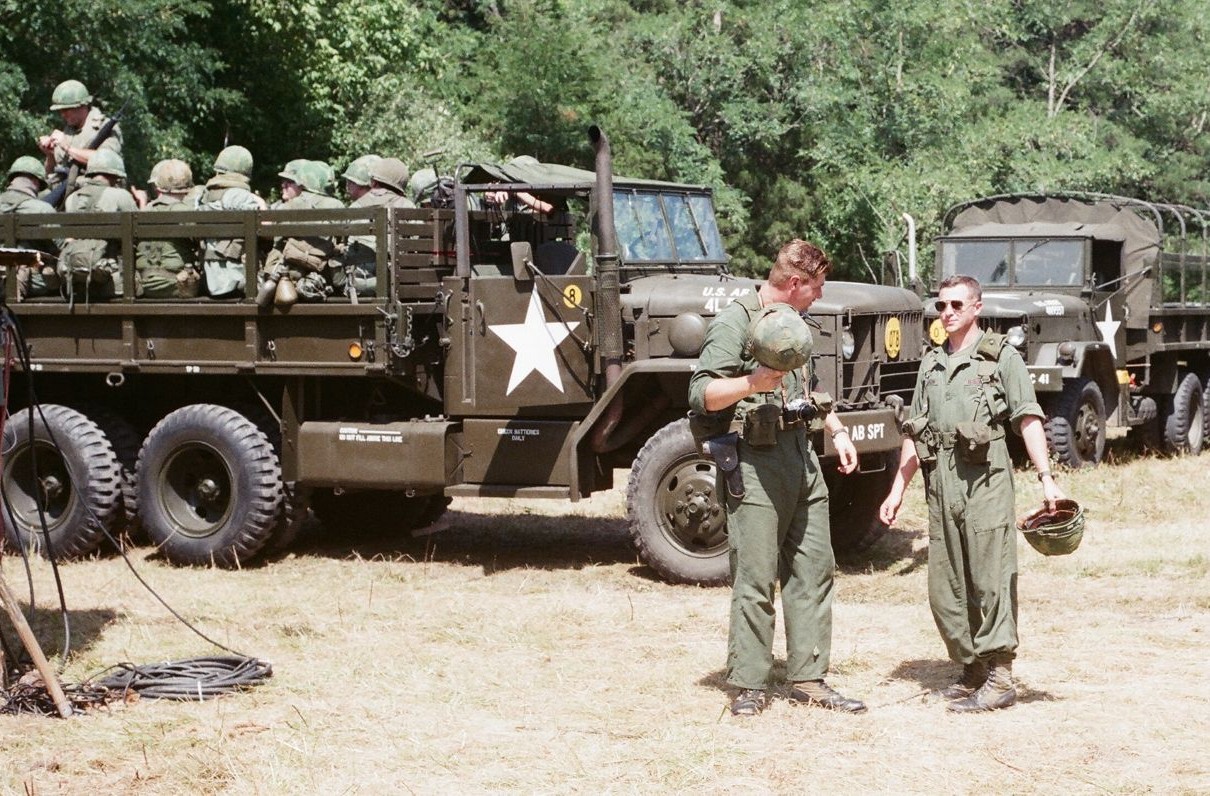
Historical reenactments like this one attract visitors of all ages who enjoy experiencing their nation’s military heritage in a direct, personal way. While for years there have been large, well-organized events commemorating Revolutionary War and Civil War battles, a number of living historians today are choosing to interpret more recent conflicts.
Military Officer spoke with several people — some of whom are combat veterans — who participate in World War II- or Vietnam War-themed events, asking why they volunteer their free time to dress in fatigues, restore an 80-year-old armored vehicle, or stand guard in the rain as part of a three-day tactical simulation.
[RELATED: More Recommended Reads From MOAA]
The ‘Greatest Generation’
Brian Benedict, a former educator and businessman from Patterson, N.Y., grew up in a family of veterans. His father and five older brothers served in the U.S. armed forces, and their stories sparked in him a lifelong passion for military history.
In 1991, to commemorate the 50th anniversary of America’s entry into WWII, Benedict organized a Memorial Day event at the Franklin D. Roosevelt Presidential Library in Hyde Park, N.Y. That weekend, he and a small group of militaria collectors put on a special display of WWII-era uniforms, equipment, and weapons.
The public enjoyed it, and Benedict’s associates were invited back next year. As word spread, more living historians joined up. They brought along their restored vehicles — jeeps, bulldozers, and even a 32-ton Sherman tank — as well as a variety of gear that visitors could observe up close. A tactics demonstration showed the crowd how 1940s-era soldiers trained to fight.
Today, the Hyde Park-based encampment continues to attract those eager to learn more about this momentous era. Benedict said he wants visitors to discover for themselves that “World War II was unlike any other time in American history. Every man, woman, and child was involved in the war effort.”
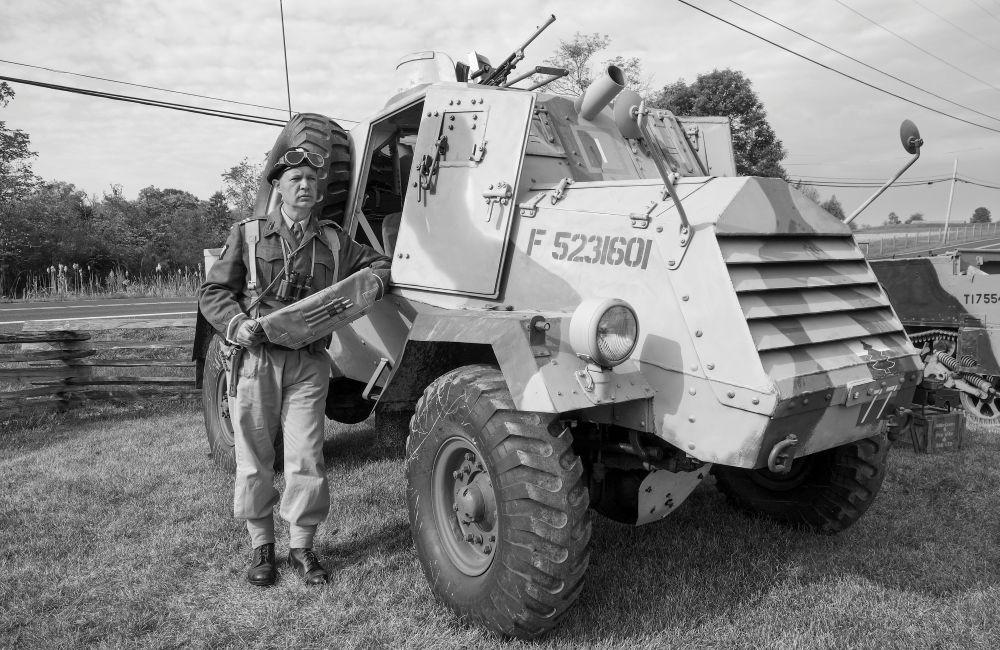
Christopher Petronis, a former Navy cryptologist, portrays a cadet officer of the 12th Podolian Lancers Regiment, II Polish Corps, based in Italy during the summer of 1944. He is standing beside a Canadian-built Otter armored vehicle. (Photo courtesy of WWII Polish Living History Group)
Polish Valor
Christopher Petronis, a former Navy cryptologist who lives in Easley, S.C., has been involved with living history for most of his life. Beginning in his early teens as a field musician with various Revolutionary War reenactors’ organizations, he became interested in creating a World War II impression after attending his first Hyde Park encampment in 1992.
Petronis said that the early 2000s were a boom time for WWII reenactors. The likes of Saving Private Ryan and Band of Brothers generated interest in the conflict, he said, while an influx of low-cost, foreign-made reproduction uniforms and gear helped make the hobby more affordable.
He recalled walking around a WWII exhibit at the Eisenhower National Historic Site in Gettysburg, Pa., only to encounter a “repetitive interpretation of standard U.S. issue equipment.” The rows and rows of steel helmets, M1 rifles, and EE-8 field phones on display were no longer holding his interest.
Petronis was determined to offer the public a more diverse educational experience. His inspiration came from the tales of valor and sacrifice involving WWII-era Polish veterans who attended his church. And thus was born the WWII Polish Living History Group.
Recruiting a cadre of like-minded reenactors, he began acquiring the kit required to portray a member of Poland’s land or air forces fighting in the war. After Nazi Germany invaded Poland, Polish servicemembers fled to France and later the United Kingdom, “where they made an invaluable contribution to the Allied war effort,” notes a report from the U.K.’s House of Commons. Because of their contribution under British command, Petronis began seeking out Commonwealth-issued gear.
Today, the group’s collection includes a fully tracked T16 Universal Carrier, an American-made variant of the British Bren Gun Carrier. Petronis purchased this 9,500-pound fighting vehicle in 2012, and he regularly brings it to events up and down the East Coast.
“The T16 is an icebreaker,” he said. “Most people have never seen one and want to know more about it. That gives us a chance to talk about the role of Poland’s soldiers and airmen in defeating Nazi Germany.”
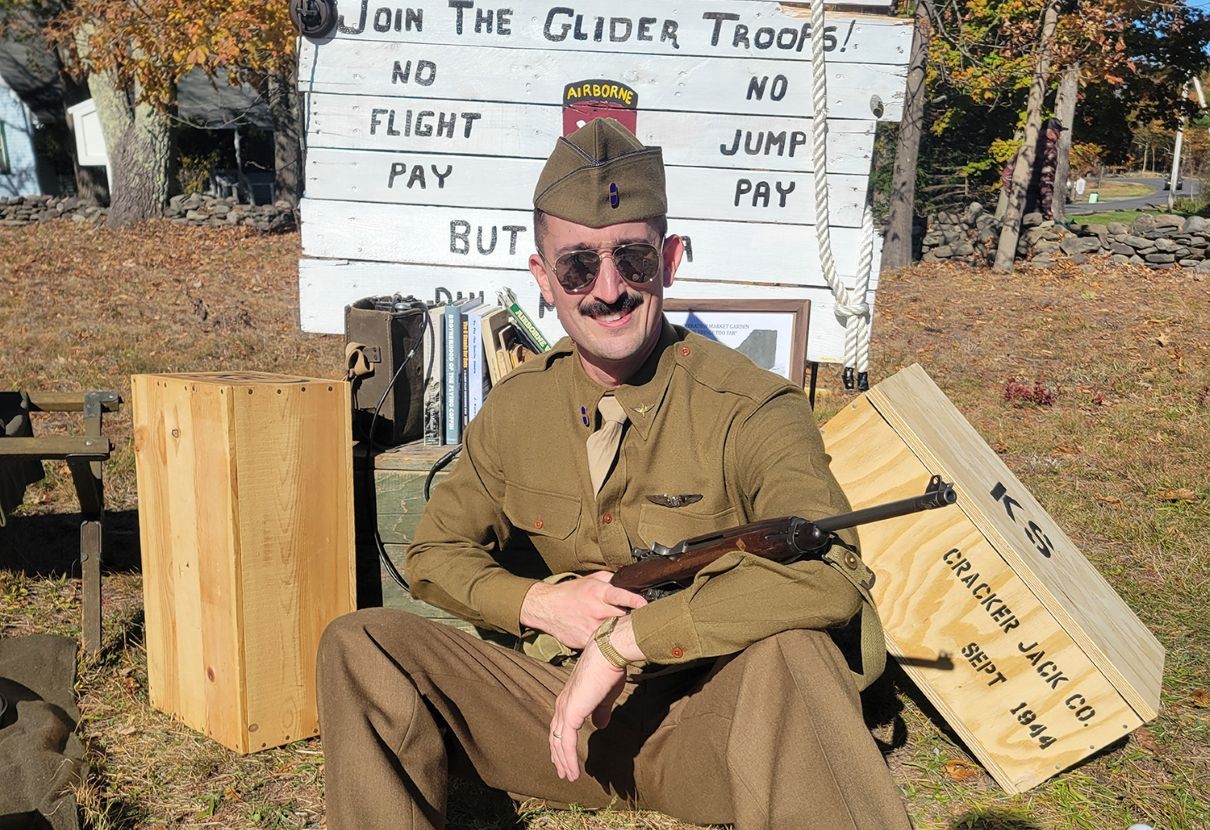
Reenactor Dan Pavlak, dressed like a flight officer in the 440th Troop Carrier Group, sits by a replica sign that appeared at a glider training base during World War II. (Photo courtesy of Two Lost Lieutenants)
Cargo Gliders
A new generation of living historians is now entering the hobby. Army CW2 Dan Pavlak said he “grew up going to Brian Benedict’s event on the lawn of FDR’s house in Hyde Park” and always wanted to participate as a reenactor.
Pavlak, an Apache helicopter pilot currently assigned to the 10th Mountain Division at Fort Drum, N.Y., said he learned about WWII glider pilots while attending flight school. That experience led him to create a flight officer impression, which he now uses to inform the public about the history of U.S. Army warrant pilots and the cargo gliders they flew. “We like to say we are trying to teach the lesser-known parts of the conflict,” Pavlak said.
“We [perform] this little skit where if a teen boy comes by, we’ll ‘draft’ him,” he added.
“We throw all our extra gear on him while talking about the requirements to join — [if it were] back during the war — and the benefits that came after. Most of the time the parents are smiling wide and the kid is either mortified or loving it. Either way, we’ve given them a memory.”
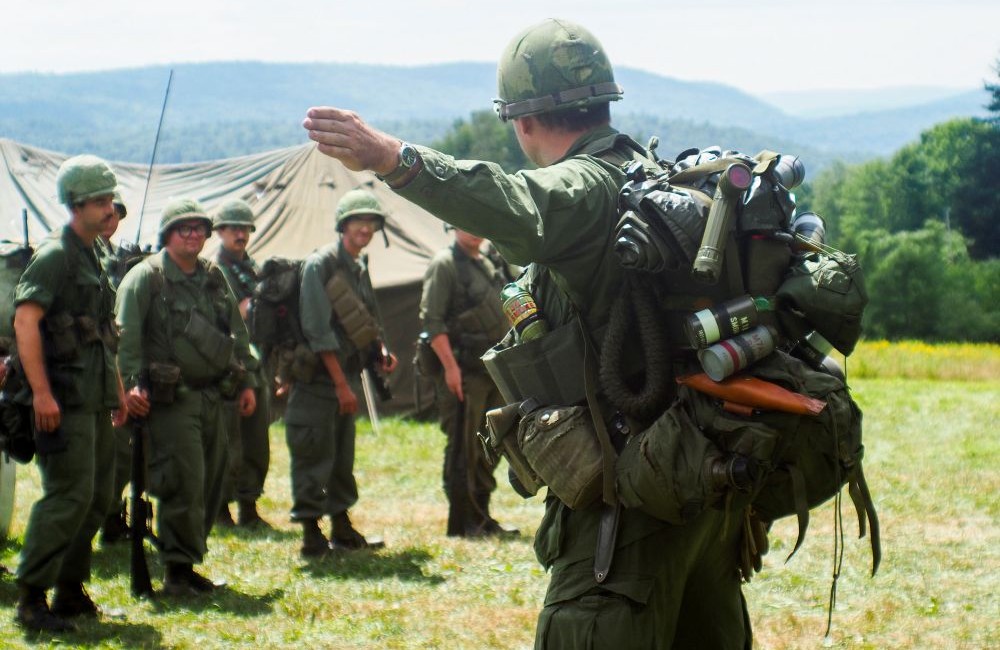
A reenactor briefs his troops ahead of a patrol near a mountainside during a Vietnam War-era reenactment. (Photo courtesy of Broken Arrow Events)
20th Century Simulations
Not all reenactors participate in public-facing events. In fact, some hobbyists prefer to immerse themselves in a field environment designed to replicate the sights, smells, and sounds of a 20th century battlefield.
Members of Broken Arrow Events (BAE) practice this form of living history, dubbed MILSIM (short for military simulation). BAE is an association of reenactors based in the Northeast region of the U.S., and several times a year, it holds training sessions and multiday tactical exercises set in 1960s Vietnam.
In a typical MILSIM scenario, participants operate out of a recreated Vietnam base camp complete with a mess tent, aid station, and perimeter line that must be guarded 24/7. Those who attend these events endure grueling, daylong patrols, followed by nights spent digging defensive positions or setting up ambushes.
Joe Sabia of Port Chester, N.Y., said he often portrays a Vietnam War-era combat photographer with BAE. When putting together his impression, Sabia ensures the film cameras he carries are “period-correct,” just like his uniform of green cotton fatigues, jungle boots, and helmet.
No firearms are permitted. Instead, participants carry airsoft replicas and wear shatterproof eyeglasses. These tactical scenarios are off-limits to spectators.
For Mike “Bear” Diamante, a former member of the U.S. Army’s Military Police Corps and a veteran of the Iraq and Afghanistan wars, MILSIM events provide a “medicinal effect.”
“My main role is to provide combat and garrison-related training for all elements of the company [and] enforce the standards while reenacting and professionally leading, mentoring, and helping [other participants],” said Diamante, who lives in Gettysburg.
In particular, he added, BAE “painstakingly strives for complete and total accuracy.” The reward for upholding such high standards, he said, is when actual Vietnam veterans tell him, “You’re doing it right,” and then share their wartime stories.
Sabia noted that BAE “routinely sets up interactive displays at local museums, emphasizing the human and personal side of things by showing the weight of a helmet and ruck … and explaining how important things like foot powder and Kool-Aid were.”
In Their Honor
The living historians who spoke to Military Officer said they reenact events to honor those who served.
“It’s not about shooting guns and playing army,” Benedict said.
Diamante agreed, noting he hopes his group’s efforts “shed more light on Vietnam-era veterans.”
Sabia said he participates in MILSIM events to “experience a sliver of what it may have been like [to serve] in a largely ignored, misrepresented, and misunderstood war.”
Dedicated reenactors, Benedict added, help keep alive the memory of those who fought their nation’s wars over the past century.
Large living-history events, air shows, and tactical recreations held across the country continue to attract participants and onlookers interested in this hands-on approach to history. And the reenactors interviewed all believe their main mission is to educate the public.
As Benedict observed: “You can’t read about it in a textbook.”
Lt. Col. Patrick J. Chaisson, USA (Ret), is a writer and historian in Scotia, N.Y.
Military Officer Magazine
Discover more interesting stories in MOAA's award-winning magazine.