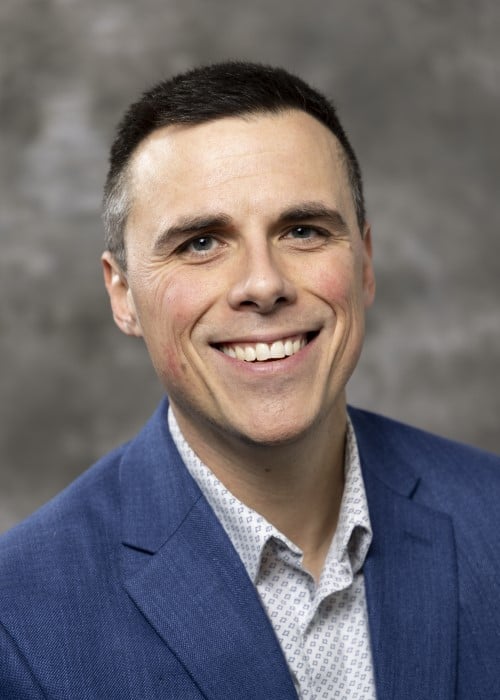
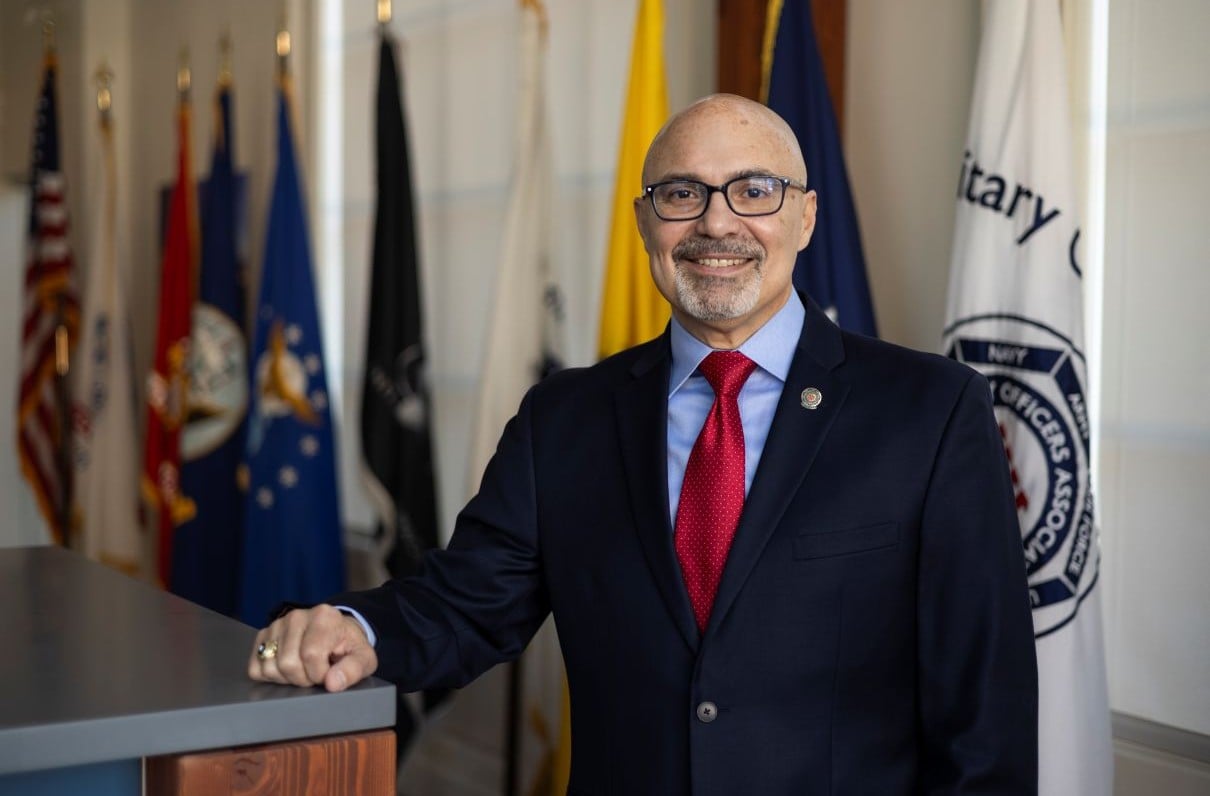
Col. Carlos Perez loves economics, finance, and data-crunching, seeks out opportunities to serve, and misses the camaraderie he found downrange in the Army.
So it’s no surprise the retired combat engineer jumped at a chance to join MOAA’s leadership team as executive vice president and chief financial officer.
Perez began his new job in May. He succeeds Regina Chavis, who retired after more than nine years overseeing MOAA’s finances.
Perez, a Port Chester, N.Y., native, previously served as principal at The MITRE Corporation, financial advisor at the Knights of Columbus, and chief financial officer at the American Armed Forces Mutual Aid Association (AAFMAA), now Armed Forces Mutual.
He graduated from the U.S. Military Academy at West Point, N.Y., and served more than 26 years with deployments to Bosnia, Iraq, and Afghanistan.
Perez and his wife, Tricia, are parents of four and grandparents of two.
[RELATED: MOAA Members in the Spotlight]
Your new CFO, and longtime MOAA member, sat for a recent interview to share more about his time in uniform and his newest mission.
Q. Talk about your experience at West Point.
A. Well, I have two experiences at West Point. The first one was as a cadet, which really was foundational. I graduated from there with leadership training and a great education, served a few assignments, and then was fortunate enough to be picked up for an assignment as a rotating faculty member. ... I went back to West Point at about the 10-year mark in my Army career and taught the core economics course to second-year cadets and a couple of electives.
[RELATED: New Officers Meet MOAA at Graduation Events Across the Nation]
Q. Where does your interest in finance come from?
A. I’ve always been interested in math, and I’ve always been interested in what's going on around me. What I found is that economics and finance blend those two worlds. You have to understand people, you have to understand systems, you have to understand government to be able to employ economics as a useful tool.
Q. Talk about your experience in Iraq and Afghanistan.
A. In Iraq I was a major in the Army. I was with an engineer battalion from Schofield Barracks, Hawaii, and we deployed with a brigade of the 25th Infantry Division. That engineer unit was a combat heavy battalion, so it did a lot of construction type projects in an austere environment: Roads, airfield repair, some basic barracks and facilities. Iraq was a pretty difficult assignment, and it's one that I value a great deal. It prepared me to be a better leader.
My experience in Afghanistan came when I was more senior. I deployed there as a colonel a few years before I retired. We were drawing down and we spent a lot of our time thinking through and planning for how to reduce an operational unit footprint while still being able to satisfy the operational demand.
[RELATED: Senior Enlisted Leaders Tackle Tough Issues at MOAA Forum]
Q. What inspired you to apply to the CFO position?
A. When I left the service, I was always interested in finding what I would consider mission-focused, service-oriented organizations. That’s what drew me to service in the Army.
I realized that you can do that through nonprofits. And so I was drawn to nonprofits from the get-go. When I saw that MOAA had this position open, I realized that not only am I a veteran and a member of MOAA for years, but between my experience with other nonprofits and in finance, I could use those experiences and skills in MOAA to help contribute to the association.
My son is in the Army, my son-in-law is in the Army, and my nephew is in the Air Force. So, I am very interested in an organization that is dedicated to preserving and protecting earned benefits -- not only mine, but theirs and servicemembers’ as a whole.
Q. How do you view your role as CFO?
A. My role at MOAA is the same as your role and everybody’s role, which is to advance the mission to preserve and protect earned benefits of our uniformed services, our families, veterans, and surviving spouses.
One of General Kelly’s top priorities is to ensure MOAA’s long-term financial stability. My role is to not only make sure that we're performing the day-to-day operations that we need to keep things running today, but also to take a step back and look at how we're doing potentially 10, 20, 30 years down the road. So that as we approach our 100th year anniversary in 2029, we're ready for at least another 100 years going forward.
[RETURNING IN 2027: TotalForce+]
Q. What do you miss most about being in uniform?
A. I miss the camaraderie that we had in very tightly knit units in very difficult situations. And the benefit of my service is that I’ve made lifelong friends that I treasure to this day. I bring that up because what I see here at MOAA is that it's a similar place where we have this great culture, cohesion, and camaraderie, all working toward the common good of helping the uniformed services community.
Support MOAA Charities
Donate to help address emerging needs among currently serving and former uniformed servicemembers, retirees, and their families.