
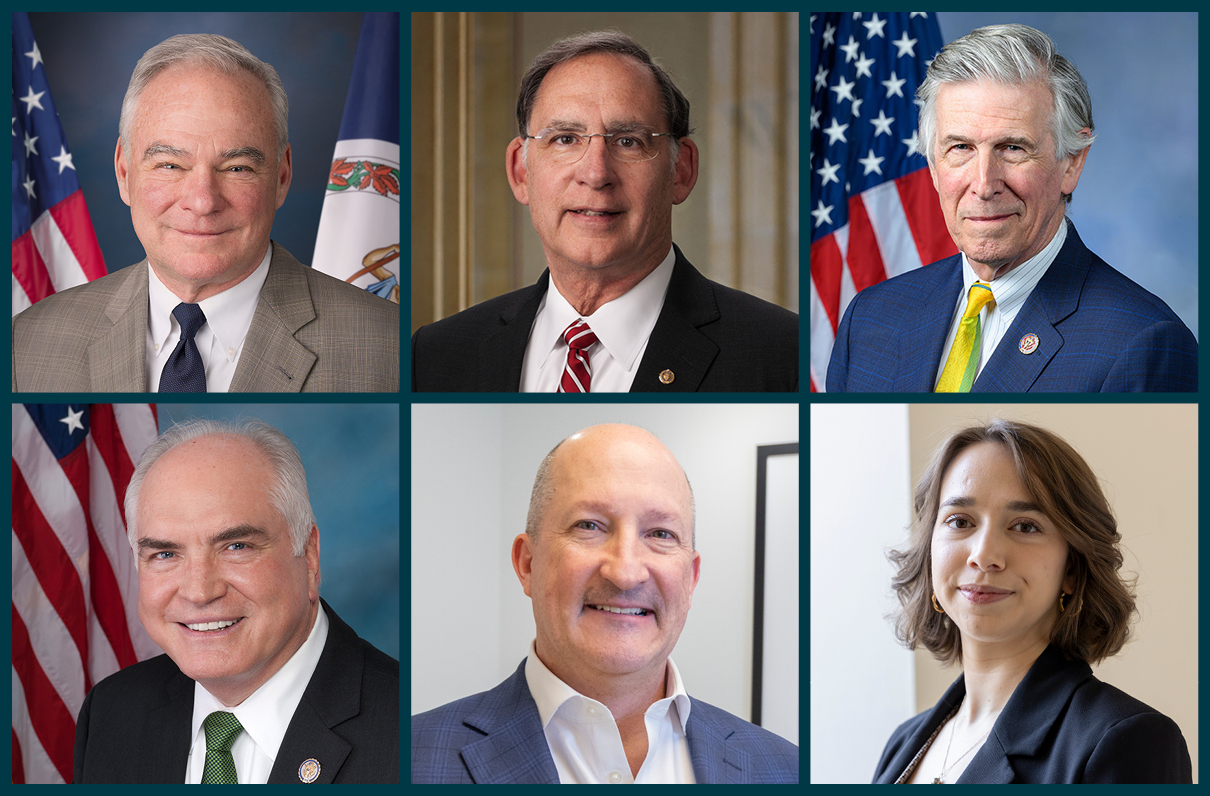
MOAA’s annual awards honor recipients who are working to improve the lives of servicemembers, veterans, and their families.
The presentation coincides with MOAA’s Advocacy in Action campaign, where hundreds of members and staffers visit offices on Capitol Hill in support of key legislative priorities.
Learn more about the 2026 awardees at the links below:
Colonel Arthur T. Marix Congressional Leadership Award
Colonel Paul W. Arcari Meritorious Service Award
- Patrick Flood, former national security advisor to Rep. Don Bacon (R-Neb.)
- Jordan Nasif, senior policy advisor and military legislative assistant to Rep. Sara Jacobs (D-Calif.)
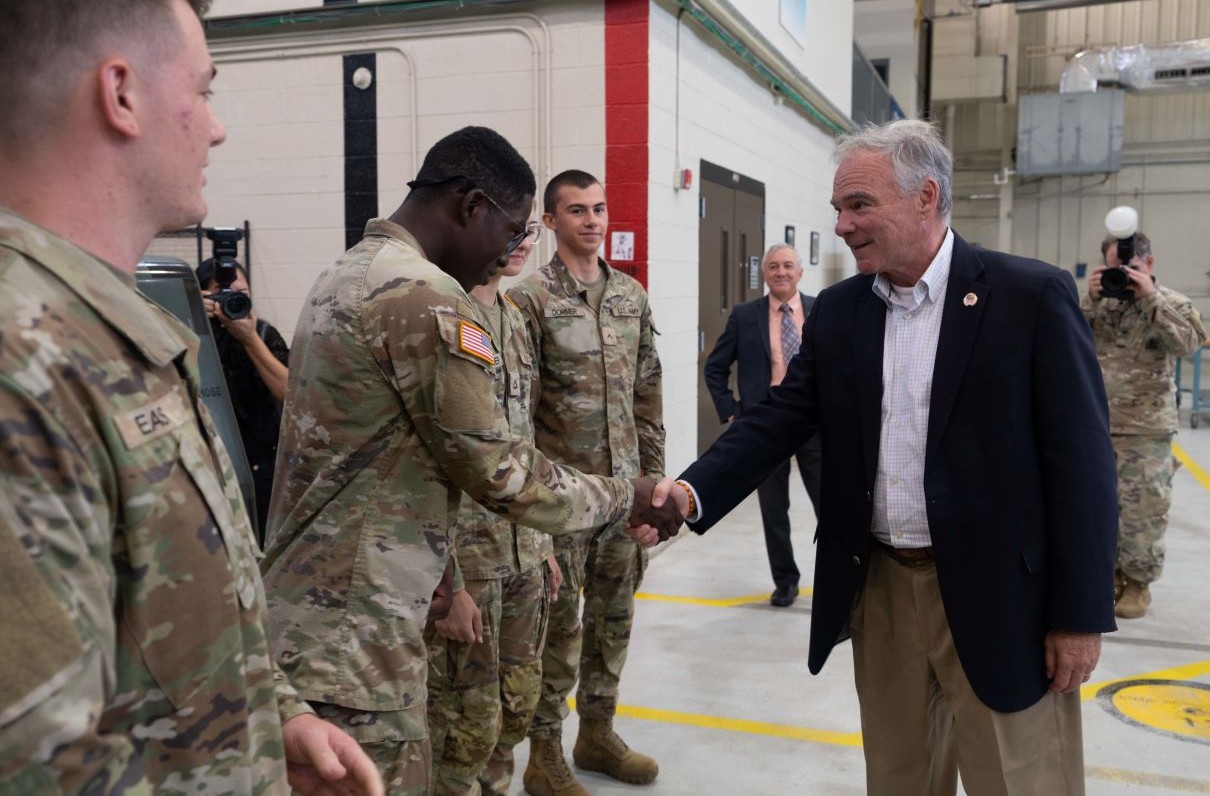
Sen. Tim Kaine shakes hands with soldiers during a 2022 visit to Fort Eustis, Va. (Photo by Sgt. Rydell Tomas/Army)
Sen. Tim Kaine: ‘What We Do to Support Military Families Matters’
Sen. Tim Kaine remembers clearly a moment from a decade ago when a military spouse spoke up at a Hampton Roads roundtable held for active duty servicemembers and their families.
A few years earlier, Kaine had introduced the Troop Talent Act to help address high unemployment rates among veterans of the wars in Iraq and Afghanistan. Key provisions of that act were included in the FY 2014 National Defense Authorization Act, and Kaine was grateful for the impact it was making.
The roundtable participant asked whether the senator knew that military spouses also faced high unemployment — at five times the national average. Kaine didn’t know, although it certainly made sense, he acknowledged.
“Military spouses face frequent moves,” he said. “They interview for jobs, but employers know they may move in a couple of years. Many military spouses have certifications or licenses that don’t easily transfer to another state.
“There are a lot of barriers,” he added. “I’m really glad I was at that roundtable that day and got challenged with that fact.”
Kaine has long made troops and their families a priority. While serving as governor of the state from 2006 to 2010, thousands of members of the Virginia National Guard deployed to Iraq and Afghanistan. His visits there — and the joyful homecomings and heartbreaking funerals — dominate his memories from that time.
“Some of the most moving experiences I had as governor were connected to Virginia Guard deployments and the sad occasions where servicemembers were killed or injured,” Kaine said.
In 2012, a year before joining the Senate, his son commissioned into the Marine Corps. “Suddenly, I wasn’t just talking about other people’s kids — I was talking about one of my own.”
One of his first orders of business as a U.S. senator was a request to join the Armed Services Committee. In March 2025, Kaine joined other senators to introduce the bipartisan Military Spouse Hiring Act, which would expand the existing work opportunity tax credit (WOTC) to include military spouses, providing tax credits to employers who hire them.
[TAKE ACTION: Ask Your Lawmakers to Support the Improve and Enhance the Work Opportunity Tax Credit Act]
“People often say that you recruit the soldier, the sailor, the airman, or the Marine, but you retain the family,” Kaine said. “What we do to support military families matters. Creating employment opportunities for spouses is one piece of that.”
MOAA continues to champion the Military Spouse Hiring Act — bipartisan, bicameral legislation that would include military spouses among those who are eligible for WOTC. That federal tax credit is already available to employers who hire individuals from groups facing significant barriers to employment, such as veterans, individuals with disabilities, and the long-term unemployed.
Unlike previous efforts to enhance the job prospects of military spouses, the Military Spouse Hiring Act would target employers, providing an incentive meant to mitigate employers’ concerns with inevitable relocation orders.
WOTC has proved effective at lowering unemployment rates for veterans, incentivizing 630,000 new veteran hires from 2019 to 2023. Replicating this success for military spouses would have an immeasurable impact on families that have volunteered to serve this country.

Sen. John Boozman discusses updated housing conditions at Joint Base Lewis-McChord, Wash., with service leaders during a 2024 visit. (Photo by Staff Sgt. Christina Westover/Army)
Sen. John Boozman: ‘Taking Care of Military Families Really Is a Readiness Issue’
For Sen. John Boozman, growing up in a military family meant belonging to an even bigger family: a community of people who served.
Boozman’s father was in the Army Air Corps during World War II — he would go on to rise to the rank of Air Force master sergeant — and the family spent six years in London when he was a child.
“We just had a great experience,” he said. “We had a lot of opportunities that many people don’t normally have.”
But there were challenges, too. “My mom really struggled to find work,” Boozman said.
His firsthand understanding of the sacrifices and unique obstacles faced by those in uniform has informed his work on the Senate Veterans’ Affairs Committee and in appropriating funds for the Pentagon and the VA. Being part of a military family impacts every facet of life, Boozman said, from schools and housing to child care and employment.
“Being in the military is a family affair. So often when we talk about the military budget, families are overlooked,” he said. “In recent years, we’ve been doing a lot better job of trying to take care of the whole family, but we’ve still got work to do.”
[RELATED: MOAA-Endorsed Bill Would Support Veterans Facing Fertility Challenges]
That includes removing barriers that make employment for military spouses especially challenging. In March 2025, Boozman and Sen. Tim Kaine (D-Va.) renewed their push to pass the bipartisan Military Spouse Hiring Act, which would expand the existing work opportunity tax credit to include military spouses, who face high rates of unemployment.
“It’s difficult when you are a military spouse because you are going to be moving in a couple of years and your future employer knows you are going to be moving. You have a worker you are going to train and invest time and energy in, and you know they are going to leave,” Boozman said. “Because of that, you’re put at a disadvantage. In some places, especially overseas, it’s almost impossible to work.”
The hope is that the tax credit will incentivize employers to hire military spouses.
“Taking care of military families really is a readiness issue,” Boozman said. “Recruitment is up and retention is up because we are doing a better job taking care of families. We’re really concentrating on housing needs, child care needs, military spouse employment — all of these issues” that impact quality of life and allow servicemembers to focus on the mission.
“Democrats and Republicans are working together,” he added. “We’ve done so many things in the last few years, including working with our service organizations, which are so important. They are really the tip of the spear — pushing things forward that might not otherwise get done.”
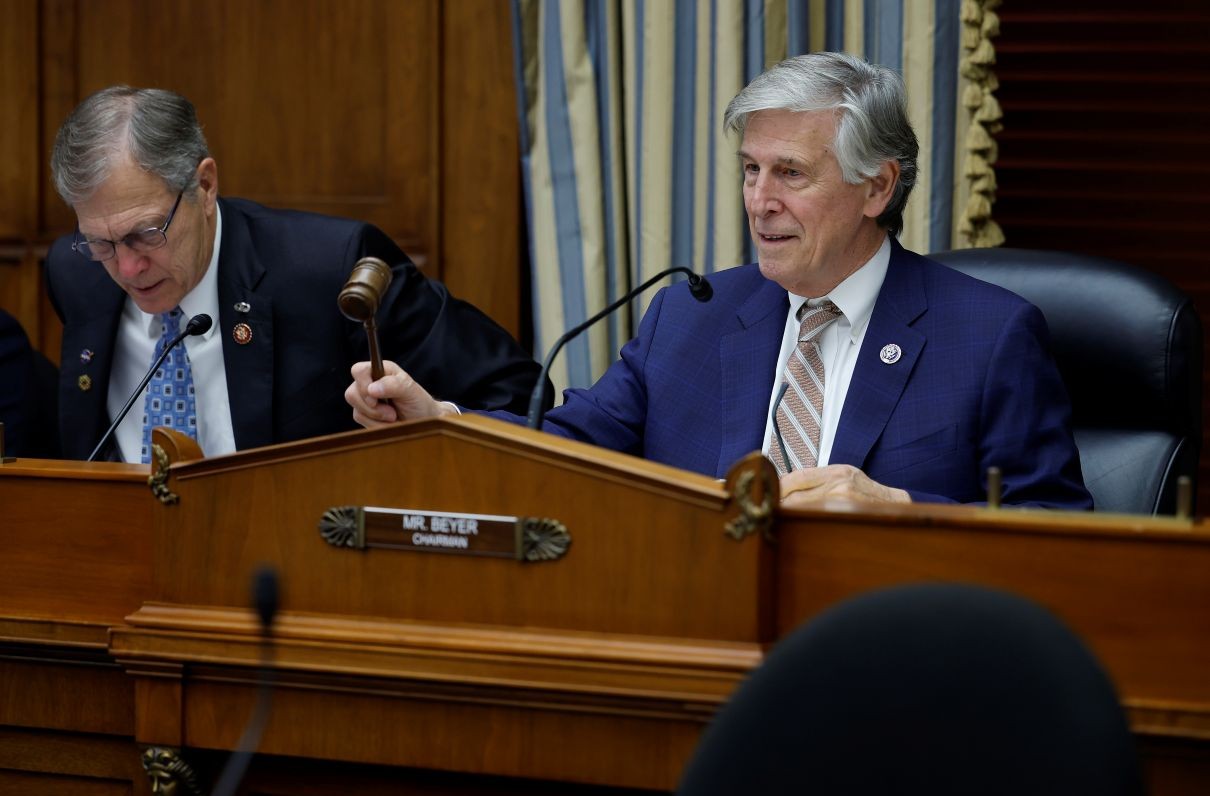 The son of a career soldier, Rep. Don Beyer has represented Virginia in the House of Representatives since 2015. (Photo by Chip Somodevilla/Getty Images)
Rep. Don Beyer: Respecting ‘Courage and Sacrifice’
Rep. Don Beyer began his childhood in the Free Territory of Trieste, a short-lived, post-World War II territory between Italy and Yugoslavia, where his father was stationed.
The elder Don Beyer, a 1946 graduate of the U.S. Military Academy, served in a camp for displaced persons during the Korean War and on Eniwetok Atoll in the Marshall Islands during U.S. nuclear testing there.
His father’s 20-year Army career meant regular moves for the Beyer family: Fort Gordon, Ga.; Fort Leavenworth, Kan.; West Point, N.Y.; and Washington, D.C., with as many as six children in tow at any given time.
The junior Beyer’s mother taught in an Army school in Italy, and he attended the service schools in West Point and Leavenworth. He also was a frequent guest at Walter Reed National Military Medical Center when he was sick or injured. And his family shopped at the commissary and leaned on his grandmother for support when his father was away.
“When my dad retired, my mom famously said that her next move was going to be the center aisle of a church at her own funeral,” Beyer said. “She had lived in so many places because he moved every two years.”
[RELATED: Would You Recommend Service to a Family Member?]
Fortunately, it didn’t come to that. The Beyer family settled in northern Virginia, where the retired Army officer founded a car business that he and his sons later ran together. “Everyone called him ‘Colonel,’” said Beyer, whose father lived into his 90s.
Today, Beyer represents Virginia’s 8th congressional district, home to 50,000 veterans and active duty servicemembers as well as their families. In March 2025, he introduced the Military Spouse Hiring Act, bipartisan legislation that would provide a tax credit to employers who hire military spouses.
“I saw what my mom went through,” Beyer said. “Many years later, in Congress, I realized just how difficult it was for her” — and perhaps even more so for military spouses today.
“We’ve created an economy where, in general, both parents need to work. Yet if you are a military spouse moving every two years, how do you ever establish a career? We should be able to have great tax incentives to hire military spouses,” Beyer said.
It’s something lawmakers — regardless of political party — can agree on, he added.
“Every one of us respects the courage and sacrifice of our soldiers and sailors and Marines and airmen. They can make more money doing something else that’s less dangerous and less stressful on their families, but they don’t. They are genuine public servants.”
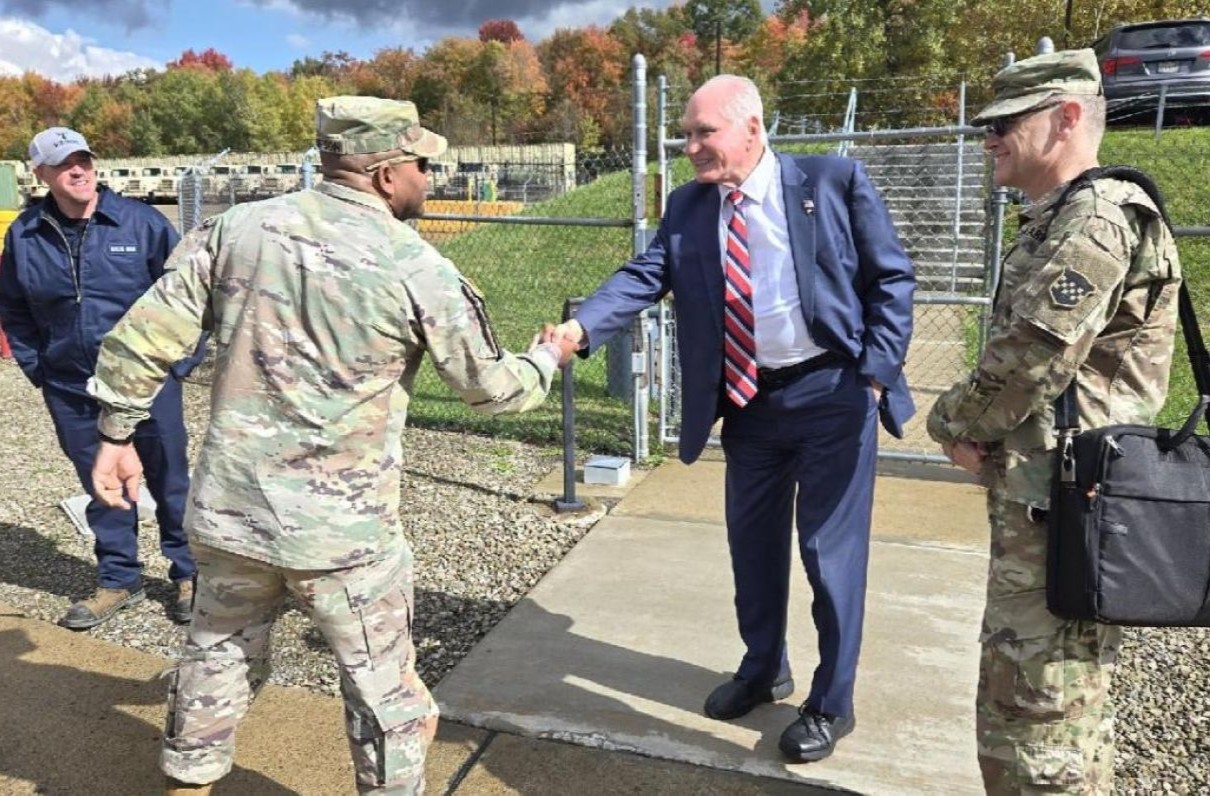
Rep. Mike Kelly helped lead the bipartisan introduction of the Military Spouse Hiring Act in 2025. (Courtesy photo)
Rep. Mike Kelly: ‘If We Want Strong Servicemembers, We Have to Have Strong Families’
Rep. Mike Kelly’s values were shaped around his family’s kitchen table. His father endured the Great Depression and later flew B-17 and B-29 aircraft during World War II.
Over dinner, his father told stories of struggling to scrape together a living when people had virtually nothing, and of friends and family who signed up to fight in Europe and the Pacific region before they were old enough for military service.
“They went anyway,” Kelly said, “because of their devotion to the country.”
Today, those memories shape his work on behalf of servicemembers, veterans, and their families as the representative of Pennsylvania’s 16th Congressional District.
In March 2025, Kelly, who serves on the House Committee on Ways and Means, helped lead a bipartisan group introducing the Military Spouse Hiring Act, legislation that would amend the tax code to incentivize employers to hire military spouses.
“Our military families are on the move all the time,” Kelly said. “Wherever they’re stationed, they pack up their belongings, pack up their children, and start over again.”
Frequent moves can make it difficult for military spouses to build long-term careers, even as they play a vital role in maintaining stability at home.
[RELATED: MOLD Act Would Protect Military Families From Hazardous Living Conditions]
“When I was hiring people in the private sector, I wanted someone to come in and build a long history with the company. But if they might be transferred in a year or two, that becomes a difficult decision,” Kelly said.
Yet that is the reality military spouses face every day. The Military Spouse Hiring Act would provide tax credits to businesses that hire military spouses.
“If we want strong servicemembers, we have to have strong families. And if families are going to be strong, we need to make sure they have opportunities,” Kelly said. “When you ask someone to join the military, you’re asking them to put their life on the line. At the same time, their spouse may not have opportunities to work and help with the family bills.”
That’s a hard sell in today’s economy.
“There isn’t another country in the world that has such a strong military. And it’s not based on people who were drafted — it’s based on people who chose that career, knowing it would be difficult,” Kelly said.
Helping military spouses maintain employment is a quality-of-life issue, and it’s tied directly to national security.
“If we keep families together and make sure they have opportunities, we’re going to have a much stronger military and a much stronger nation,” he said.

Patrick Flood joined the office of Rep. Don Bacon as national security advisor in 2017. (Photo by Mike Morones/MOAA)
Patrick Flood: ‘Serving the Nation – Just in a Different Role’
Patrick Flood met Rep. Don Bacon (R-Neb.) during a leadership conference in 2006 when both were serving as Air Force unit commanders.
Flood remembers Bacon for “his leadership, his demeanor, how he communicated with other people, and how he commanded respect.”
It would turn out to be a fortuitous encounter. Their paths crossed again several times over the next decade, and their shared professional respect turned to friendship. When Bacon was elected to Congress in 2016, he asked Flood to help create a national security team.
“We both felt we weren’t done serving,” Flood said. “This was an opportunity to continue serving the nation — just in a different role.”
Flood joined Bacon’s office as national security advisor in 2017, beginning what he describes as “extra innings” in public service.
Flood grew up in a family shaped by service: Both parents were career civil servants, and his father spent decades in the Army Reserve. Military service among his ancestors even stretches back to the Civil War.
“It was sort of in the family DNA that I would join the military,” Flood said. “I grew up in the 1980s when the Cold War was burning pretty bright. That’s what inspired me to seek a career in military service.”
[RELATED: MOAA on the Hill: CEO Outlines Key Priorities at Joint Veterans Hearing]
Flood attended the Air Force Academy, where he “fell in love with the lifestyle, the people, the values of service, and the challenge of it. It didn’t seem like work. It was something I loved doing, and it became part of who I was.”
His decades in the Air Force shaped the way Flood approached policy work on Capitol Hill. He played a key role in discussions surrounding the House Armed Services Committee’s 2024 Quality of Life Panel, an effort focused on challenges facing servicemembers and their families.
Drawing on his own experience in uniform, Flood helped shape conversations around issues affecting military families, including compensation, health care, housing, and spouse employment.
He also frequently worked with MOAA on these issues, collaborating on legislative efforts to improve military housing conditions and to expand employment opportunities for military spouses.
For Flood, the work reflects a leadership lesson he carried throughout his career.
“In the Air Force, we always said: ‘Take care of the people and they’ll take care of the mission,’” he said.
That philosophy applies to policymaking.
“If we lose that trust,” Flood said, “we risk the strength of the all-volunteer force itself.”

Jordan Nasif has worked in the office of Rep. Sara Jacobs since 2020 and now serves as senior policy advisor and military legislative assistant. (Photo by Mike Morones/MOAA)
Jordan Nasif: ‘There’s Still So Much Work to Be Done’
Jordan Nasif didn’t set out to work on Capitol Hill.
“When I got to D.C., I thought: ‘We’ll see what happens,’” she said. “I was very young and uninformed, but I realized we can advance real policy through Congress. It plays a very important oversight role.”
In 2019, she took an internship in the office of Rep. Mike Levin (D-Calif.) — a practical step toward the work she wanted to do in national security. Within weeks, she knew she’d found her calling.
“This is it,” Nasif remembered thinking. “I’ve got to come back.”
Since 2020, Nasif, a native of San Diego married to a Marine Corps veteran, has worked for Rep. Sara Jacobs (D-Calif.), rising to the role of senior policy advisor and military legislative assistant. In those positions, she has helped lead efforts on several initiatives affecting military families — from housing oversight to child care access and fertility benefits.
“All of these issues are huge priorities for Congresswoman Jacobs, and I’m really privileged and honored to work on them,” Nasif said.
Nasif’s efforts have included serving as a key staffer in discussions on military housing, including both privatized and unaccompanied housing, such as barracks. The goal, she said, is ensuring servicemembers and their families have safe and adequate places to live.
The issue has received increased scrutiny from Congress in recent years as lawmakers continue oversight of privatized housing companies and push the Pentagon to address long-standing problems in barracks.
“Congress is doing a good job making it a priority, especially through the military Quality of Life Panel, but there’s still so much work to be done,” she said, adding that housing is part of a larger readiness issue. “We cannot expect servicemembers to be focused on their job if their kid is sick in a house with mold or if their spouse can’t go back to work because of a lack of child care.”
Those concerns shaped her work on the FY 2026 National Defense Authorization Act. In the House-passed bill, Nasif helped secure an extension of the in-home child care pilot program, which provides additional child care options for military families. Because pilot programs often expire after a set period, extending the initiative ensures families already using the service will not lose access.
She also worked on an amendment to expand TRICARE coverage of in vitro fertilization. Servicemembers are more likely to experience infertility due to occupational exposures and other factors related to military service, she said, yet fertility treatment options through TRICARE remain limited.
[RELATED: MOAA's TRICARE Guide]
Her efforts have also helped lead to Jacobs’ support for additional military health care priorities backed by MOAA.
“We ask servicemembers to sacrifice so much,” Nasif said. “At the end of the day, it’s just the right thing to do.”
Profiles by Kristin Davis, a writer based in Virginia.
When MOAA Speaks, Congress Listens
Learn more about MOAA’s key advocacy issues, and contact your elected officials using our messaging platform.