
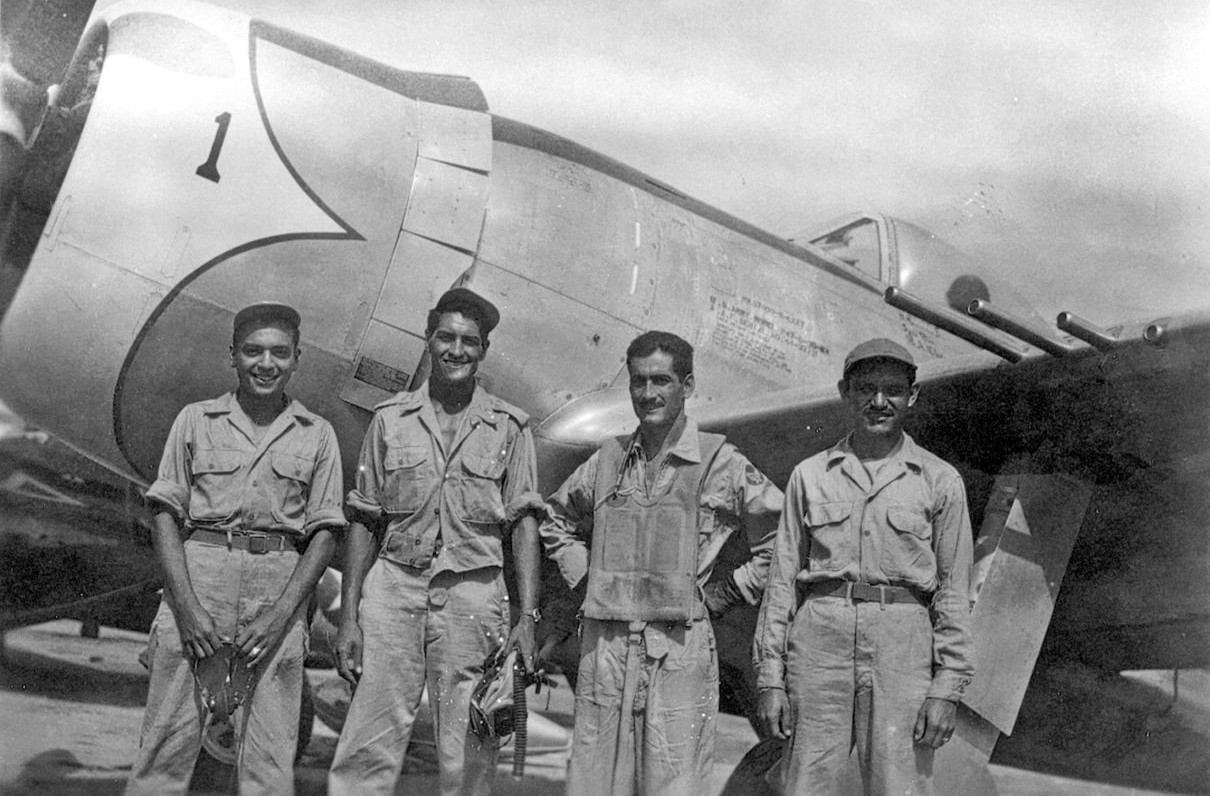
(This article by Lt. Col. Patrick J. Chaisson, USA (Ret), originally appeared in the September 2026 issue of Military Officer magazine.)
As one of more than 40 nations to join the Allied cause during World War II, Mexico played a little-known but meaningful role in the conflict’s outcome.
In 1945, a squadron of Mexican fighter pilots equipped and trained by the U.S. Army Air Forces (USAAF) entered the fight against Japan. Dubbed the Aztec Eagles, these courageous aviators flew 59 operational missions over the Philippine islands and Formosa (now Taiwan) throughout the war’s final months.
This is their story.
Drawn Into War
In June 1942, after losing several merchant ships to German submarines, Mexico declared war on the Axis powers. By the spring of 1944, the Mexican Expeditionary Air Force (MEAF) had been organized for duty overseas. At its heart was the Escuadrón Aéreo de Pelea 201, a fighter squadron that included 36 officers and 270 ground crew members.
Col. Antonio Cárdenas Rodríguez commanded MEAF headquarters, which coordinated administrative and logistical matters with Allied forces in theater. Capt. Radamés Gaxiola Andrade led Escuadrón 201. Importantly, both men spoke fluent English, as did many of their pilots and ground personnel.
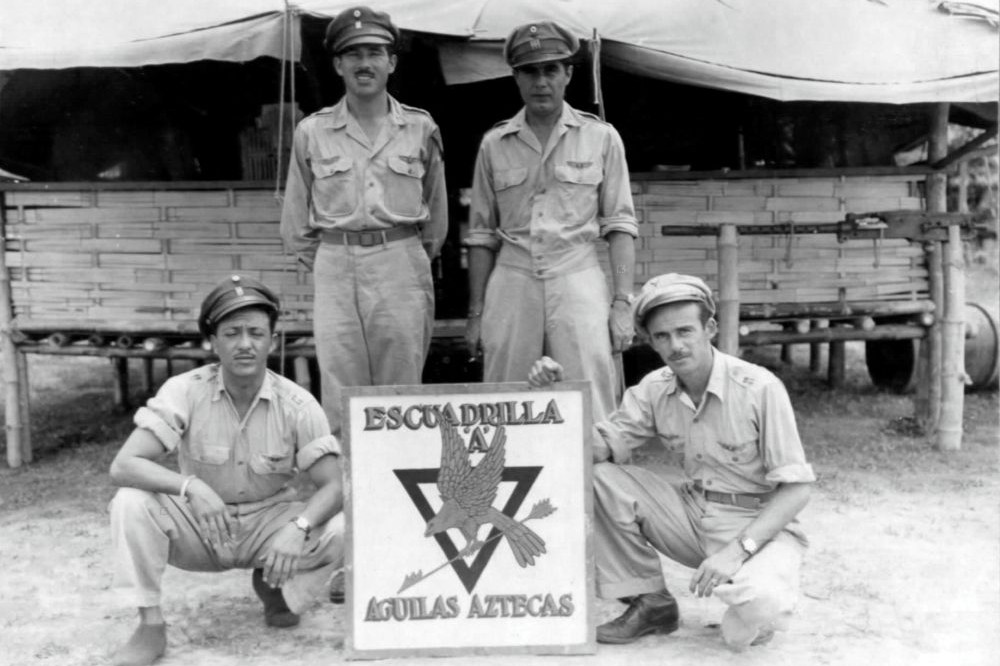
Officers with the A Flight unit of Escuadrón 201 pose with their logo at Clark Field on Luzon, Philippines, during the summer of 1945. (National Archives and Records Administration Photo)
In July, the Aztec Eagles were sent to air bases across the U.S. where they spent many months learning USAAF tactical procedures and advanced flying skills.
When in April 1945 the members of Escuadrón 201 were declared combat-ready, they deployed to the Philippines.
Based at Clark Field on the island of Luzon, the squadron became part of USAAF’s 58th Fighter Group. Equipped with Republic P-47D Thunderbolt fighter-bombers, the Mexican airmen began flying operational missions June 4. As USAAF pilots had nicknamed this rugged warplane the “Jug” (a moniker inspired by the Thunderbolt’s bottle-shaped fuselage), Mexican pilots followed suit by dubbing it “El Jarro.”
[RELATED: Wings of World War II]
On Luzon, aviators with Escuadrón 201 chiefly conducted close air support strikes against enemy ground targets, while also flying long-range fighter sweeps deep into Japanese-held territory.
Their P-47s wore several distinctive markings, aviation historian Jonathan Bernstein told Military Officer.
“The 201st’s airplanes were marked similarly to [USAAF] Thunderbolts,” Bernstein said, “but instead of having American red/white/blue markings on their rudders, they had the vertical green/white/red stripes of the Mexican flag.
“Their national insignia retained the U.S. star and bar on the fuselage [and the] upper left and lower right wings. But on the upper right and lower left wings, they added the Mexican tricolor triangle insignia.”
[MORE HISTORY: How a Test Pilot’s Tragic Death Changed Modern Aviation]
A Hero’s Welcome
Overcoming issues such as experience, and the language barrier, Escuadrón 201’s airmen established a solid operational record while on Luzon. The Aztec Eagles often flew in support of the U.S. Army’s 25th Infantry Division, earning several letters of commendation from that outfit during the war’s closing days.
Members of the MEAF also won decorations for their achievements, including the Philippine Presidential Unit Citation, numerous American awards, and the Mexican Far East Service Medal (Servicio en el Lejano Oriente).
The Aztec Eagles received a hero’s welcome when they returned home that autumn. Thousands of cheering citizens gathered to celebrate their service at a grand military parade held in Mexico City on Nov. 18, 1945.
During World War II, the fighter pilots of Escuadrón 201 completed about 800 individual aircraft sorties while accumulating nearly 2,000 hours of combat time. Seven aviators died in training accidents or operational mishaps.
The squadron’s contribution to victory, though small in scale, strengthened U.S.-Mexico relations and became a source of great civic pride.
To this day, the Aztec Eagles remain Mexico’s first and only military force to serve in combat outside of the country.
Lt. Col. Patrick J. Chaisson, USA (Ret), is a writer and historian in Scotia, N.Y.
Military Officer Magazine
Discover more interesting stories in MOAA’s award-winning magazine.