
(This article by Lt. Col. Patrick J. Chaisson, USA (Ret), originally appeared in the March 2026 issue of Military Officer, a magazine available to all MOAA Premium and Life members who can log in to access our digital version and archive. Basic members can save on a membership upgrade and access the magazine.)
When Freida Hardin enlisted for duty in World War I, women could serve their country but weren’t yet allowed to vote. When she was 101, former U.S. Navy Yeoman (F) 3rd Class Hardin summed up her service, saying: “We did our part and served with honor and distinction.”
With those words, she addressed a crowd of 40,000 dignitaries, friends, and veterans at the dedication of the Military Women’s Memorial (MWM) in 1997.
“To those women now in military service, I say: ‘Go for it.’ To those young women who may be thinking about a career in the military service, I say: ‘Go for it,’” Hardin said at the ceremony at the site of the MWM, located at Arlington National Cemetery in Virginia.
Hardin died in 2000 at age 103. Today, stories like hers inspire and inform those who visit the MWM. Military Officer recently toured the facility and its exhibits to learn more about the contributions of servicewomen from Revolutionary War times to the modern day.
Historic Site
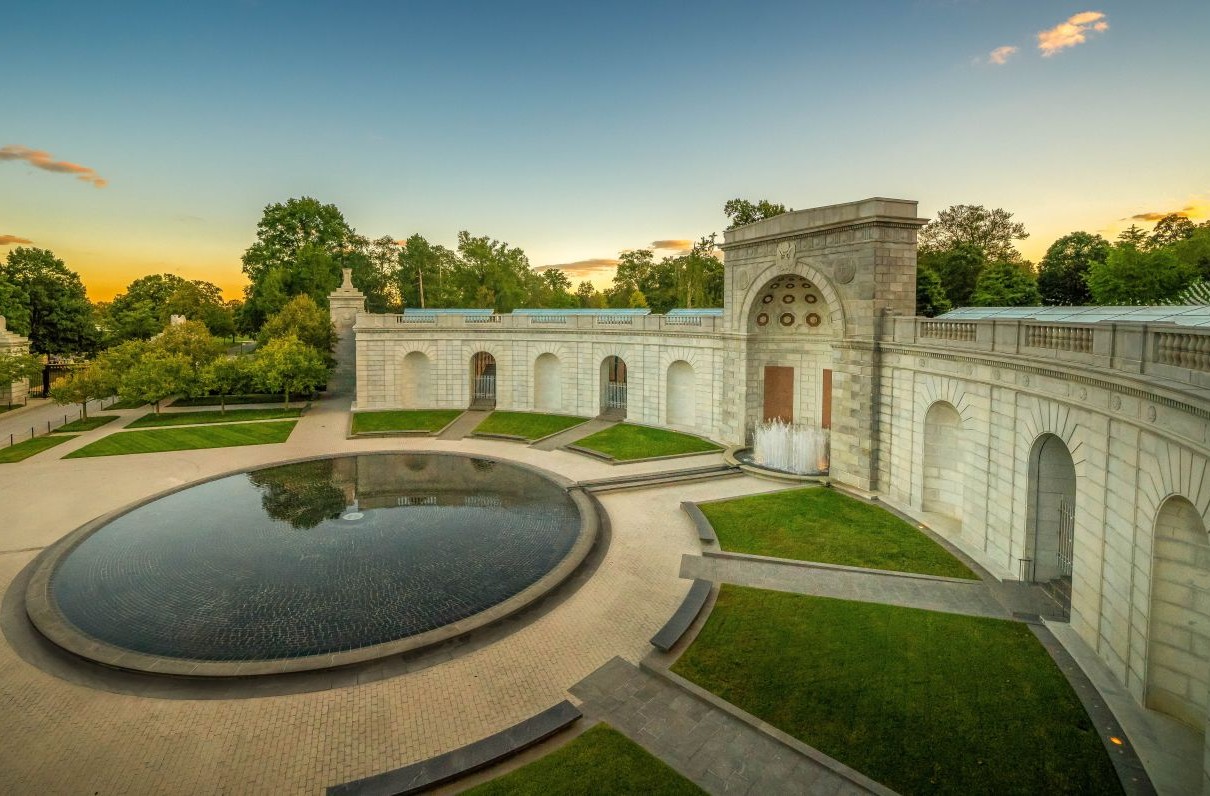
Visitors to the memorial will see the structure’s iconic facade, which was first constructed as a semicircular retaining wall located just inside Arlington Cemetery’s main gate. Although major construction was completed in 1932, the structure remained unfinished until 1986.
Inside the spacious memorial building are an exhibit gallery, a 33,000-square-foot education center, a large meeting space, a gift shop, and a room where veterans may register their personal histories in the Military Women’s Memorial Register.
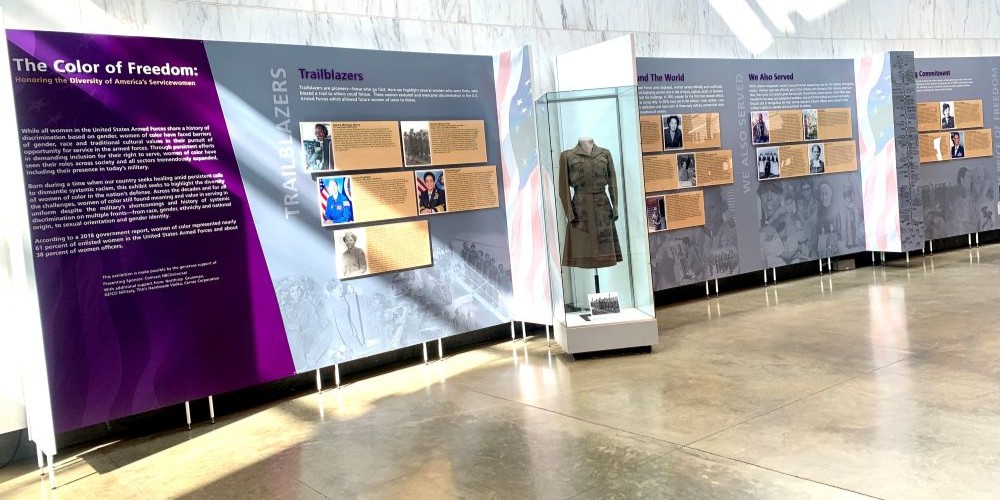
Women who were trailblazers in the military are highlighted in an exhibit at the Military Women’s Memorial.
The design of the memorial features skylights that on sunny days cast the reflections of quotations, by and about military women, onto the interior walls. This feature “illuminates the experience of servicewomen” in a remarkable way, said CW5 Phyllis Wilson, USA (Ret), president of MWM and a MOAA Life member.
Main Gallery
In the main gallery, visitors can examine artifacts, photographs, and first-person accounts that trace the evolving role of women in the service of their nation. The stories of such civilians as USO workers, Women Airforce Service Pilots of World War II, and American Red Cross volunteers in Vietnam are told here.
Each item on display is selected to illustrate the challenges and opportunities often unique to women’s service. Pointing to a pair of high-top “mosquito boots” worn by Army nurses in North Africa during World War II, Wilson said women adopted this unauthorized footwear because the knee-length uniform skirts they wore did nothing to protect their lower legs from insect bites.
‘Sea Change’
Lt. Col. Marilla Cushman, USA (Ret), senior advisor to the MWM president, related the story of Freida Hardin to introduce a special exhibit titled “A Sea Change: Navy Women on Combatant Ships.” Thirty years have passed since the regulation prohibiting female sailors from serving aboard warships was rescinded, Cushman said, a fact surprising to many of the memorial’s younger visitors.
“Women only got an opportunity to enter the armed forces because they were needed,” Cushman said. She noted a number of women veterans who overcame great obstacles in their quest to serve as members of the military.
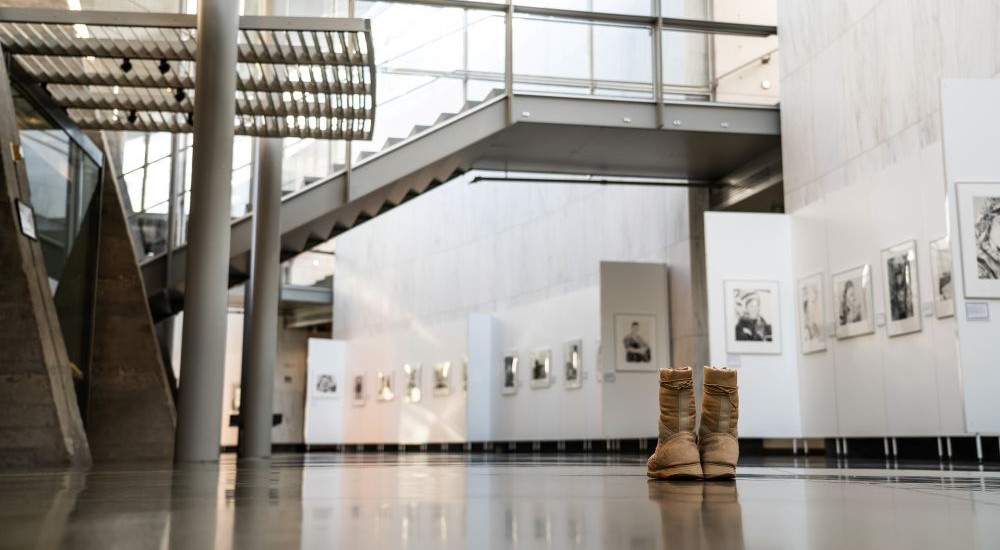
A pair of boots on display serve to illustrate challenges women faced during wartime.
The collections appeal to visitors both young and old. Here is a sample of exhibits and topics at the memorial:
World War I
At a display honoring the Army’s “Hello Girls” of World War I, Cushman said these 223 servicewomen, who ran telephone exchanges in France, did not receive formal veterans’ status until 1977, when just 18 of them were still alive to acknowledge that honor.
In 2024, the Hello Girls received belated recognition in the form of a Congressional Gold Medal.
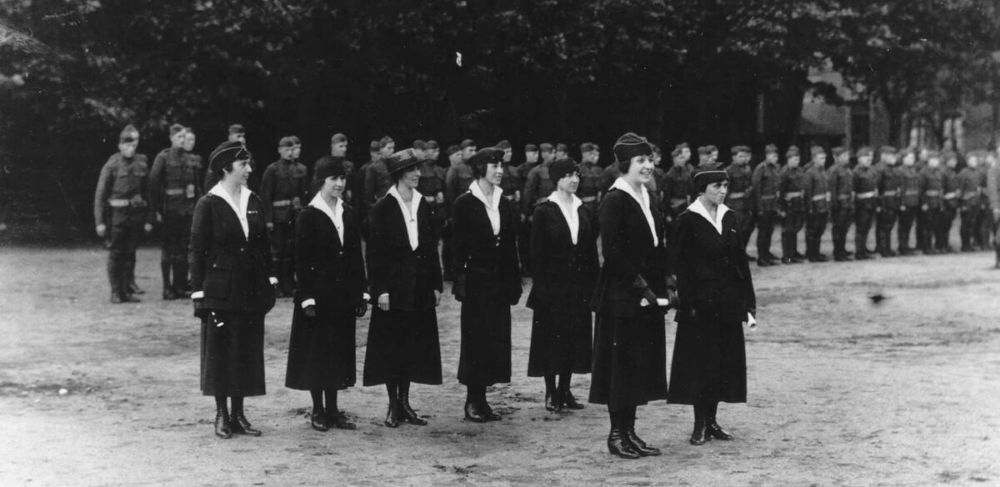
Members of the Signal Corps “Hello Girls” receive recognition for their work in France in World War I. (Army Signal Corps Archives)
Newsmakers
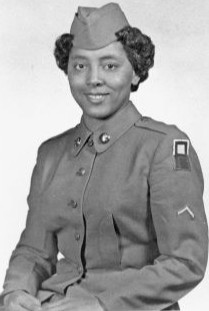 The MWM interprets social history as well as military history, Wilson and Cushman noted. For example, visitors can find the story of Army Pfc. Sarah Louise Keys, pictured, who in 1952 helped spark the civil rights movement when she refused to give up her seat to a white Marine while on board an interstate bus.
A lawsuit, which Keys won in 1955, might have helped inspire Rosa Parks of Montgomery, Ala., to perform a similar act of civil disobedience later that year.
Vietnam and Beyond
“The Vietnam Experience” display features personal items worn by American women in Southeast Asia during the 1960s and ’70s.
Nearby, a wall of watercolor paintings titled “The Changing Face of Courage” portrays modern-day women in the U.S. armed forces.
[RELATED: MOAA Members Produce Vietnam Film]
Hall of Honor
The Hall of Honor remembers those women who gave their lives in service to the nation or who received its highest awards.
Three “sister stones,” all cut from the same Colorado white marble as the Tomb of the Unknown Soldier, stand as silent sentinels watching over this solemn place of reflection.
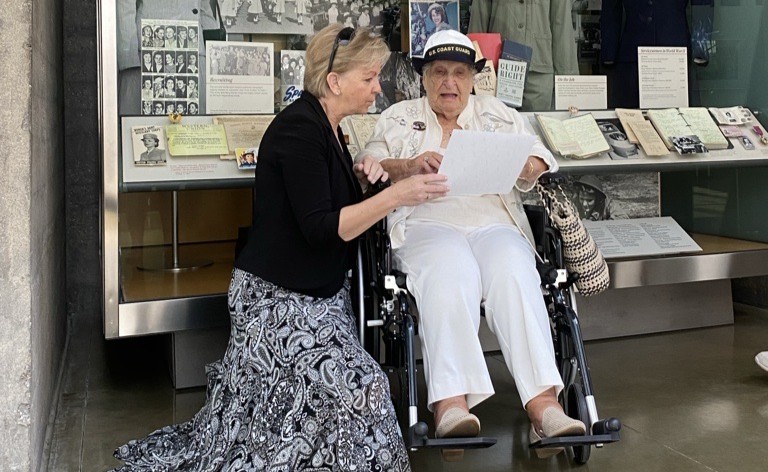
SK3 Elizabeth “Gena” Macres Fischle, a World War II veteran who served in the Coast Guard Women’s Reserve, received the MWM Living Legend Award from CW5 Phyllis Wilson, USA (Ret), in 2022.
New Exhibit
The newest special exhibit is “From War to Peace: World War II Opportunity, Postwar Domesticity,” open through May 1.
In 11 three-dimensional scenes, artist Vivian Cavalieri showcases trailblazers of World War II such as the Code Girls, the women of the 6888th Central Postal Directory Battalion, Women Airforce Service Pilots, and others.
The exhibit shows some of the critical roles of millions of women who served during the war with the expectation they would go back to traditional gender roles during peacetime.
But their value, experience, and skills made a lasting impression, and eventually legislation gave women greater opportunities for military careers.
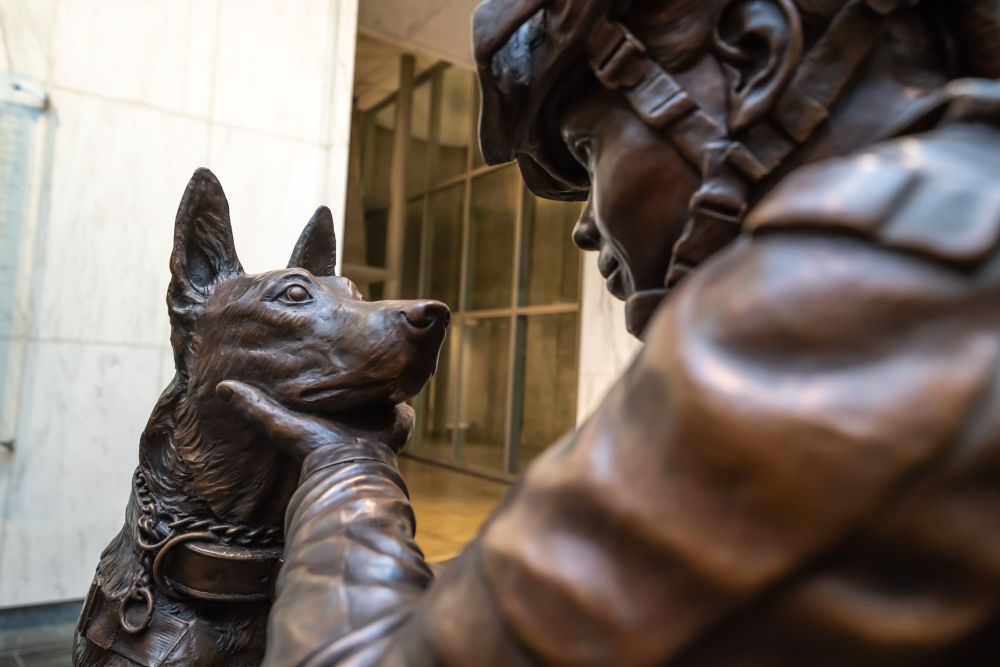
A statue entitled “The Pledge” captures a dog handler and her Belgian Malinois.
Virtual Tour
The memorial’s website and social media accounts “bring the stories of America’s servicewomen to people everywhere,” Clare Tomasetti, the MWM chief of staff, told Military Officer.
“Through our website,” Tomasetti said, “visitors can explore a virtual tour of the Military Women’s Memorial, view online exhibits, and search our growing collection of artifacts that showcase women’s service.”
Other online features, she said, include an educational curriculum and a schedule of the traveling exhibits.
More Online
The organization’s social media outlets, including Facebook, Instagram, and LinkedIn, help provide veterans, servicemembers, families, and supporters with a means to honor, uplift, and engage with those who served. Tomasetti recommends visiting the Memorial’s YouTube channel for the “HERstory Spotlight Series,” which brings to life powerful, often untold stories of servicewomen throughout the country’s history.
At MWM, visitors will discover many examples of courage, sacrifice, leadership, and innovation.
“We tell the story of women in the armed forces,” Wilson said, “but it is really the story of America and how women accepted great challenges to serve their nation. They helped change society.”
[RELATED: MOAA Life Member Recognized With Eagle Rising Award]
Telling Her Story
Since the American Revolution, approximately 3 million women have served the nation. But their stories have mostly gone untold. A nationwide network of more than 100 volunteer “ambassadors” aims to give those women a voice.
“We educate people about the Military Women’s Memorial,” said Lt. Col. Barbara Kucharczyk, USAF (Ret), who serves in Sumter, S.C., as an MWM ambassador.
Their mission involves connecting with women who have served, as well as local veterans’ organizations, to promote the memorial. As part of her outreach, Kucharczyk encourages eligible women and the families of deceased veterans to record their service with the Military Women’s Memorial Register. The register is an interactive database designed to preserve the personal histories of women who served either in the U.S. military or in support of those forces. It costs nothing to establish a profile, which then becomes part of a limited-access collection maintained by the MWM.
Those eligible for the register include any living or deceased woman veteran of the U.S. armed forces (active duty, Reserve, and Guard), U.S. Public Health Service Commissioned Corps, National Oceanic and Atmospheric Administration Commissioned Corps, Coast Guard Auxiliary, and Civil Air Patrol. Also eligible are women who served during wartime in direct support of the armed forces in such organizations as the U.S. Public Health Service Cadet Nurse Corps, Red Cross, USO, Office of Strategic Services, Women Airforce Service Pilots, and Special Services.
[RELATED: MOAA Joins Other Advocacy Groups on Capitol Hill to Support Women Veterans]
A typical profile includes dates of service; branch of service; awards and decorations; at least one memorable experience; and a photo, in uniform if possible. Full profiles can be viewed by people who’ve already created an account or who visit the Memorial’s Register Room.
Veterans often use the register to search for former shipmates or battle buddies and view their profiles, Kucharczyk said. Family members or friends may also establish an account to honor a woman’s service.
Thanks largely to the efforts of ambassadors like Kucharczyk, the stories of more than 333,500 women in service have been preserved. All eligible women, and the families of those who have died, may create a profile on the register.
“By telling her story,” Kucharczyk said, “we help complete the nation’s history.”
Lt. Col. Patrick J. Chaisson, USA (Ret), is a writer and historian based in Scotia, N.Y.
Military Officer Magazine
Discover more interesting stories in MOAA's award-winning magazine.