
(This article by Lt. Col. Patrick J. Chaisson, USA (Ret), originally appeared in the March 2026 issue of Military Officer, a magazine available to all MOAA Premium and Life members who can log in to access our digital version and archive. Basic members can save on a membership upgrade and access the magazine.)
A group of U.S. National Guard and Army Reserve soldiers deployed to the West African nation of Mali for a routine but important exercise for two weeks in February 2012. Their mission: Train the Malian Defense Force in air resupply operations.
Instead, the 250 American logistics experts on the ground in Mali found themselves supporting a real-world combat operation, said Col. Reggie Sanders, USA (Ret), their commanding officer at the time who recently told Military Officer about his experiences there.
Representatives from U.S. Africa Command (USAFRICOM) invited his unit, the 369th Sustainment Brigade, to lead an aerial delivery exercise in cooperation with Mali’s armed services, said Sanders, a Premium member of MOAA. The training event, Atlas Accord 12, was designed to promote regional stability while strengthening partner nations’ logistics capabilities.
While in Mali, the New York City-based 369th — nicknamed the “Harlem Hellfighters” for its soldiers’ combat record in World War I — would be joined by National Guard detachments from Texas, Utah, and West Virginia as well as a Utah-based Army Reserve medical unit. French-speaking Canadian troops were to accompany the task force as interpreters.
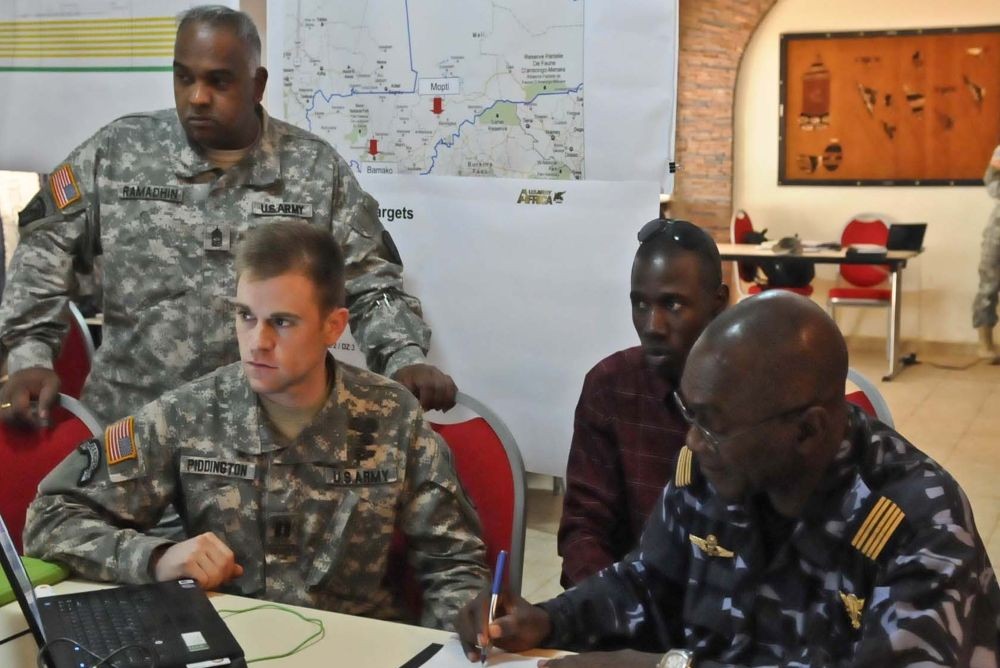 Capt. Timothy Piddington of the 369th Sustainment Brigade, New York Army National Guard, front left, and Aly Koundou Coulibaly, task force commander and chief of operations with the Malian Defense Force, front right, coordinate training with staff for the exercise in Sevare, Mali. (Photo by Staff Sgt. Shana R. Hutchins/Army)
The Harlem Hellfighters arrived in Mali’s capital city, Bamako, just as its residents filled the streets to celebrate their national soccer team winning a championship match. Sanders recalled speaking on the telephone with U.S. Army Africa’s commanding officer, Lt. Gen. David Hogg, to assure him the celebration in Bamako was peaceful and not a riot as others had reported.
Moving to the town of Mopti, Sanders met with his exercise co-director, Malian Defense Force Col. Aly Koundou Coulibaly. For Atlas Accord 12, Coulibaly and Sanders hosted logisticians from Algeria, Burkina Faso, Niger, Senegal, Tunisia, and Uganda as well as Mali.
Exercise objectives included developing theater-specific drop zone expertise, rigging knowledge, improved air crew operations, forward aerial refueling capabilities, and staff planning proficiency focused on logistics-themed aerial delivery.
Midway through the event, Sanders received an urgent phone call from USAFRICOM.
“It was a change of mission,” he remembered. “The Malian Defense Force needed our help.”
Ethnic tensions simmering in Mali’s northernmost region had just boiled over into direct conflict with soldiers stationed there to keep the peace, Sanders said.
[RELATED: Inside Operation Desert Storm’s ‘Fright Night’]
The Malian troops urgently required a resupply of water, ammunition, and medical supplies. It was a perfect mission for Sanders’ logisticians, but one that first required permission from U.S. Ambassador Mary Beth Leonard and Hogg.
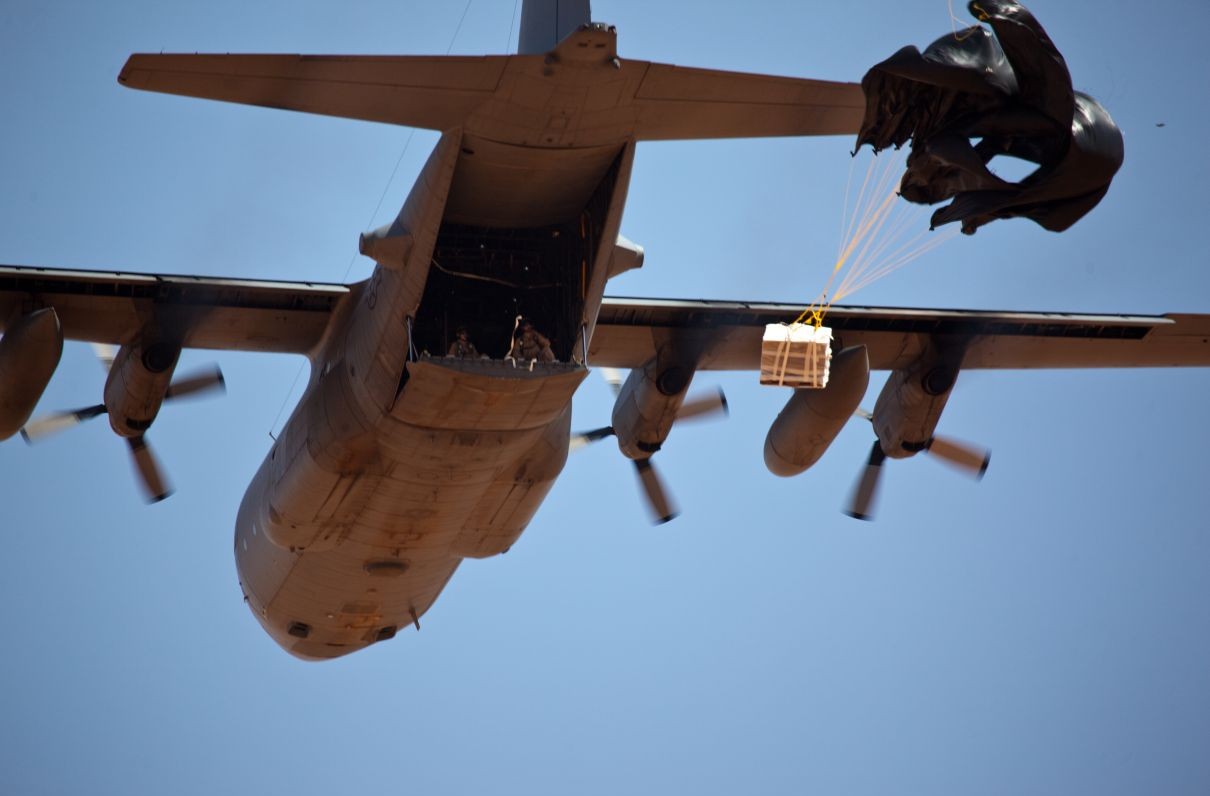
Once they obtained approval, the American soldiers and their Malian partners began rigging several 463L air cargo pallets for parachute delivery by three U.S. Air Force C-130 Hercules transport planes en route from Italy.
“Everyone was stoked” to use their pallet-rigging skills in a real-world operation, Sanders recalled. Malian troops, now trained in marking drop zones, went forward to ensure the cargo was put on target. It all worked as planned.
‘Culture of Confidence’
For the National Guard and Reserve soldiers who participated in Atlas Accord 12, their experience in Mali was a memorable one. Sanders has fond recollections of an impromptu soccer match held in Mopti between Malian players and their American guests. The game, which ended in a tie, “was a great way to show our fellowship on the soccer pitch.”
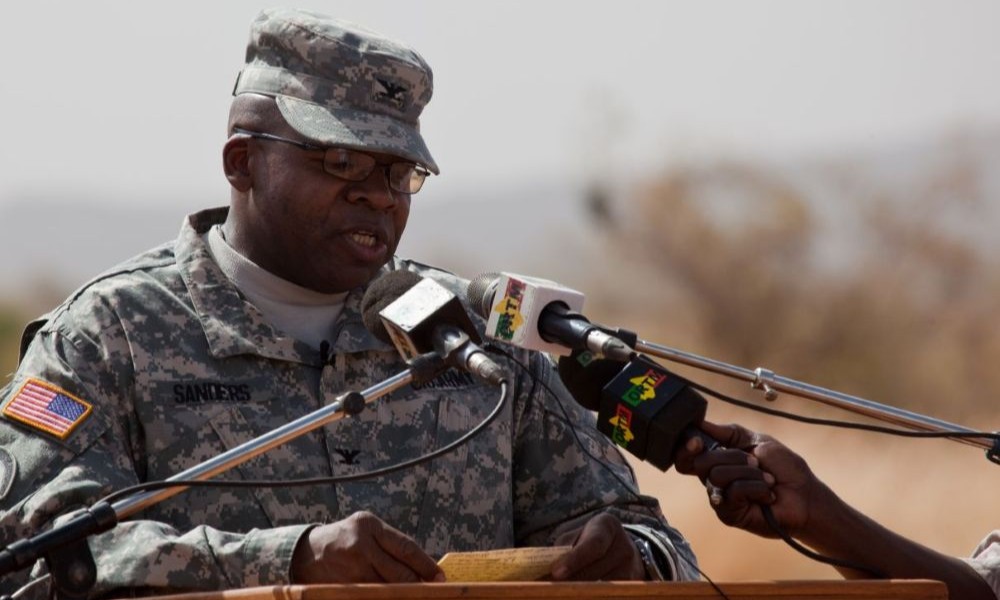
Col. Reginald Sanders, USA, speaks during the opening ceremony for Atlas Accord 12 at the Mopti Airfield in Sevare, Mali, on Feb. 9, 2012. (Photo by Spc. Kimberly Trumbull/Army)
The 369th Sustainment Brigade later conducted two more logistics exercises in Gabon and Cameroon. Lessons learned during those missions came in handy when the Harlem Hellfighters deployed to Southwest Asia in 2016 and 2022.
Among these lessons, said Sanders, was the need to trust junior officers and let them lead. The Hellfighters created “a culture of confidence” that enabled the unit’s lieutenants and captains to take charge and make decisions in Mali.
For Sanders, who in civilian life works for Bridgestone Americas, one highlight of Atlas Accord 12 was his opportunity to act as an ambassador for the U.S. military. At the exercise’s closing ceremony, he delivered his remarks in French — sending a clear (if heavily accented) message of the United States’ commitment to its international partners.
Lt. Col. Patrick J. Chaisson, USA (Ret), is a writer and historian based in Scotia, N.Y.
Military Officer Magazine
Discover more interesting stories in MOAA's award-winning magazine.