
(This article by Rita Ellen Stone originally appeared in the April 2026 issue of Military Officer, a magazine available to all MOAA Premium and Life members who can log in to access our digital version and archive. Basic members can save on a membership upgrade and access the magazine.)
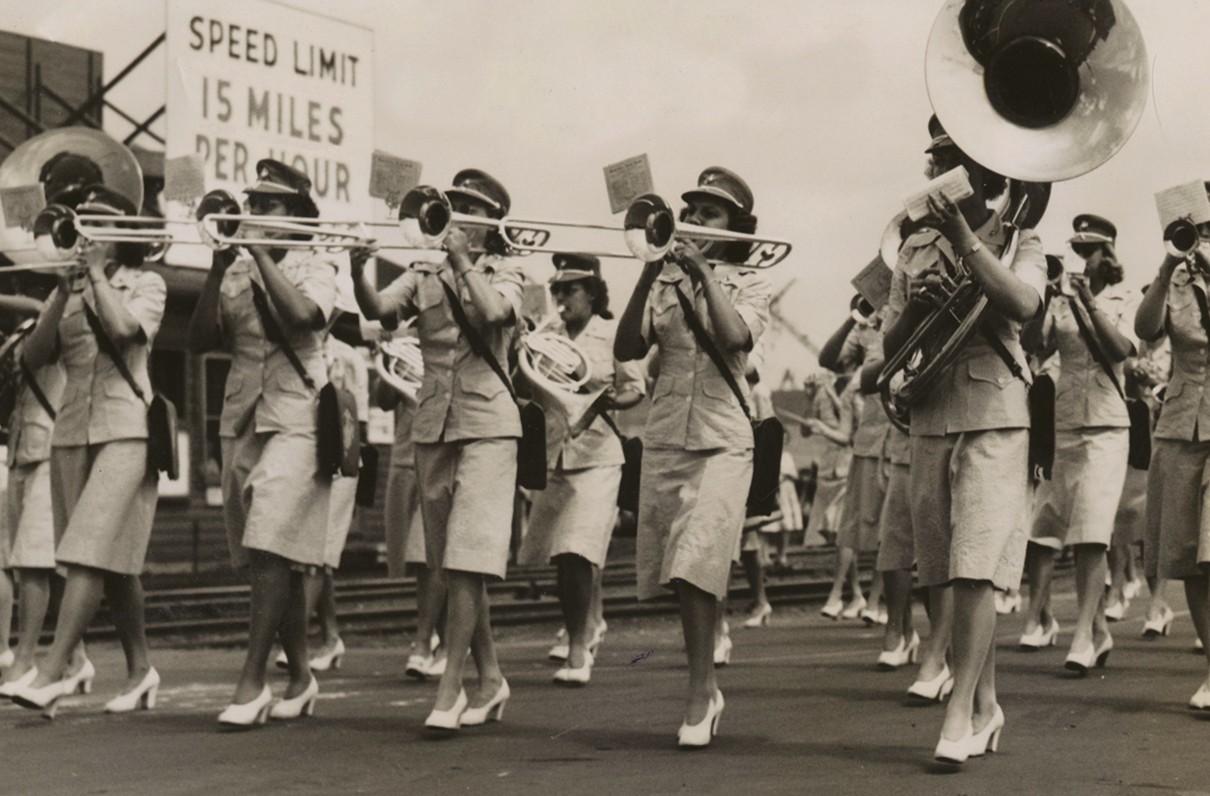
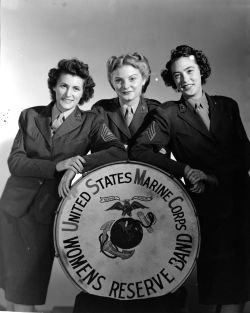
In 1943, a group of women enlisted in the U.S. Marine Corps and coalesced as the only all-female Marine Corps band in the history of the service.
They were full-time Marines who had completed basic training at Camp Lejeune, N.C. Yet many were surprised to serve as musicians in the newly created Marine Corps Women’s Reserve Band, filling positions vacated by male instrumentalists sent overseas to fight.
The Marines were the last of the services to form a women’s band. Gen. Alexander Vandegrift, who was in line to become commandant of the Marine Corps, ordered the director of the United States Marine Band, Capt. William Santelmann, to find and organize talented women Marines at Camp Lejeune into a full-time marching and concert band.
Santelmann assigned three musicians from the all-male band — The President’s Own — for the task. Those three were Sgts. Charles Owen for percussion, Andrew Bodner for woodwinds, and Edward Masters for the brass section.
When the three sergeants arrived at Camp Lejeune, they scoured records of enlistees and found women with musical experience. Charlotte Plummer had been the director of music for the public schools in Portland, Ore., and became director of the women’s band. Others had been working as clerks in corporations and played on a part-time basis in local symphony orchestras.
 One woman grew up in a Salvation Army family and played the double bell euphonium. Another was making minesweepers in a defense plant and brought her trombone to Camp Lejeune. A woman who played the bugle would learn all 96 regulation bugle calls.
Bonnie Smallwood, a music teacher from Oklahoma, had enlisted to “free a Marine to fight.” She felt she had a good voice and could become a control tower operator, but her pronounced southern accent disqualified her. Instead, she played percussion in the Women’s Reserve Band.
The band raised money playing for war bond drives. They played for the wounded at hospitals, for parades, and during drills. They entertained returning troops with concerts and as a smaller jazz band for dances.
Their music greeted trains with new enlistees and those returning in flag-draped caskets.
After World War II ended, many of the female musicians used the GI bill to further their education, joined civilian women’s bands, or became full-time homemakers.
The band dissolved after just two years in existence. Smallwood married a Marine she met at Camp Lejeune and became the historian for the group of band alumni at 67 strong.
In March 1973, the United States Marine Band in Washington, D.C., accepted its first woman musician, a French horn player who by 1980 was first chair.
Rita Ellen Stone is a writer, musician, and educator based in Guilford, Conn.
Military Officer Magazine
Discover more interesting stories in MOAA's award-winning magazine.