
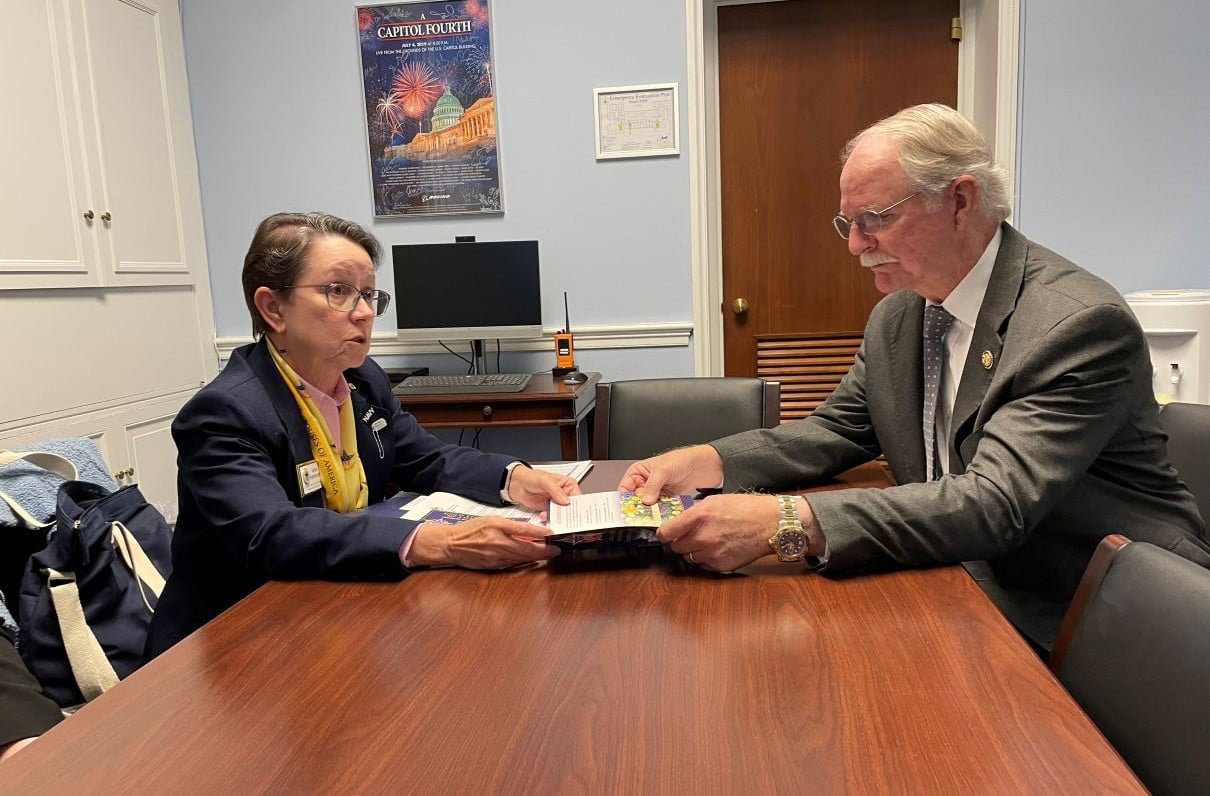
Gold Star spouses from around the country arrived in Washington, D.C., this month to meet with Congress and advocate on behalf of all uniformed services survivors.
“It is our job to educate them about the issues. There are too many bills for any one person to know about all of them,” said Kathy Prout, a MOAA Life member and founding member of Gold Star Spouses of America (GSSA).
The organization led an April 21 campaign on the Hill that included several MOAA members and staff among the advocacy teams meeting with legislative leaders.
“Everyone should have the opportunity to see how democracy works,” said Prout, who was honored this year as one of MOAA’s 2025 Changemakers. “I feel so fortunate to be able to participate in our government through grassroots advocacy.”
[RELATED: This Bill Would Support Grieving Military Families. It Has Reached a New Milestone in Congress]
GSSA outlined three legislative priorities, and MOAA backs each of them:
The Caring for Survivors Act (H.R. 2055 | S. 611). Dependency and Indemnity Compensation (DIC) rates for survivors of those who die in the line of duty, or of veterans who die of service-connected ailments, have been only minimally adjusted since 1993. They now rest at 43% of a 100% disabled veteran’s compensation; this bill would raise that rate to 55%, resulting in about $450 more per month and matching the compensation percentage offered by similar federal programs.
The bill also allows more survivors who have cared for a disabled veteran to claim DIC benefits. Current law requires a veteran to have been totally disabled by a service-connected condition for at least 10 years for a survivor to qualify for DIC. The Caring for Survivors Act would reduce this to five years.
[TAKE ACTION: Send a Letter Via MOAA’s Legislative Action Center]
The Sharri Briley and Eric Edmundson Veterans Benefits Expansion Act (H.R. 6047). This bill would increase the rate of DIC to provide additional financial support for survivors and increase the rate of Special Monthly Compensation (SMC) to boost financial support for catastrophically service-connected disabled veterans. The bill is named for Sharri Briley, widow of CWO3 Donovan Briley, an Army Black Hawk pilot killed in Somalia in 1993, and for Eric Edmundson, a former Army sergeant who suffered shrapnel wounds, a heart attack, and a brain injury after his Humvee struck a roadside bomb in Iraq in 2005.
[GOLD STAR SPOUSES OF AMERICA: Advocacy Priorities]
The Love Lives on Act (H.R. 1004 | S. 410). This bill would allow surviving spouses to maintain certain benefits, including DIC and Survivor Benefit Plan payments, regardless of the age at which they remarry. Current law revokes these benefits if the spouse remarries before age 55, leaving many young spouses a stark choice: Restore a two-parent household or maintain financial security.
[TAKE ACTION: Ask Your Lawmakers to Support the Love Lives on Act]
MOAA Life member Julie Hammond, a Gold Star Spouse and retired Navy Reserve captain, met with Rep. John Rutherford during the Hill Day event. When hearing Hammond make her case for the Love Lives On Act, the Florida Republican told her his name would be on the bill tomorrow. He kept his word.
Hammond’s husband was killed in a 1986 helicopter accident 10 miles off the coast of Mayport, Fla.
With only a small percentage of Americans willing to serve, and a small percentage of those families enduring the death of their servicemember in the line of duty, Gold Star spouses risk being forgotten, Hammond acknowledged. Advocacy efforts like GSSA’s Hill Day are essential.
“We could easily disappear into nothing,” she said. “Us being here, seeing our face, interacting with us, hearing our stories, makes a big difference.”
When MOAA Speaks, Congress Listens
Learn more about MOAA’s key advocacy issues, and contact your elected officials using our messaging platform.