
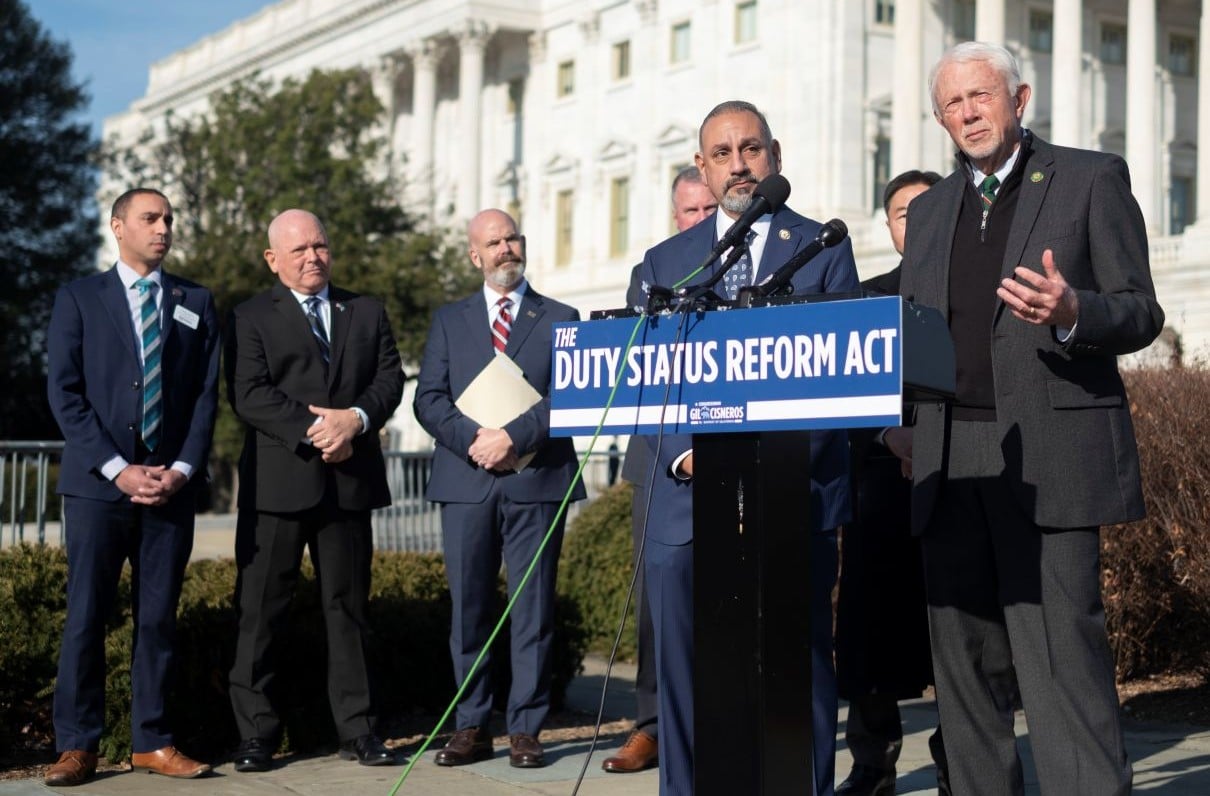
A new bill would dramatically simplify the reserve component’s duty status classifications to fix unfair pay and benefits disparities servicemembers have dealt with for years.
The Duty Status Reform Act (H.R. 6976), introduced Jan. 8, would reduce duty statuses from 30 to just four.
“This legislation simplifies the Pentagon's access to the reserve forces helping maintain mission readiness and enhancing force posture,” said Jimmy Santos, MOAA’s director of government relations for currently serving affairs. “For servicemembers in the Guard and Reserve, it guarantees equal delivery of benefits to include health care and the housing allowance.”
[TAKE ACTION: Ask Your Lawmakers to Support Duty Status Reform]
Reps. Jack Bergman (R.-Mich.) and Gil Cisneros (D-Calif.), announced the bill in a Jan. 8 press conference outside the U.S. Capitol. The bill is cosponsored by Reps. Sam Graves (R-Mo.) and Ted Lieu (D-Calif.). In addition to MOAA, the bill has the support of the National Guard Association of the United States, Reserve Organization of America, and Enlisted Association of the National Guard of the United States.
MOAA has advocated for years that the confusing and numerous duty classifications has negatively impacted servicemembers’ abilities to count time for benefits like the Post-9/11 GI Bill and for family access to military health care.
The new bill would create just four duty categories, according to Cisneros’ bill explainer:
- Contingency duty. Active service in which the member is involved in contingency operations such as military action or operations; responding to a national emergency or natural disaster; or similar missions. This covers post-deployment activities.
- Training and support: Active service that does not involve a contingency operation. This may include required training, administrative assignments, support to reserve units, and members reported missing.
- Reserve component: Partial-day duty dedicated to readiness training and support to prepare individuals and units to be ready for future use and mobilization. Includes training periods, flight training, administrative activities, and support activities such as funeral honors support.
- Remote assignments: Online learning and individually assigned duties that are completed virtually.
[RELATED: Guard and Reserve Early Retirement Rule Change: Here’s What to Know]
“We owe it to our servicemembers to deliver this much-needed change and ensure they are receiving equitable pay and benefits,” said Cisneros, a Navy veteran and former undersecretary of defense for personnel and readiness.
Bergman, a retired Marine Corps lieutenant general, said the bill would improve readiness and reduce bureaucracy.
“It cuts through decades of red tape to make sure those who serve get consistent benefits, clear orders, and the support they’ve earned,” he said. “Whether they’re responding to disasters at home or missions abroad.”
When MOAA Speaks, Congress Listens
Learn more about MOAA’s key advocacy issues, and contact your elected officials using our messaging platform.