
(This article by MOAA staff originally appeared in the April 2026 issue of Military Officer, a magazine available to all MOAA Premium and Life members who can log in to access our digital version and archive. Basic members can save on a membership upgrade and access the magazine.)
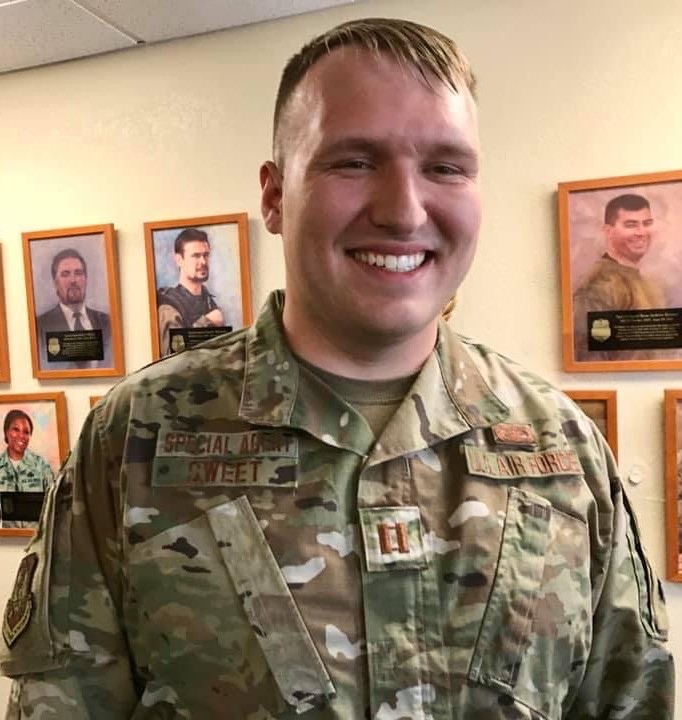 Philip Sweet, pictured, commissioned into the Air Force in 2017 after graduating from the U.S. Air Force Academy. He went on to serve as a special agent in the Air Force Office of Special Investigations and served in multiple assignments, including a tour in a combat zone. Six years later, he decided it was best for his family to separate from active duty and finish his career in the reserves.
But, in June 2024, the Air Force captain’s “life was upended” when he was medically retired for combat injuries.
When filling out the paperwork to set up his military retirement account, he learned he would now be among the approximately 54,000 combat-injured veterans subject to a cost-saving offset where their retirement pay is reduced for every dollar of VA disability received. This offset costs Sweet and his wife and two young children over $4,500 a month.
“Financially, we miss out on some of the money we should be receiving for my service and sacrifice,” Sweet said. “We feel as though my service is lessened because of my medical retirement.”
[RELATED: Star Act Stories]
The Major Richard Star Act would remedy this injustice. Sweet has been writing to his lawmakers and sharing his story to raise awareness about why the legislation needs to pass.
“If I received the full benefits I earned, my family’s life would be completely changed,” he said. “It’s time for Congress to honor the contract I signed at 18 years old.”
The Star Act is one of the four priorities MOAA advocates will take to Capitol Hill during the association’s 2026 Advocacy in Action campaign.
On April 15, MOAA members from across the nation will join association leaders and staff to visit congressional offices and meet in person with lawmakers and their staff. But all MOAA members and their networks, whether in Washington, D.C., or remote and at home, are encouraged to join in the effort. Visit our Advocacy in Action page to learn more and download issue papers on each topic, and be sure to register in MOAA’s Legislative Action Center to receive timely calls to action.
Here are this year’s four key advocacy topics, why they matter, and what actions MOAA is asking for:
Major Richard Star Act
Why it matters: Medically retired servicemembers injured in combat lose some or all of their earned retirement pay because of an outdated offset, despite having earned retirement through service and disability compensation through sacrifice. Correcting this policy restores fairness, honors commitments made to wounded warriors, and strengthens trust in the all-volunteer force.
Key facts:
- Medically retired, combat-injured servicemembers often lose retirement pay due to a dollar-for-dollar offset with VA disability compensation.
- Congress previously authorized concurrent receipt for retirees with 20-plus years of service and a 50% or higher disability rating, leaving medically retired veterans behind.
- Approximately 54,000 combat-injured veterans receive Combat-Related Special Compensation (CRSC) but are not eligible for Concurrent Retirement and Disability Pay (CRDP).
- Nearly 28,000 of these veterans have 10 or more years of service and would financially benefit from the option to choose CRDP.
- The Congressional Budget Office estimated the cost at $9 billion over 10 years, assuming full participation, though actual costs are likely lower due to the continued use of tax-free CRSC by many veterans.
- Nearly three-quarters of both chambers of Congress currently support the Major Richard Star Act.
The ask: Pass the Major Richard Star Act (H.R. 2102/S. 1032) and phase in implementation over five years, while leveraging the existing CRSC/CRDP open season to responsibly manage costs. This corrects a long-standing injustice for combat-injured retirees and restores fairness in military compensation.
Shutdown Fairness Act
Why it matters: Members of the uniformed services continue to serve even when government funding lapses, often without timely pay or benefits. This creates financial stress for servicemembers and their families, disrupts retirement credit accrual for reserve component members, and threatens mission readiness. A permanent legislative solution ensures those who commit to public service are not subject to the uncertainty of political negotiations or repeated shutdowns.
Key facts:
- During a lapse in appropriations, active duty servicemembers perform their duties without guaranteed pay or benefits.
- Reserve members have to suspend inactive duty training, affecting both mission readiness and retirement service credit.
- Servicemembers must still cover essential family expenses, including rent/mortgage, utilities, child care, and commuting, often relying on loans or outside assistance, which incurs long-term costs.
- Government shutdowns are frequent: The first FY 2026 shutdown marked the 208th continuing resolution since FY 1977, highlighting the chronic nature of this uncertainty.
The ask: Pass the Shutdown Fairness Act (H.R. 7317/S. 3168) to ensure members of the armed forces will continue to receive pay and benefits while Congress determines relevant appropriations for the remainder of government operations. This legislation also enables drill-status reservists to continue performing inactive duty training. MOAA supports the addition of an amendment that extends this protection to all members of the uniformed services.
Governing Unaccredited Representatives Defrauding (GUARD) VA BENEFITS ACT
Why it matters: Predatory, unaccredited companies exploit veterans navigating the VA disability claims process, charging thousands of dollars for services that are legally available for free through accredited representatives. These actors use misleading contracts, aggressive marketing, and contingency-based fees, eroding trust in the VA system and harming veterans and their families. Restoring accountability ensures veterans receive professional, ethical assistance while protecting the integrity of earned benefits.
Key facts:
- Federal law allows only accredited representatives, including attorneys, claims agents, or veterans service organizations, to assist veterans with VA disability claims for compensation.
- In 2006, Congress removed the VA’s enforcement authority over unaccredited actors charging unauthorized fees, creating a regulatory gap exploited by predatory companies.
- Over 40 unaccredited companies actively market themselves as “consultants” or “coaches,” charging contingency-style fees that can total tens of thousands of dollars.
- Veterans report aggressive, targeted marketing; misleading contracts; and long-term payment obligations, often with minimal or no added assistance.
- Aging veterans and newly eligible claimants under the PACT Act are particularly vulnerable to these sophisticated predatory practices.
- VA enforcement is limited to cease-and-desist letters, which have proved largely ineffective, allowing most companies to continue operating and charging unauthorized fees.
The ask: Pass the Governing Unaccredited Representatives Defrauding (GUARD) VA Benefits Act (H.R. 1732) to reinstate fines on individuals for soliciting, contracting for, or receiving any unauthorized fee or compensation with respect to the preparation, presentation, or prosecution of any claim for VA benefits. Take steps to enhance awareness of reporting tools that allow claimants to submit complaints about individuals or organizations assisting with VA claims.
Military CARE Act
Why it matters: Patients at military treatment facilities (MTFs) often face appointment shortages, unanswered calls, and referral delays, making it difficult to access earned medical care. These access barriers disproportionately affect active duty members and their families who rely on MTFs. A standardized, transparent system for reporting access issues would provide new data on beneficiary challenges, allowing leaders and Congress to identify and resolve systemic problems, ultimately strengthening the health and readiness of the force.
Key facts:
- MTF patients, including servicemembers, retirees, families, and survivors, regularly encounter delays and obstacles in receiving care.
- TRICARE policies limit plan changes to annual open enrollment or qualifying life events, which can trap beneficiaries in MTFs that do not meet their needs.
- Existing complaint systems (like the Interactive Customer Evaluation application) are inconsistent and underused.
- The Military CARE Act requires a standardized digital platform for beneficiaries to submit and track MTF access-to-care issues.
- Submissions will be routed to the appropriate patient advocate and aggregated for use by the Defense Health Agency to address systemic and fixable problems.
- The bill mandates MTFs to report on the most common access complaints and to document steps taken to reduce them, increasing transparency and accountability.
- Bipartisan support and backing from MOAA and other military and veterans’ organizations emphasize its importance to military families and overall readiness.
The ask: Cosponsor the Military CARE Act (H.R. 6796) to improve access to care at military hospitals and clinics through enhanced data, transparency, and accountability.
When MOAA Speaks, Congress Listens
Learn more about MOAA’s key advocacy issues, and contact your elected officials using our messaging platform.