
This article originally appeared on Stripes.com. Stars and Stripes serves the U.S. military community by providing editorially independent news and information around the world.
This year was unusually busy for Army and Air National Guard personnel, with deployments to support natural disaster response and recovery and crime prevention and federal protection missions.
The year began with wildfires in the Los Angeles area, prompting the call-up of more than 2,700 members of the Guard. Those fires claimed over 30 lives and destroyed more than 16,000 structures in one of the most expensive natural disasters in U.S. history.
Later that month, about 7,800 troops with the Guard were on duty in the Washington area for the inauguration of President Donald Trump. At his inauguration, the president vowed to send members of the Guard to the southern border, which he soon did.
[MOAA PUBLICATION: Guard and Reserve Retirement Guide]
In February, troops in Kentucky rescued nearly 300 people from one county in a single day from deadly floods that killed over a dozen people. Guard members in Indiana also contributed to the rescue efforts.
In April, over 800 Michigan National Guard personnel assisted recovery efforts after an ice storm left thousands without power.
In June, about 4,000 California National Guard troops were federalized and deployed to Los Angeles on what would be the first of a series of controversial deployments to protect federal personnel, property and deter crime.
In July, hundreds of Texas National Guard personnel helped rescue hundreds of people from flooding that killed dozens, including 27 children at a summer camp.
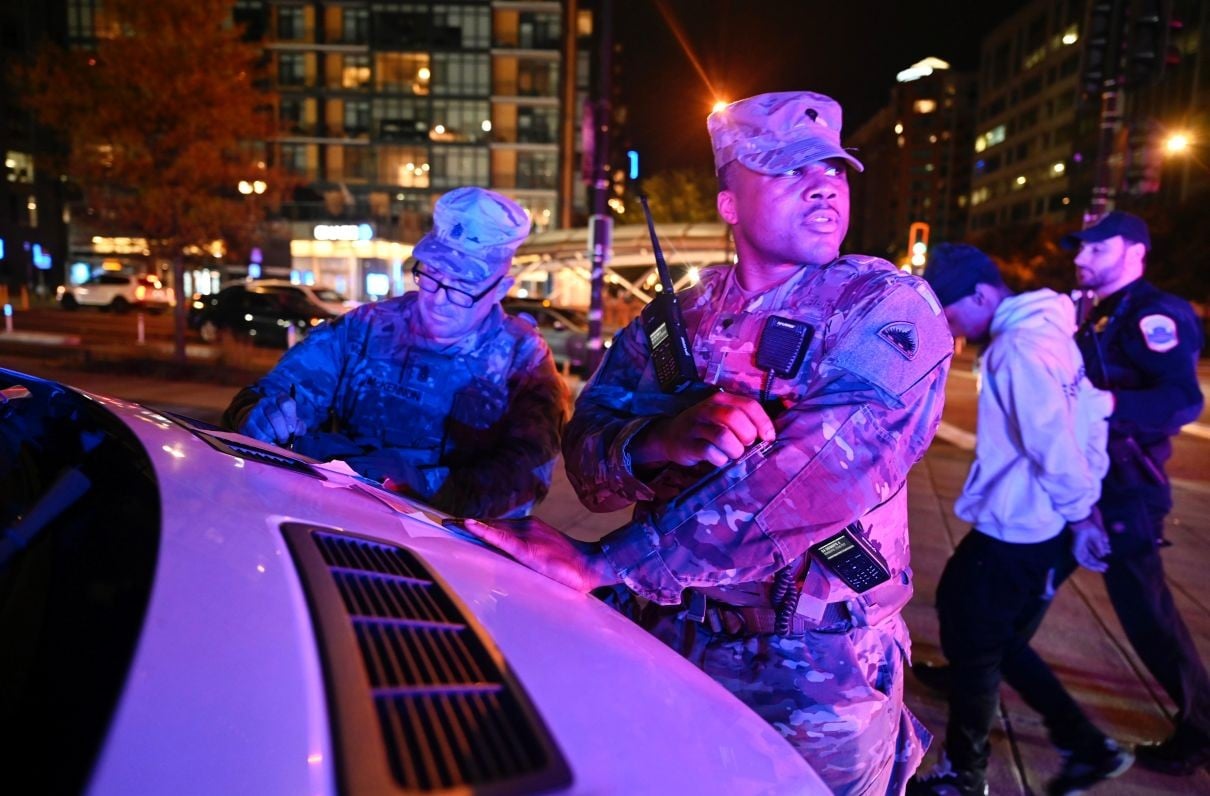
In August, about 800 D.C. National Guard troops were deployed throughout the nation’s capital to crack down on crime. Hundreds of troops from other states later joined the mission.
[RELATED: What to Know About a Guard and Reserve Early Retirement Rule Change]
In October, about 400 Texas National Guard troops went to Illinois for a federal protection mission akin to the one in Los Angeles.
Also in October, the Alaska Air and Army National Guard evacuated over 1,500 people from remote communities struck by Typhoon Halong in what was likely the largest airlift in the state’s history.
In November, two personnel with the West Virginia National Guard on patrol in Washington were shot in a targeted attack. Spc. Sarah Beckstrom died from her injuries, and Staff Sgt. Andrew Wolfe was in critical condition. Wolfe has since been slowly recovering.
In December, up to 300 National Guard personnel in Washington state were mobilized to support rescue efforts in the wake of catastrophic flooding that ultimately caused at least one death and 400,000 people to lose power.
[MOAA WEBINAR: Understanding Your Guard and Reserve Benefits]
The unusually busy schedule of domestic deployments coincided with the regular overseas deployments of National Guard troops.
One of those recently included a tragedy.
This month, two soldiers with the Iowa Guard became the first U.S. casualties in Syria in a year, when a lone gunman attacked their patrol. One other American, a civilian contractor, was also killed. The soldiers’ remains returned home to Iowa last week.
Concerns about overstretching forces needed in the event of natural disasters and other emergencies were expressed by lawmakers with the initial deployment of troops to Los Angeles and Washington. Legislators also expressed concerns about cost.
But Mark Ditlevson, the Pentagon official overseeing the policies and plans related to the missions, testified before the Senate this month that the deployments are a “modest burden” on the Defense Department, and most of the incurred costs are reimbursable by the Department of Homeland Security.
The Guard in 2025 beat its recruiting goal for the second fiscal year in a row. In September, Air Force Gen. Steven Nordhaus, the National Guard’s top general, praised the Guard’s recruiting apparatus but also noted the Trump administration’s use of the force for a variety of new missions has increased its visibility and likely contributed to a recruiting boost.
[RELATED: Recruiting Off to ‘Strong Start’ for Fiscal 2026, Pentagon Says]
Stars and Stripes reporters Svetlana Shkolnikova and Corey Dickstein contributed to this report.

Resources for Currently Serving Officers
MOAA can help you succeed in your military career and beyond.