

(This article by Hope Hodge Seck originally appeared in the January 2026 issue of Military Officer, a magazine available to all MOAA Premium and Life members who can log in to access our digital version and archive. Basic members can save on a membership upgrade and access the magazine.)
With major military policy and equipment development initiatives underway and an emerging conflict taking shape in the Caribbean, the work of the U.S. uniformed services remains in sharp focus at the start of 2026.
Service leaders are looking to stay ahead of the nation’s strongest adversaries by leaning into new technologies like autonomy, artificial intelligence, and drones. Meanwhile, an ambitious missile shield plan might put the newest service — the Space Force — on the map like never before.
The new year brings a focus on priorities for the National Oceanic and Atmospheric Administration (NOAA) and the U.S. Public Health Service (USPHS). Here’s a look at what’s ahead for the uniformed services in the coming year.
‘Department of War’
In September, the Defense Department got a rebrand when President Donald Trump renamed it the Department of War by executive order. But the name, which the U.S. military’s supervisory department carried from 1775 to 1947, wouldn’t be official without Congress confirming it.
The Department of War Restoration Act was introduced Sept. 2 in the House and Senate.
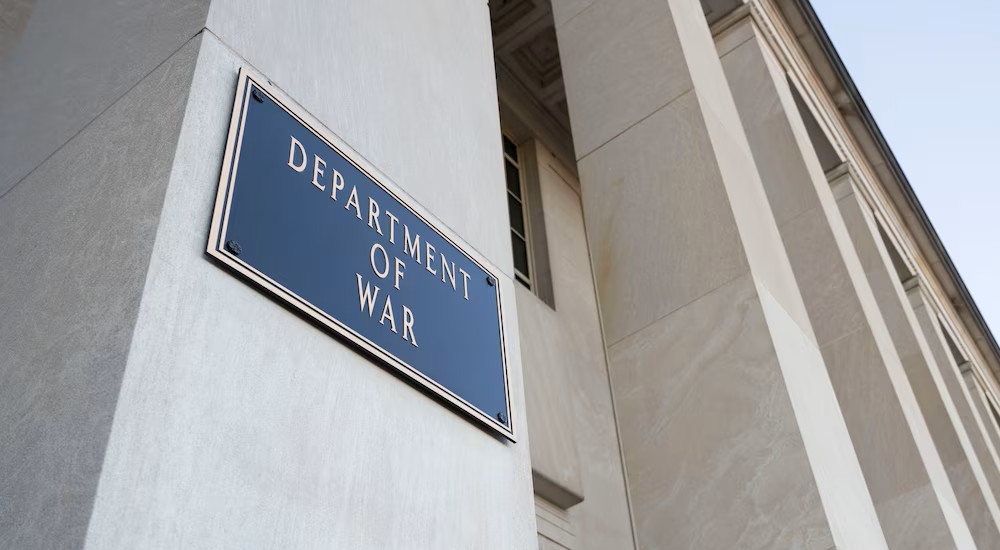
“Restoring the name ‘Department of War’ will sharpen the focus of this department on our national interests and signal to adversaries America’s readiness to wage war to secure its interests,” White House officials have said.
Standards and Training Review
In a historic in-person address to all active general and flag officers in Quantico, Va., Secretary Pete Hegseth warned that military training is paramount and those in uniform who couldn’t meet standards would be shown the door. Top military leaders have been considering the results of a 60-day review of training standards ordered by Hegseth in a memo and requiring leaders to report any changes to standards since 1990, with an eye to restoring any rigor that has been lost.
Other memos issued at the same time call for a validation of physical fitness tests, new guidance on performance as well as height and weight standards, and reduction of mandatory computer-based training requirements in order to spend more time on readiness.
Hazing Rules Get New Look
Decisions were also forthcoming on a review of rules around how terms including “hazing, bullying, and harassment” are defined. In his speech, Hegseth described a desire “to empower leaders to enforce standards without fear of retribution and second-guessing.”
Former basic training mainstays, including “putting hands on recruits” and swearing, would be restored, he said, to make training “scary, tough, and disciplined.” Rules would remain in place, he added, to prevent recklessness.

President Donald Trump discusses the Golden Dome missile defense shield in the Oval Office on May 20. (White House photo)
Golden Dome Takes Shape
Major moves are coming in 2026 for Trump’s Golden Dome national missile defense shield concept. In 2025, Golden Dome received $24.4 billion in funding through the One Big Beautiful Bill reconciliation package and received a dedicated czar in Space Force Gen. Michael Guetlein. With announced plans to make the shield operational by 2029, this year will be critical for the Pentagon to award major contracts and implement the “objective architecture” Guetlein was ordered to create for the program by fall 2025.
The first major test of the yet-to-be-created Golden Dome intercept system has been scheduled to take place before the 2028 elections.
Modest Pay Bump
The FY 2026 National Defense Authorization Act is set to include a 3.8% pay raise. The bump, which stays in line with civilian wage growth calculations, continues the trend since 2017 of raising troop pay at least 2% every year.
The past three years, which also had significant inflation trends, saw historically high raises of 4.6% in 2023, 5.2% in 2024, and 4.5% in 2025. The latest raise comes on the heels of the 43-day government shutdown, in which Trump took the extraordinary step of ordering the Pentagon to use research and development accounts to pay servicemembers.
[RELATED: 3 Ways to Protect Servicemembers and Veterans From the Next Shutdown]
COLA Increase
While the government shutdown delayed an announcement from the Social Security Administration, officials in late October finally confirmed the cost-of-living adjustment affecting veterans with a disability rating of 10% or higher. At 2.8%, the COLA is a slight increase from the modest 2.5% adjustment delivered last year, which was itself the smallest COLA bump since 2021.
Based on Consumer Price Index data, the adjustment represents the year-over-year inflation increase. In 2023, the COLA bump was 8.7% — the largest such raise since 1981.
[RELATED: MOAA's COLA Watch]
Separation Allowance Might Expand
Family separation allowance — pay troops receive when duty separates them from their dependents for more than a month — might see a sizable jump.
The House version of the defense budget bill would require the Pentagon to raise this allowance from $250 per month to $400, the first increase in more than 20 years. Last year’s budget bill included language to allow the Pentagon to increase the stipend, but the military has yet to take action on it.
The House bill turns the allowance increase into a mandate. But it would need to survive a reconciliation process with the Senate version of the bill, which does not include this provision.
Military Pilot Cancer
A bill signed by Trump in May 2025 will fund a long-range research effort into links between a dozen different kinds of cancers and military fixed-wing aircrew members who were exposed to various chemicals and toxins in the course of their duty. The law, supported by MOAA, requires a study on the “prevalence and mortality” of these cancers to be conducted by the National Academies of Sciences, Engineering, and Medicine in partnership with the VA.
[RELATED: Report Will Target Cancer Rates in Aircrews, But Toxic-Exposure Work Is Far From Finished]
The law follows a 2023 Pentagon study that found outsized and concerning incidence of certain cancers for pilots who served between 1992 and 2017.
Army
National Guard missions expand: Following a year that saw more than 2,000 National Guard troops deployed to Washington, D.C., to support municipal crime-fighting and beautification efforts, and hundreds more sent to places like Los Angeles and Portland, Ore., in response to protests, interest in using the Guard to address domestic problems seems to be increasing. In his address to generals, Trump said he’d told Hegseth to use “dangerous” American cities as training grounds for the Guard, beginning with Chicago.
Meanwhile, National Guard deployments to the pronation’s southern border continue as the White House emphasizes the need to focus national security efforts on the homeland.

A soldier with Alpha Company, 1st Battalion, 29th Infantry Regiment, 316th Cavalry Brigade, carries the Ghost-X Unmanned Aircraft System after an experimental flight on March 11, 2024, at Fort Irwin, Calif. (Photo by Sgt. Charlie Duke/Army)
Drone-fighting mission launches: Under orders from the Pentagon and the White House to “unleash drone dominance,” the Army is leading the charge to develop and field weapons to the military and U.S. agencies to defeat enemy uncrewed systems. Joint Interagency Task Force 401, established in August, puts the Army secretary in charge of efforts to counter the growing drone threat and lead information-sharing with military and civilian partners.
With an implementation plan already designed and delivered, 2026 will see the emergence of a dedicated test range for counter-drone technology along with rapid fielding of systems that promise to build out a multilevel arsenal for drone defense.
Marine Corps
New attack drones: As the Marine Corps leans into using drones as battlefield weapons with the Attack Drone Team of experts it created in 2025, it’s also distributing these systems throughout the fighting force. In early 2026, two battalions of Marines will receive new loitering munitions for testing, including during upcoming deployments, service officials said in April. The goal is to field the drones “at scale” before the end of the year.
Known as Organic Precision Fires-Light, the drone systems, carried by rifle squads, will help these units to spot and attack the enemy.
Barracks overhaul gets underway: A nearly $11 billion strategy to transform enlisted on-base housing and improve living conditions for Marines is set to begin in earnest in 2026. The Barracks 2030 initiative is set to kick off a 10-year housing refresh cycle, replacing the former 30-year version, and establish accountability and reporting mechanisms to address cases of squalor and dilapidation that have surfaced through watchdog reporting.
Set for completion by 2037, the effort will update and improve common areas and provide “well-deserving sergeants” an allowance to live off-base.
Navy
Caribbean missions intensify: As the White House declared war on South American drug trafficking operations, more ships and personnel headed to the Caribbean region. As of mid-November, approximately 15,000 U.S. troops had arrived in the area, many onboard Navy warships including the service’s largest aircraft carrier, USS Gerald R. Ford (CVN-78) and its strike group, and the three-ship Iwo Jima Amphibious Ready Group.

USS Gerald R. Ford (CVN-78) arrives in St. Thomas, U.S. Virgin Islands, on Dec. 1 as part of a Caribbean deployment. (Navy photo)
A particular focus is Venezuela, the originating country for several alleged drug boats targeted by the U.S. in covert strikes. As Venezuelan President Nicolás Maduro responded to this military buildup with threats, the U.S. Navy is poised to be on the front lines of an intensifying conflict.
Next-gen fighter gets green light: After nearly two decades of speculation and deliberation, the Navy’s future fighter jet is about to take shape. In October, the Pentagon agreed to plans for what has long been dubbed the F/A-XX, clearing the way for a manufacturer to be selected and design work on the jet to begin.
Like its predecessor, the F/A-18 Super Hornet, the sixth-generation F/A-XX will be carrier-based. A crewed fighter, the future jet is expected to have roughly 25% more range than the Super Hornet, sport stealthy characteristics, and be capable of operating in collaboration with uncrewed platforms.
Air Force
Expanded bonuses en route: As the Air Force works to fill mission-critical job fields with talented troops, it plans to make big investments in financial incentives.
Its spending plan for 2026 included a request for $141 million in enlistment bonuses — nearly triple the amount for 2025 — with plans to award them to more than five times as many airmen. Those eligible for the bonuses will commit to serving four to six years and will likely be designated for the hardest-to-fill military specialties, including cybersecurity and missile and space systems. The Space Force, which has no problem meeting enlistment targets but competes for talent against high-paying civilian employers, is requesting similar expansions in bonus funding and troop eligibility.

Air Force trainees take part in their official physical fitness test during Basic Military Training at Joint Base San Antonio-Lackland, Texas, in 2024. (Photo by Gregory Walker/Air Force)
New physical fitness test: In keeping with an intensified Pentagon-wide focus on physical fitness, the Air Force will roll out a new and more exacting physical fitness assessment (PFA) in 2026. The new test, which will begin in March as an adjustment period and will be officially scored beginning in September, adds a 2-mile run and requires all airmen to take the test semiannually.
A body composition assessment, which was removed from the PFA in 2021 amid COVID-19 restrictions, will also return in the new test. To help airmen prepare, the service in September released The Warfighter’s Fitness Playbook, a manual for building muscle, preventing injury, and fueling for performance.
Space Command and Space Force
Space Command moves: The combatant command responsible for military missions in space is relocating to Rocket City. The move of Space Command from Peterson AFB, Colo., to the Army’s Redstone Arsenal in Huntsville, Ala., comes as the command takes on a leading role in developing the Golden Dome missile defense shield concept.
While Trump has said the move would result in 30,000 new Alabama jobs, it’s not yet clear how many Space Command employees will relocate from Colorado. Space Command has set another challenge: It’s working with the Space Force to close loopholes and integrate classified systems into the service’s command-and-control architecture by 2026 in an effort to be “ready for contested space,” officials have said.

Space Force Senior Master Sgt. Brandi Gonzalez walks the Hap Arnold hallway while wearing the branch’s Service Dress Uniform at the Pentagon on Aug. 22. (Photo by Chad Trujillo/Air Force)
Dress uniforms arrive: In a milestone for the newest service branch, the Space Force will field new dress uniforms, designed by and for Guardians, in 2026.
“Our service dress uniform represents the unique identity of Guardians, blending heritage with a modern design that reflects our unity and mission,” Chief of Space Operations Gen. Chance Saltzman said.
The uniforms, which have undergone tailoring and design changes based on early feedback, are made from a polyester-wool blend with Lycra, featuring a distinctive asymmetric button line on the jackets, a high collar, and silver trim.
Guardians who order the uniform will receive it by June 2026; a mandatory wear date isn’t set.
Coast Guard
Construction to begin on six icebreakers: After years of struggling to make do with a limping pair of old icebreakers, the Coast Guard might finally get the Arctic-capable fleet its leaders have long sought. In October, the White House announced Louisiana-based Bollinger Shipyards would lead a team to build six multipurpose icebreakers using an established commercial design.

The Storis (WAGB-21) is the first polar icebreaker acquired in more than 25 years by the Coast Guard. (Photo by Petty Officer 3rd Class Carmen Caver/Coast Guard)
In partnership with Finland through the Icebreaker Collaboration Effort Pact signed in 2024, the Coast Guard now has a path to acquire up to 11 “Arctic security cutters,” with five planned to be delivered as soon as 2028. In 2025, the service christened its first icebreaker in a quarter-century: the Alaska-based Storis.
Budget boost buys ships, helicopters: A $25 billion allocation in the One Big Beautiful Bill reconciliation package will help the service fund its Force Design 2028 modernization strategy. In what Adm. Kevin Lunday, then the Coast Guard’s acting commandant, referred to as the start of “a new era for the Coast Guard,” the service plans to buy more than 40 new MH-60 helicopters, six HC-130J aircraft, and nine offshore patrol cutters, as well as invest $4.4 billion in infrastructure, training facilities, and home ports.
The Coast Guard emphasized the funding would strengthen its ability to combat drug trafficking, a high-priority mission under the Trump administration.
U.S. Public Health Service
Expanded leave benefits: A legislative move to grant USPHS officers equal leave benefits as military servicemembers has been gaining momentum. The Uniformed Services Leave Parity Act, introduced by bipartisan groups of military veterans in the House and Senate, would include the 6,000-plus USPHS officers in military leave policies. Supported by MOAA, the bill passed the Senate in October, clearing the way for its consideration in the House.
[TAKE ACTION: Support the Uniformed Services Leave Parity Act]
“When disease or disaster threatens our public safety, PHS officers are on the front lines helping keep the American people healthy and out of harm’s way,” Sen. Tammy Duckworth (D-Ill.) said of the bill. “There’s no reason they shouldn’t have the same leave benefits that officers of the Army, Navy, or any of our other uniformed services do.”
NOAA
New leader sets priorities: Confirmed in October to lead the National Oceanic and Atmospheric Administration, meteorologist Neil Jacobs is in his second term at the organization’s helm. In confirmation hearings, Jacobs said he’d make filling staffing gaps at the National Weather Service (NWS) a “top priority.”
Hit hard by deep staffing cuts that saw the departure of some 600 employees out of about 4,300, NWS reportedly resorted to double shifts and has seen some centers cut back on services. In a statement provided to the Senate Committee on Commerce, Science, and Transportation, Jacobs also said he’d work to embrace new NOAA partnerships for cloud-based data sharing, “return the United States to the world’s leader in global weather forecast modeling capability,” and reduce the seafood trade deficit.
Hope Hodge Seck is a writer based in the Washington, D.C., area.
Military Officer Magazine
Discover more interesting stories in MOAA's award-winning magazine.