By Kristin Davis
The bench on display in the lobby of the Renwick Gallery in Washington, D.C., captivated Maj. Bob Johnson, USA (Ret), the first time he saw it in 2025. He admired the live-edge wood used on the bench seat, the deceptive complexity of old snow shovel handles that formed its back.
What had once been used for a back-breaking winter chore now helped create a place to rest.
Johnson appreciated that. During his time on active duty, he spent weekends making furniture in woodshops on military bases. While in the Army Reserve, he had worked as a homebuilder and was fascinated by architectural moldings and cornice work.
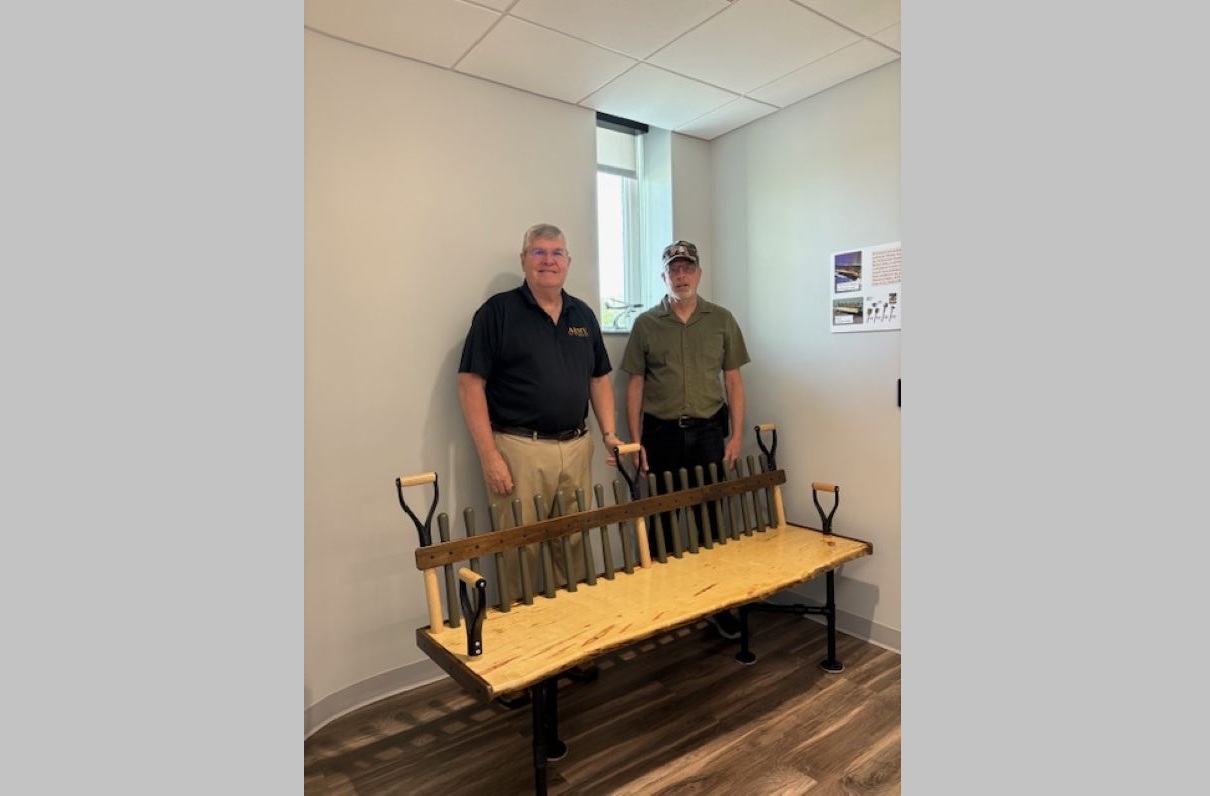
The George Nakashima-style bench in the Renwick was created by Thomas Loeser and gave Johnson an idea: Find a woodcrafter in his city of Hendersonville, N.C., who could make a similar piece of furniture. But instead of using discarded snow shovel handles, Johnson would use old military shovel handles.
He recalled the D-handled shovels that came standard on old military jeeps and was well-versed in the bone-wearying work of digging foxholes. Inspired by his father’s long military career — the elder Johnson was part of the original Green Berets, retired as a colonel, and became the president of the Central New Jersey Chapter of MOAA — Johnson entered the Virginia Military Institute (VMI) during the Vietnam War. Following graduation in 1974, he served in the Army and Army Reserve until his retirement in 1995, with active duty assignments in the 82nd Airborne Division at Fort Bragg, N.C., and the 2nd Infantry Division in Korea, along with active Reserve service in the 108th and 91st divisions.
[GET INVOLVED: Find a MOAA Chapter | MOAA Virtual Chapters]
Twelve years later, in 2007, Johnson was recalled to active duty and volunteered to go to Afghanistan. He was 55.
“I was working in the construction field. I felt like I needed to go back in again,” he said. “At VMI, you’re taught to serve your country, especially when it needs you. I felt it needed me, and I thought I could do it.”
Johnson worked hard to get back into shape. After two months of grueling training at Fort Bragg that included living in a tent for six weeks, he headed to Afghanistan. He then went on to serve at the Pentagon and Arlington National Cemetery before retiring for a second time in 2013. From 2014 to 2022, Johnson was a civil servant in Washington, D.C., retired again, this time for good, and moved back to Hendersonville.
For his bench, Johnson found old entrenching tool handles for sale online.
“I bought a slab of wood 6 feet long from a sawmill in the country. We ran it through the planer, and it turned out to be a beautiful Manitoba maple,” Johnson said.
He turned to Robert Sebby, a fellow craftsman with Apple County Woodcrafters, to construct it. “It’s very intricate work to cut the wood and get the shovel handles to fit in perfectly and solidly. Sebby had the skill and attention to detail to do it,” he said.
The nonprofit then donated the bench to the Hendrick-Rhodes Veterans Center and VFW Post 5206 in Hendersonville.
“It’s a piece of art,” said Johnson, a member of MOAA’s Western North Carolina Chapter. But it’s also a story. “Soldiers dig these foxholes in training and in combat. In wartime, it will save your life. Anyone who comes into the building would remember digging foxholes.”
But the tools that once represented backbreaking labor now offer respite to veterans whose hard work is done.
Kristin Davis is a writer in Virginia.
Want to Help Servicemembers in Your Community?
Learn how you can make a difference with your local chapter.