
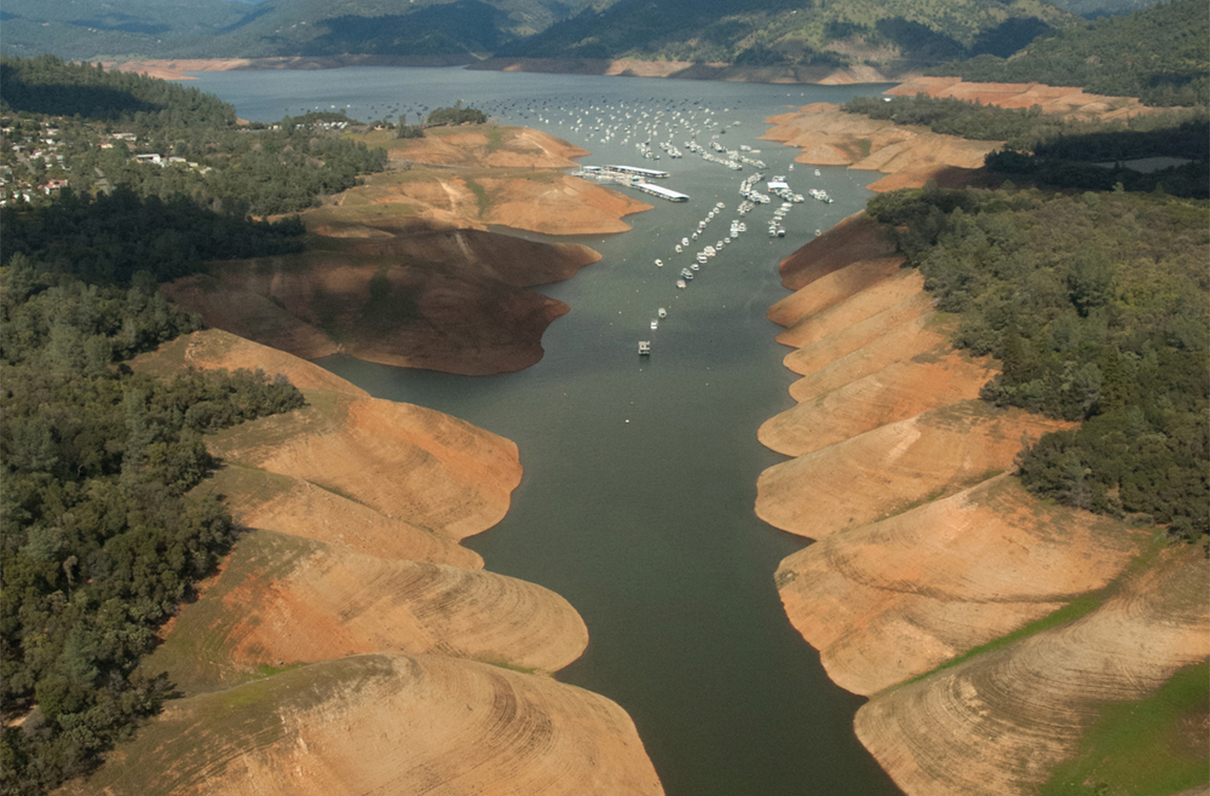
Photo: California Department of Water Resources
For exclusive photos view the full featured article from our January 2016 issue.
Water scarcity affects every continent. Currently, one-fifth of the world's population lives in areas of water scarcity, resulting in severe food shortages and a high incidence of infectious disease. And water has no substitute.
Unlike other resources, such as energy or food, water cannot be replaced by new sources. By 2025, two-thirds of the world's population, including those living in the U.S., could be under stress conditions.
Scarcity at home
Water scarcity - a lack of sufficient usable water to meet demand - is not unique to typically arid regions. You need only turn to the state where Americans get the majority of their food: California. In a recent television interview, Dr. Jay Famiglietti, a hydrologist, professor, and senior water scientist at NASA's Jet Propulsion Laboratory, explained the situation in California: “Snow and rain are like the income. Our reservoirs are like the checking account, and the groundwater is like a long-term reserve. So we have no income right now, the checking account is running out … and we are hitting that groundwater really, really hard, and it's disappearing really, really rapidly.” According to an article by Famiglietti in the LA Times in March 2015, NASA satellite data show “the amount of water stored in the Sacramento and San Joaquin river basins was 34 million acre-feet below normal in 2014. That loss is nearly 1.5 times the capacity of Lake Mead, America's largest reservoir.”
But California is not alone, says Denise Gutzmer, a drought impact specialist with the National Drought Mitigation Center (NDMC) at the University of Nebraska-Lincoln. The center's Nov. 3 2015, U.S. Drought Monitor map shows Idaho, Montana, Nevada, Oregon, and Washington have exceptional or extreme drought conditions, while other areas of the West have severe drought conditions. And even with all the snowfall the Northeast experienced this past winter, the region is deemed abnormally dry.
Water scarcity causes
The U.N. says water scarcity is both a natural and a human-made phenomenon. A growing and more affluent global population requires ever-increasing amounts of food and energy. Demand will continue to strain the supply because more than 80 percent of worldwide freshwater is used for energy, livestock, and crop production. It takes, for example, a gallon of water to grow a single almond.
Lack of effective water resource management is another contributing factor; contamination, deforestation, waste, poor infrastructure controls, and overpumping of groundwater diminish water supply.
Changes in climate and weather patterns play a role, too, reducing snowpacks and triggering glacier melting, which adversely affect water accumulation in reservoirs; hurricanes contaminate freshwater aquifers in coastal areas, where more than 40 percent of the world's population lives.
National security risks
Conflicts over water can be traced back to 2500 B.C., and water-sharing agreements, such as the Indus Waters Treaty between India and Pakistan, are not uncommon. The major water shortages many already economically and politically unstable countries will face potentially could result in regional water wars, exacerbating already volatile situations and possibly contributing to state failure. In Syria, lack of water for farmers, who then migrate to cities looking for work, often is cited as an underlying cause of the unrest there. Neighbors who once worked jointly to address water shortages might, in the future, use water as leverage. More frightening is the potential for violence, as terrorists might seek to destroy or contaminate water facilities.
Countries important to U.S. national security interests “will turn to the United States for guidance because they do not have the financial resources or technical ability to solve their internal water problems,” states a 2012 Intelligence Community Assessment on Global Water Security.
During his remarks at the U.S. Coast Guard Academy's commencement May 20, 2015, President Barack Obama addressed the military's role in dealing with the effects of climate change. “[Climate change] is not just a problem for countries on the coasts or for certain regions of the world,” he said. “[It] will impact every country on the planet. No nation is immune. … Climate change constitutes a serious threat to global security, an immediate risk to our national security. And make no mistake, it will impact how our military defends our country. And so we need to act - and we need to act now.”
Similarly, National Security and the Threat of Climate Change, a report from the CNA Corp. Military Advisory Board, a group of retired three- and four-star admirals and generals tasked with assessing the effect of global climate change on key matters of national security, says, “The consequences of climate change can affect the organization, training, equipping, and planning of the military services.”
Finding solutions
DoD has stated decisively climate change is a national-security concern that will shape the operating environment and the missions it undertakes.
The DoD 2014 Climate Change Adaptation Roadmap identifies in great detail how the military's plans, operations, training and testing programs, and built and natural infrastructure likely will become adversely affected. It commits the military to finding solutions.
Retired Navy Capt. Leo Goff, program manager for the Military Advisory Board, points to a 2014 meeting of all combatant commanders, at which recommendations for department-wide plans for how to deal with climate change were documented for the first time, as real progress.
But tackling the issue of water scarcity requires a multipronged approach and calls for action from average citizens and the military- industrial complex. Conservation efforts, the innovative use of existing and new technology, as well as infrastructure upgrades, will be necessary worldwide. Education outreach, information sharing, and diplomacy also will prove vital in improving the world's water security.
Goff refers to conservation efforts as low-hanging fruit. These include modifications similar to those you can do in your own home, such as installing high-efficiency plumbing fixtures and advanced monitoring systems, detecting and repairing leaks, harvesting rainwater, and xeriscaping (adapting landscaping to be less water-intensive).
DoD estimates military departments account for 98 percent of its total potable water consumption, so reducing the military's water footprint is a high priority. These improvements are being implemented at military facilities around the world. As a result, DoD substantially exceeded its 2013 goals for reducing potable water intensity, and the Army already has exceeded its goals established for 2020.
Additionally, desalination - the process of removing salt - to render saltwater fit for consumption already is used by the military on ships and submarines, as well as by soldiers via point-of-use kits. The process, as it exists today, is expensive and energy-intensive and therefore has not been considered a realistic solution for widespread use.
However, desperate times call for desperate measures, and Goff says he “wouldn't be surprised to see [desalination] happening in California.”
According to Goff, new Navy ships also are equipped with reverse osmosis systems, a more energy-efficient method of desalinating water. Other methods for purifying water, such as solar technology and advanced nanotechnology applications, might prove adaptable for large-scale use.
Better food distribution networks, improved infrastructure development (such as levees and water treatment facilities), large-scale drip irrigation systems, and the development of drought-resistant crops all will help reduce the need for water. But technological advances and proven techniques, as they relate to water management, will be needed across the globe.