
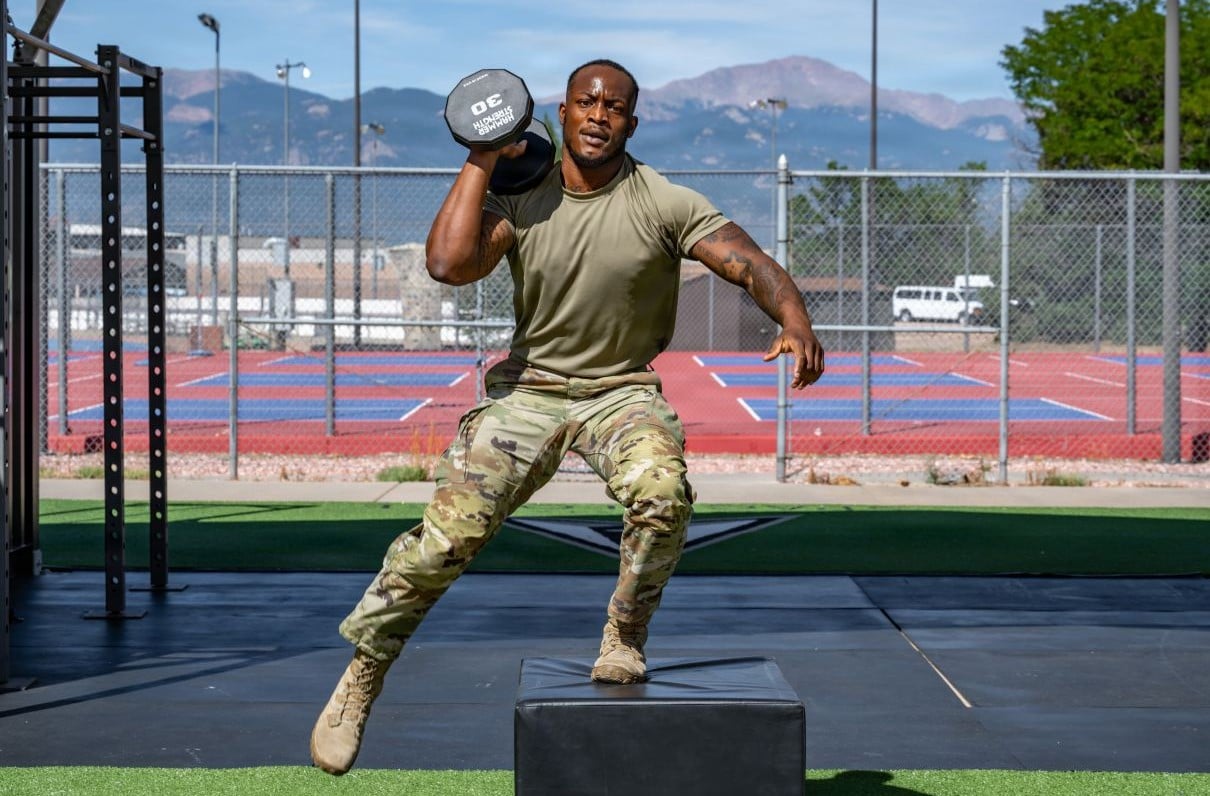
(This article by Hope Hodge Seck originally appeared in the November 2026 issue of Military Officer magazine.)
Addressing a crowd of U.S. military generals and flag officers in Quantico, Va., in September 2025, Secretary of War Pete Hegseth deplored the “tiring” sight of “fat troops” in formation and “fat generals and admirals in the halls of the Pentagon.” He wanted change — and it had to begin right away.
By the time the 45-minute speech was over, new directives were landing in the inboxes of military commanders around the globe, laying out strict new requirements for military fitness, including twice-annual fitness assessments; a common way of measuring body composition; and a gender-neutral, but age-graded, physical qualification test for all troops in combat specialties.
“The new War Department Golden Rule is this: Do unto your unit as you would have done unto your own child’s unit,” Hegseth said. “Would you want him serving with fat or unfit or under-trained troops or alongside people who can’t meet basic standards or in a unit where standards were lowered so certain types of troops could make it in, in a unit where leaders were promoted for reasons other than merit, performance, and war fighting? The answer is not just no; it’s hell no.”
A Fitness Reset
The problem is well-established. A December 2025 military health system study shows the proportion of overweight and obese active duty troops dramatically increased from 2013 to 2023, with mid-2019 representing an “inflection point.” Obesity among male troops increased from 18.1% in 2019 to 25.3% in 2023, and among female troops from 12% to 19.6%. The study’s authors noted the steep increase was likely explained by the COVID-19 pandemic, which prompted the services, to varying extents, to suspend physical fitness testing.
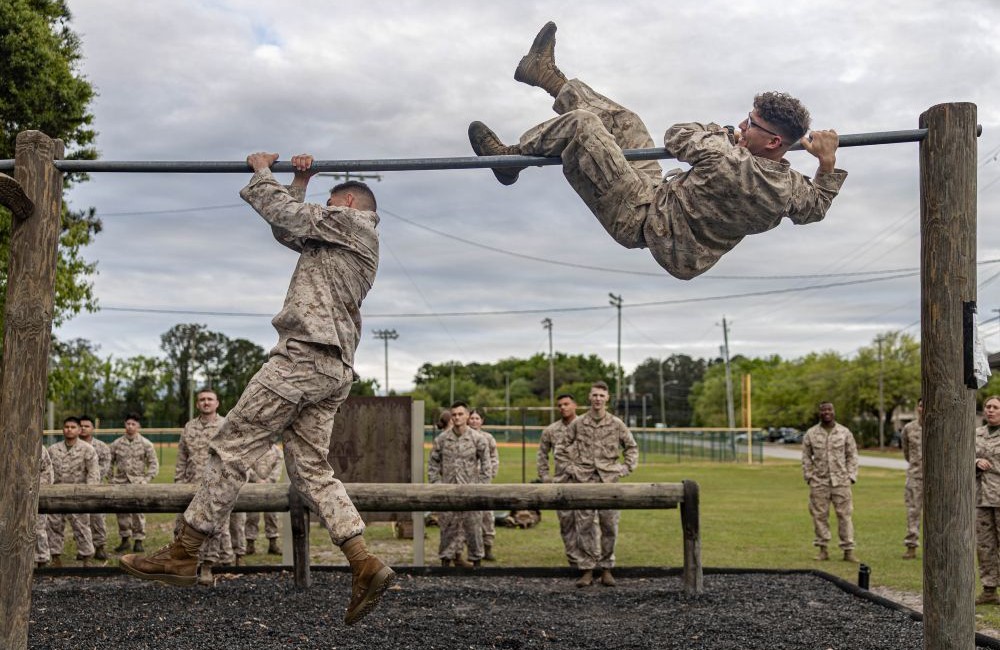
Marines participate in the obstacle course at Marine Corps Air Station Beaufort, S.C., on April 6. (Photo by Cpl. Isabella Renaud/Marine Corps)
Hegseth’s fitness mandate sent service leaders in a race to prepare their troops for the change and roll out new guidance. For some services, the unambiguous message from the top was a clarifying kick start for long-discussed new fitness initiatives; for others, it competes with more holistic paths they’ve charted toward a common goal of advancing total force readiness. Experts who spoke to Military Officer recognized the need for a fitness overhaul but cautioned that abrupt implementation might lead to unintended consequences like injuries or sidelining fit troops who don’t match a strict mold.
In the Air Force, the implementation of a new scored physical training (PT) test on July 1 — after a six-month unscored diagnostic period that began in March — was met by some with despair. Among the changes were a 2-mile run that replaced the previous 1.5-mile run, and score charts that, in many cases, required troops to do more repetitions on exercises like pushups and situps to earn the same points they had before.
An anonymous poster on the online forum Reddit complained the Air Force standards were “out of touch” and more appropriate for special operators.
“Most of us work 12 hour shifts on the flightline or sit behind a desk coding all day, when are we suppose to train for a 2 mile run?” the user wrote.
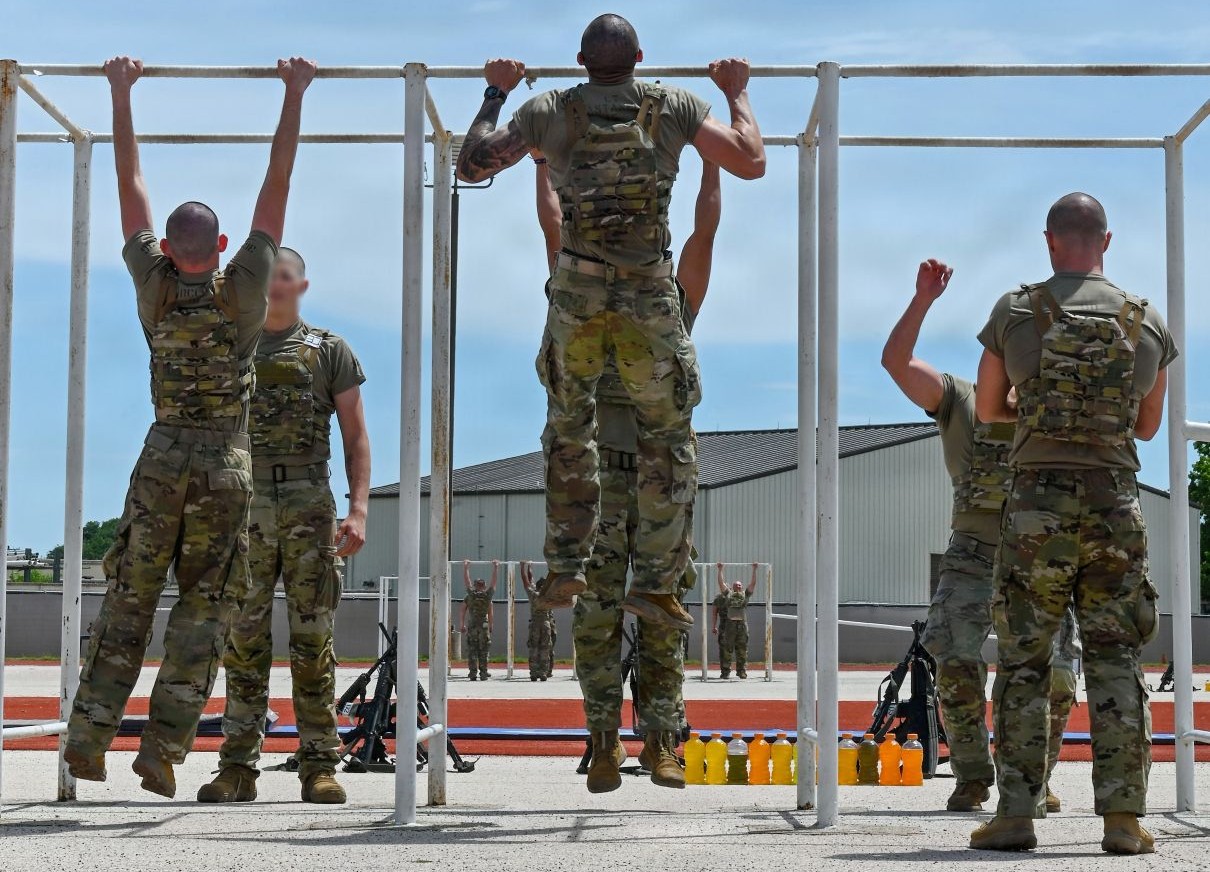
Candidates in Special Warfare Assessment and Selection perform pullups wearing 20 pound weight vests before sprinting to the next activity during the Pararescue Memorial workout on Joint Base San Antonio-Lackland, Texas, on April 7. (Photo by Jennifer Gangemi/Air Force)
But according to Air Force officials, the diagnostic period proved airmen, by and large, could get it done. In that period, according to Col. Marjorie Barnum, the chief of the Air Force’s Military Force Policy Division at the Manpower, Personnel, and Services Directorate, 40,000 tests were recorded, and the standard proved an “adequate assessment” of fitness across gender and age demographics.
“We do think we may have missed some demographics in that initial testing window, and so we’ll continue to receive and analyze data,” Barnum said, adding that fewer airmen over the age of 50 were represented in the data and that those most at risk of failing the test were less likely to have taken it during the nondiagnostic period, leaving the fittest troops overrepresented. She also said the Air Force planned to clarify guidance about a directive to get physical training done every duty day, as that move had caused some consternation within the force.
While the full impact of the stricter fitness test remains unclear, Hegseth’s directive did prove the catalyst for launching another initiative for the Air Force: a Master Fitness Leader (MFL) program that kicked off its first training course in March and had, as of July, graduated 325 leaders distributed throughout the force.
[FROM AF.MIL: MFL Course Enhances New USAF Fitness Mindset]
The idea to develop airmen who could guide their peers in safe and effective physical training had long been “discussed and in the works,” said Chief Master Sgt. Bobby Drayton, a career field manager. “Once the shift came down and the messaging came down from [the secretary of war], it definitely prompted us to roll out a little faster and make it a top priority,” he said.
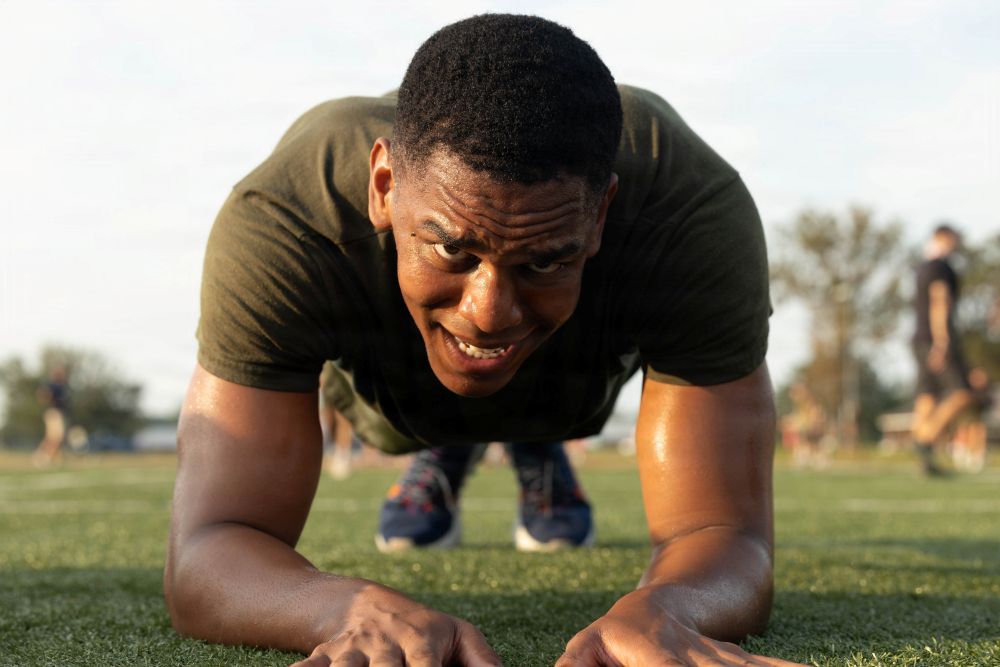
A Marine with 2nd Marine Aircraft Wing participates in physical training at Marine Corps Air Station Cherry Point, N.C., on Aug. 17. (Photo by Cpl. Mya Seymour/Marine Corps)
Beyond the PT Test
Hegseth’s line in the sand had the same effect for the Navy’s Human Performance Optimization (HPO) Program, which rolled out as a San Diego-based pilot in February after 12 years of internal development. The program, similar to the Army’s well-received Holistic Health and Fitness (H2F) Program, aims to aid in injury prevention, sleep, nutrition, and cognitive enhancement in addition to increasing fitness test scores.
[RELATED: Navy HPO | Army H2F]
“I think with the new leadership and the new direction and the new desire to support the human hardware, it was perfectly aligned and perfectly timed to jump on this human performance optimization effort and run with it,” said Tunde Ridley, fitness branch director for Navy Installations Command.
With 17 commands now involved and plans to take the program aboard ships, leaders say they’re seeing great success from the pilot. In one case, according to Capt. Brian Bungay, commander of Naval Base San Diego, leaders were approached by the commander of USS Higbee (DDG-123) with a pressing need: 20 sailors who failed their last fitness assessment needed to get back to regulations.
Through the HPO Program, the sailors were fed into a remediation initiative involving workouts up to four times per week and, Bungay said, were ultimately able to pass the test.
Bungay noted the program helped him increase his own physical fitness assessment score year over year and allowed him to max out his plank hold.
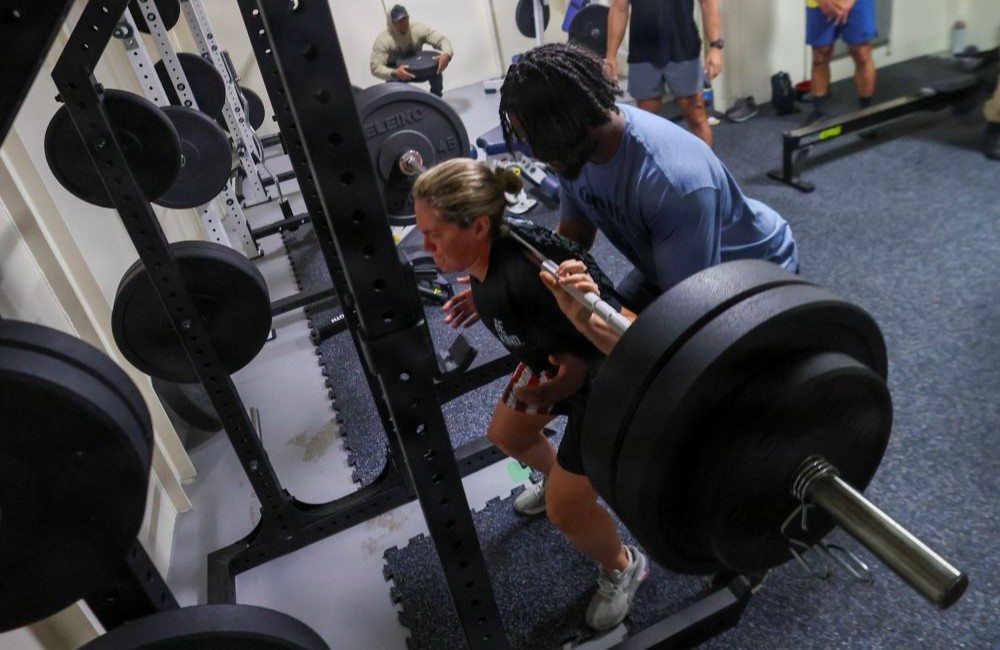
A sailor assigned to the Pre-Commissioning Unit John F. Kennedy (CVN-79) lifts weights as part of a 1,000-pound fitness challenge during acceptance trials on Aug. 14. (Photo by Mass Communication Specialist 1st Class Sean Gallagher/Navy)
A Common Standard
Not all the services had the same distance to travel when implementing Hegseth’s mandate for a gender-neutral combat-qualifying test. The Navy, which had never had a combat-specific test, assembled experts from the special operations and explosive ordnance disposal communities to develop an “initial look at what a [combat fitness test] can be,” said Lt. Cmdr. Maile Richert, a professor in the Department of Military and Emergency Medicine at Uniformed Services University.
The test involves an 800-meter swim with fins, plus pushups, pullups, and a timed run, all while wearing a 20-pound weighted vest. The test, which began as a requirement July 1 and applies to just four job specialties, is likely to be much more difficult than the Army’s new combat field test, which will be administered for 24 jobs.
The Army’s version of the test — based, per Hegseth’s direction, on the service’s existing Expert Physical Fitness Assessment — includes a seven-event exercise sequence involving movement and carry drills, bookended by 1-mile runs.
“We took this as an opportunity to look at ourselves and examine inwardly how we were evaluating fitness and how we were promulgating physical readiness for soldiers,” said Maj. Alex Boroff, then a Training Management Directorate action officer for the Army.
The new test follows the Army’s blighted efforts to roll out a gender- and age-neutral Army Combat Fitness Test for all soldiers that included an upper-body isolation event and the leg tuck. The move had prompted immediate outcry, with critics saying it was hard to train for and caused disproportionate failure rates among women. After a decade of development, the test would be Army policy for just three years, getting replaced by the gender- and age-specific Army Fitness Test in 2025.
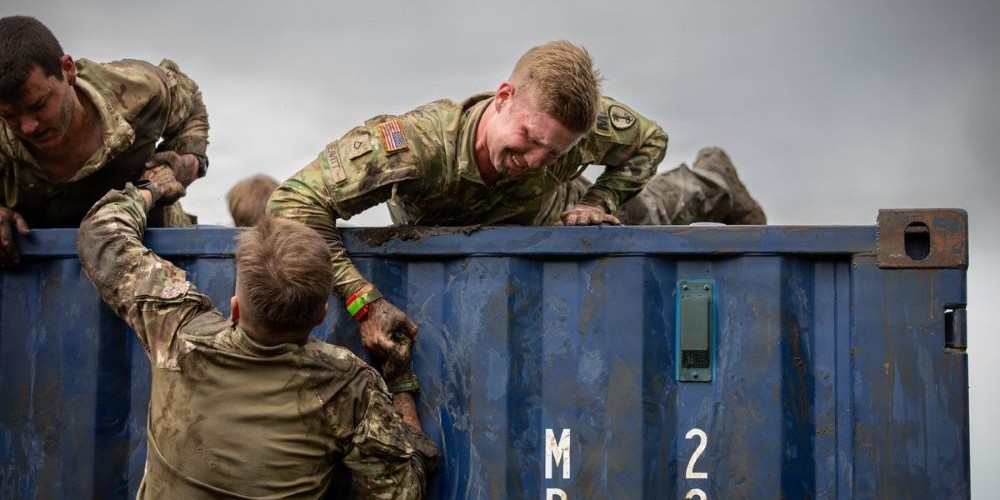
American soldiers and allied forces take part in the Day of Bir Hakeim 10K mud race at Tapa Army Base, Estonia, on June 10. (Photo by Staff Sgt. Olivia Lauer/Army)
The Army rolled out the Combat Field Test in April 2026, steering clear of leg tucks and cautiously giving soldiers a yearlong diagnostic period to take the test without consequences so the service can adjust it if the data reveals a concern.
While test results are still filtering in, the Army in July dropped another big update for soldiers: a new waist-to-height ratio body composition evaluation, to be undergone twice a year, per Hegseth’s direction. There’s little recourse for soldiers who don’t fall within the prescribed ratio of less than 0.55; the Army’s new policy does away with previous exemptions for exceptionally fit and muscular soldiers or secondary testing methods, like the DEXA scan bone density test, for troops who want to contest the tape test’s accuracy.
This is despite a 2023 study by the U.S. Army Research Institute of Environmental Medicine of nearly 2,700 soldiers that had formed the basis for the Army’s previous body composition system and guided the service in crafting backup options.
Alex Morrow, a host of the tactical human performance podcast MOPs & MOEs and an Army reservist, said he wondered if the service’s choice to build a strict no-exceptions policy was intended to provoke a crisis that might force the Pentagon to take notice.
“The populations that’ll get weird are shorter men and then specifically postpartum women,” Morrow said. “And I think when the service starts to see some examples of very fit people from those categories failing and having no recourse, it’ll be easy to tell those stories.”
For its part, the Marine Corps kept the high-performance tape test exemption and the backup screening option, using a technology known as bioelectrical impedance. But the Corps also adapted a stricter waist-to-height ratio requirement than the Army: 0.52.
Benjamin McAndrews, head of the service’s human performance branch, said the Corps chose that standard because it represented “early risk detection,” adding that the impact of the more exacting standard on the force will take time to become clear.
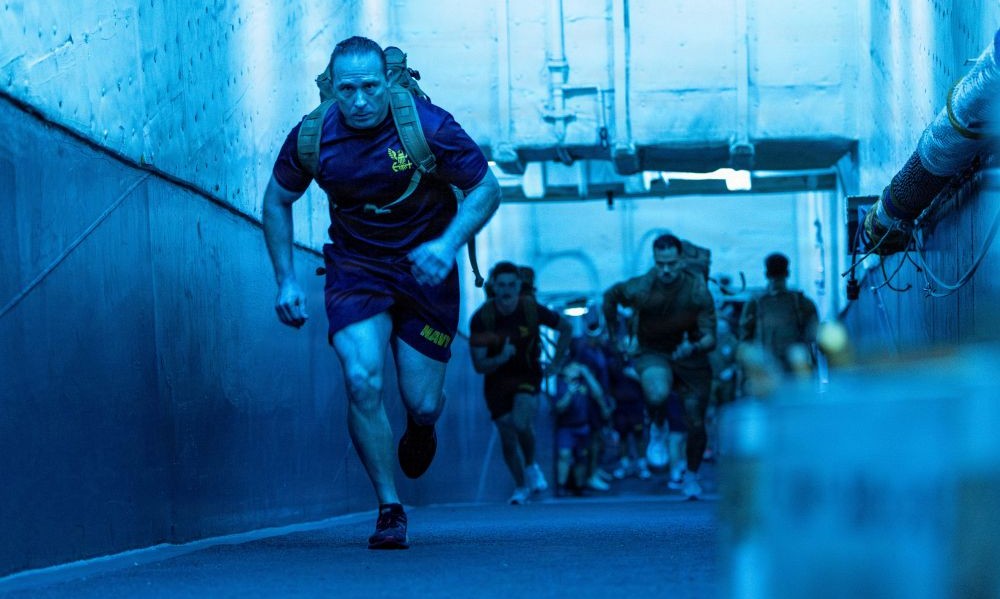
A sailor sprints up a ramp during a physical training event in the hanger bay of USS Boxer (LHD-4) on June 16. (Photo by Sgt. Trent A. Henry/Marine Corps)
The Readiness Paradox
To varying extents, the services are waiting for data to show the impact of the changes rolling out to the force. While additional Pentagon memos released in May stress the value of “Warfighter Performance Optimization” and promise upcoming programming to bring together best practices in regard to holistic health, leverage wearable technology, and shore up brain health, a former head of human performance for the Marine Corps worries the initial jolt toward higher fitness standards and accountability will take its toll as injuries.
“Daily training without programming, periodization, and recovery isn’t fitness — it’s an injury pipeline,” said Col. Brian McGuire, USMCR (Ret), who now runs his own human performance advisory firm. “Musculoskeletal injury is already the single-largest driver of lost duty days and medical non-deployability in the force. A directive that increases training volume without resourcing the human performance infrastructure to manage it can, paradoxically, reduce the readiness it’s trying to build.”
Still, Morrow and McGuire see value and opportunity for the services to prioritize fitness and hold troops to a higher, data-driven standard, particularly after years of post-COVID-19 backsliding.
“For some branches, it absolutely has been the kick in the pants they needed,” Morrow said, adding that he had observed a “culture change” brought on by the return to daily PT sessions.
But for services that invested in specialized ways to achieve common fitness goals, it’s uncertain how much flexibility there will be to divert from Pentagon mandates in pursuing those paths.
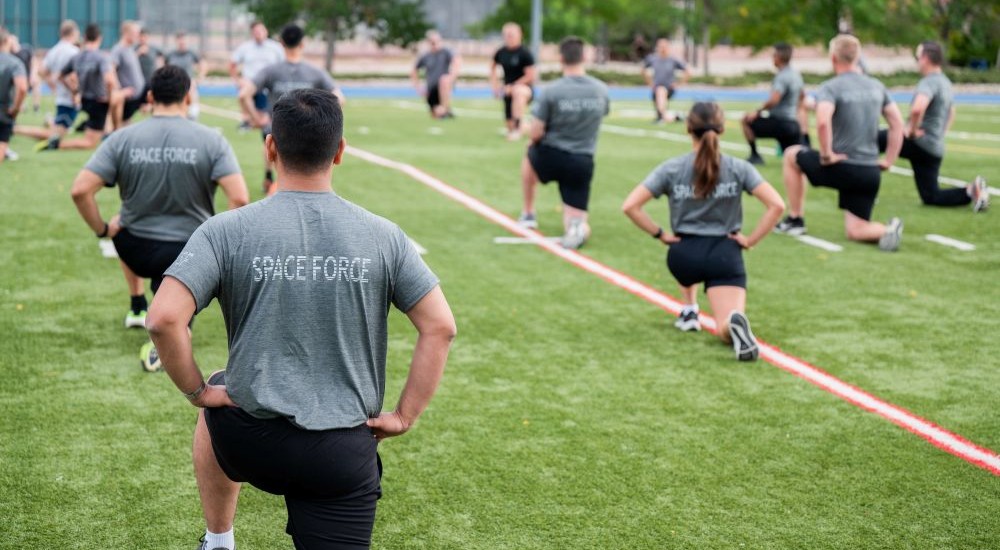
Guardians stretch before beginning the Delta 12 Summer Fitness Challenge Physical Training Field Day at Peterson Space Force Base, Colo., on Sept. 12, 2025. (Photo by Keefer Patterson/Space Force)
A Different Measure
The Space Force, the youngest and smallest of all the branches under the Pentagon, has championed “continuous fitness assessments” over semiannual ones, using Garmin Instinct watches to hold troops accountable to complete “regular, purposeful physical activity,” said Christine Heit, the service’s head of holistic health assessments. While the Space Force did roll out a human performance evaluation that complies with Pentagon mandates, leaders continue to work on turning the wearables-based assessment into a program of record by next year.
“You can perform great and do great on your physical fitness assessment, or you might not be feeling well that day, or the temperature might be a little hot, and you don’t perform as well as you could,” Heit said of the traditional test. “The study totally eliminates that because it’s based on heart rate, and heart rate doesn’t change over time, so we’re actually able to measure health and cardiorespiratory fitness instead of one’s ability to perform during a test on a specific day.”
Once the service has a validated program, it could ask the Pentagon for an exemption from conventional testing. But leaders aren’t yet ready to commit to an action plan.
“We’re still likely going to be the first service to develop an enterprise-wide wearable program,” Heit said. “How that’s going to impact our way forward for physical fitness, I can’t share yet because I just don’t know. We’re going to see what we can accomplish.”
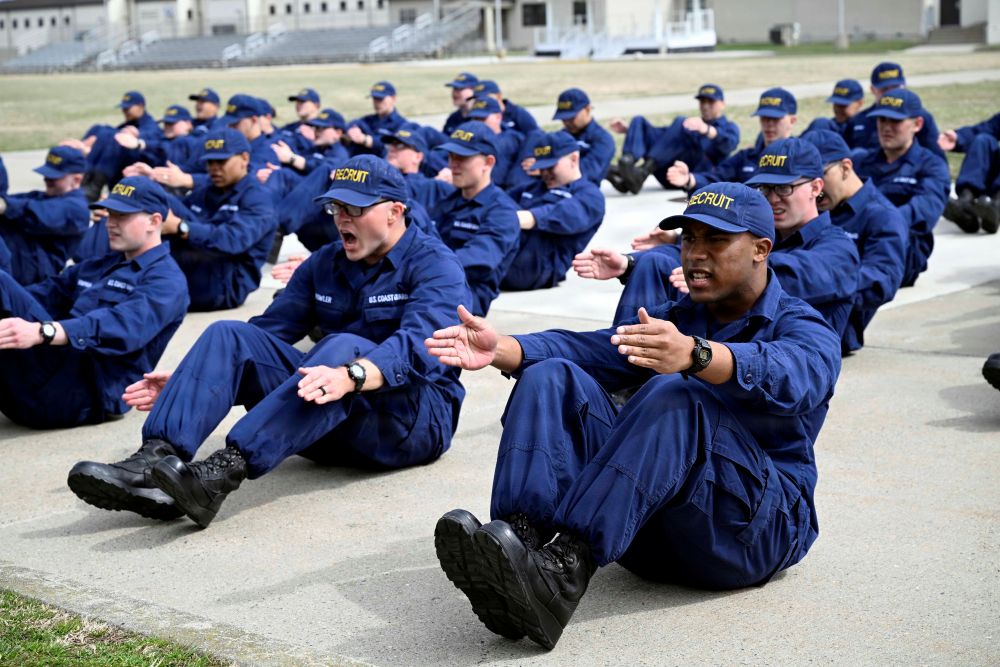
Recruits exercise at Coast Guard Training Center Cape May, N.J., on March 30. (Photo by Petty Officer 3rd Class Danielle Layton/Coast Guard)
Coast Guard Makes History
For the first time since its establishment in 1790, the U.S. Coast Guard debuted a mandatory physical fitness test for all members on July 1, citing, among other things, increased attention and resources flowing to the service amid high operational tempo. While the Coast Guard ranks somewhere in the middle among the services for obesity, a 2021 data analysis from the think tank Rand found nearly 67% of its personnel were overweight or obese.
Rear Adm. Christopher Hulser, who spoke in his previous role as chief of staff and executive assistant to the commandant of the Coast Guard, said the service’s fitness culture has been siloed, with high motivation among elite fields like rescue swimmers and little incentive for workouts in other jobs.
Uniquely among the services, the Coast Guard opted to make the test binding for officers and senior leaders first, a move intended to show that accountability flowed from the top down. The service also handed leaders the responsibility of ensuring their subordinates had time to conduct daily exercise during the workday.
“What [Coast Guard Commandant Adm. Kevin Lunday] wanted to … show the fleet ... is we take care of ourselves; we take care of physical readiness as part of our duty,” Hulser said.
The new fitness test, which may be revised as performance data comes in, includes pushups, a timed forearm plank, and a choice of cardio events, including running, rowing, or swimming.
Hope Hodge Seck is a writer in Massachusetts.
Resources for Currently Serving Officers
MOAA can help you succeed in your military career and beyond.