By Kristin Davis
Polly Parks spent years in the military’s orbit.
What began as activism opposing authoritarian rule in the Philippines in the 1970s eventually led to a career focused on the environmental legacy of former U.S. military bases overseas, including launching a program focused on the toxic legacy of the Cold War in the U.S. and the former Soviet Union.
Yet despite her proximity to the military, she understood little about the institution itself. Until she met George Cajigal, a Vietnam veteran and retired Army colonel whose career spanned airborne combat engineering, the Pentagon and, later, efforts to eliminate weapons of mass destruction from the former USSR.
The two met through their work. When the government of Panama raised concerns about unexploded ordnance left behind on former U.S. military property, Parks was referred to Cajigal, who had the military expertise to help.
A few months later, they had their first date. Cajigal, who’d come to the U.S. from Cuba at age 13, brought out photo books from his career.
“This is the strangest thing I’ve ever seen,” Parks remembers thinking.
For the next 27 years, Cajigal would be her window into the military. His friends became her friends. Her friends became his.
They’d both spent much of their lives in public service. It just looked different.
“George taught me about the military, and I taught him about the world of nongovernmental organizations,” Parks said. “We shared a passion for this crazy, secular, democratic experiment.”
Parks retired in 2016, and when she and George moved to Sebring, Fla., he became active in the local MOAA chapter. A few years later, Parks was recruited to edit the Florida Council of Chapters’ newsletter.
“That is when I began learning about MOAA’s nonpartisan advocacy,” she said.
When Cajigal died of pancreatic cancer in November 2020, Parks found herself navigating the practical realities of being a surviving spouse.
[RELATED: Surviving Spouse Corner: The Value of Connection]
“You’re having to do this in grief, and there is also sort of this fog of war where you forget things,” she said.
Parks returned west to be closer to family and settled in Tucson, where she joined the local MOAA chapter and quickly became its surviving spouse liaison.
“It gave me something to do, which was really important.”
She also credits MOAA with helping ensure she receives 55% of George’s pension. “I am eternally grateful for the work MOAA has done,” she said.
Parks went on to write the surviving spouse and personal affairs column, edit The Territorial, and take over the Davis-Monthan Retiree Activities Office newsletter, using her writing to reach a broader military-retiree audience.
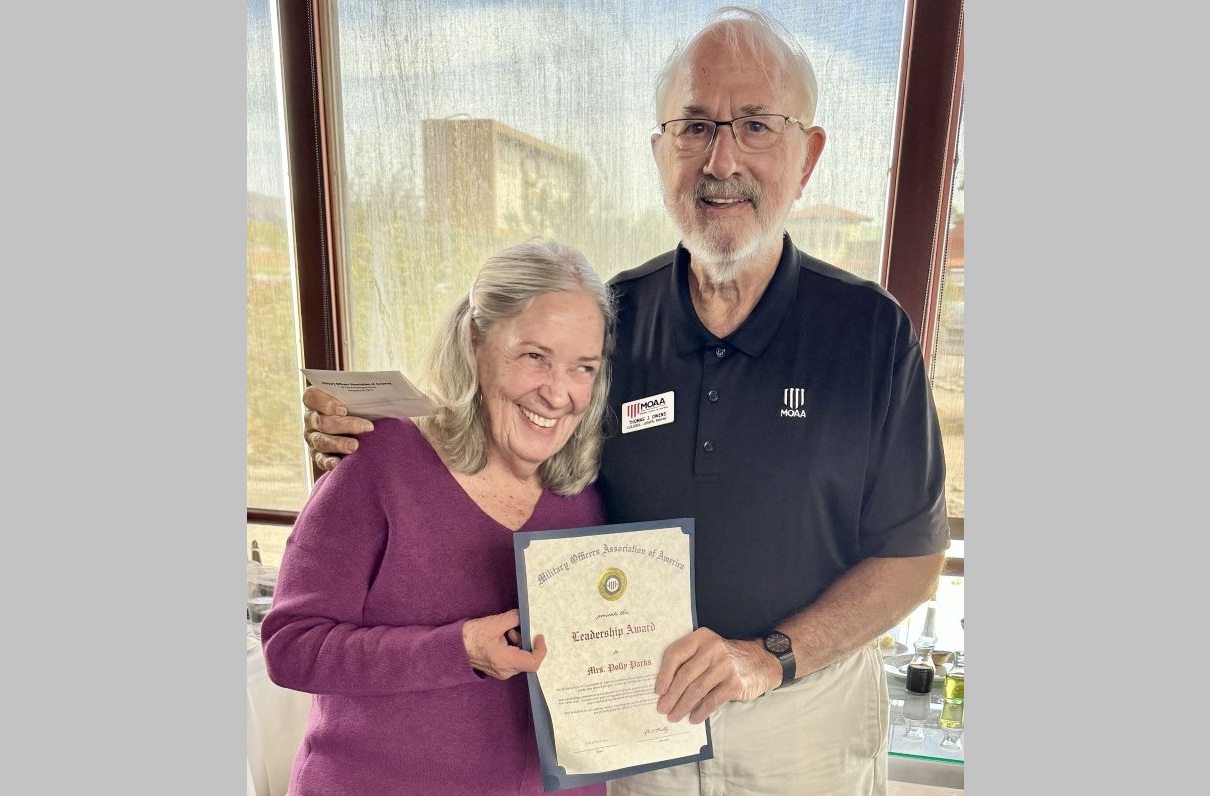
Today, Parks serves as president of the Tucson Chapter, which she agreed to lead on one condition: That it try to grow. She sees younger retirees and veterans working as contractors at Davis-Monthan as a potential new generation of members.
After decades spent moving between the military and civilian worlds, Parks believes MOAA’s ability to bring people with different perspectives together might be one of its most important roles.
Kristin Davis is a writer based in Virginia.
Want to Help Servicemembers in Your Community?
Learn how you can make a difference with your local chapter.