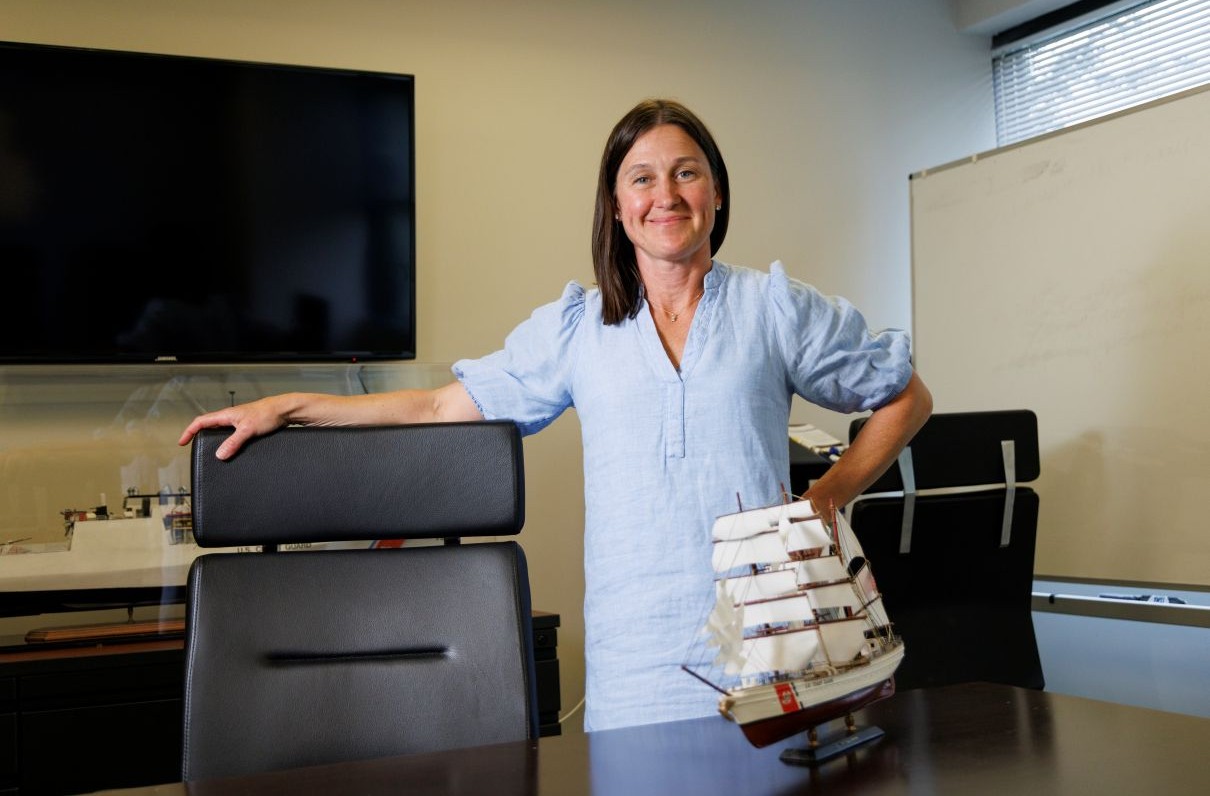
Cmdr. Brooke Millard likes a saying: There’s no growth in the comfort zone, but there’s no comfort in the growth zone.
The retired Coast Guardsman has always opted to steer clear of comfort.
After graduating from the U.S. Coast Guard Academy in 2003, Millard’s cutterman career would include 12 years at sea with missions ranging from migrant interdictions and drug busts off Key West to fishing boat policing off Gloucester, Mass., to serving as commanding officer of the medium endurance cutter Bear (WMEC-901).
The Boxford, Mass., native then returned to the academy to teach literature. She also served as speechwriter for the commandant and vice commandant.
“I feel like the Coast Guard did a really good job of always providing me with opportunities to be uncomfortable, to try something new, to grow and to learn,” said Millard. “And because of that, I think I am where I am today.”
[RELATED: MOAA Member Dove to Olympic Gold While Serving in Air Force]
Today, Millard is CEO of Coast Guard Mutual Assistance (CGMA), the 102-year-old relief society undergoing a number of modernization efforts to increase awareness and more effectively support the Coast Guard community. Federal government shutdowns in recent years have resulted in increased challenges facing Coast Guardsmen and their civilian counterparts; Millard has spoken candidly about the chaos shutdowns can cause.
The MOAA member recently sat down to discuss her career and her penchant for risk-taking.
Interview excerpts edited for space and clarity.
Q. What made you decide to join the Coast Guard?
A. When I was in fifth grade, I wanted to be a doctor. My father saw an article in the Boston Globe about a woman who had just graduated from West Point and was now at Harvard Medical School, which she said was easy. So he was like, ‘Well, you should consider a military school.’
When I got closer to applying, I realized the Coast Guard has amazing duty stations and was also a life-saving service. And no restrictions to women.
This is before 9/11. If I wanted to be a woman in the Army, I couldn't do Special Forces. If I wanted to be a woman in the Navy, I couldn't be on a submarine. And I didn't want to join any organization that would put limits on what I could do because of my gender.
[RELATED: 40-Year Soldier Honored With Eagle Rising Society Induction]
Q. You talk about “the magic of teamwork.” I imagine that's something that you have carried throughout your career.
A. I was probably 30 when I discovered the magic of teamwork, because when I went to the Coast Guard Academy, there were so few women. I think we were all very competitive. It was all about how can I get this job, or how can I look good, or how can I do that?
When you're in charge of a team you realize you can't do it all, and you're actually not supposed to do it all. You have to figure out what everyone's strengths are and bring them to the table.
Q. What was the challenge of speechwriting?
A. I think I wrote 180 speeches in a one-year period. So we’re talking about a couple of speeches a day or a couple of speeches a week, and I was the only speechwriter.
The challenge was managing that workload.
Q. Have you thought about writing a memoir?
A. I started writing a book when I was the CO of Bear. I’d write at 4 o’clock each day, for about an hour and a half. I have 36 pages, but it's more of a tween coming-of-age story. I have not opened it since I left the Bear.
[RELATED: MOAA Member Named Veteran of the Year in Milwaukee]
Q. What about your current role appealed to you?
A. Originally I was not interested in this job. When I left the Coast Guard service, I just thought I needed a break.
However, this job became open and some senior people in the Coast Guard were like, “Hey, Brooke, we really would think it'd be great for you to apply.”
When I got to the second interview, I was like, you know what? How many opportunities is somebody going to leave active duty service and become the CEO of an amazing organization that's been around for 102 years? That's pretty darn incredible.
I was really attracted to finding a role where I could connect with the mission and as, as a commander of ships, I saw Coast Guard Mutual Assistance as not just a resource for individuals but also for commands.
I was interested because of the opportunity to be able to lead another organization and help them imagine what more was possible. The Coast Guard has always been incredibly resourceful and accustomed to accomplishing a lot with constrained resources. At CGMA, I saw an opportunity to think expansively about how we could grow our capabilities and provide even better support to the people and families we serve.
And I am just so much more supercharged to provide better service for my people from here on forward.
[RELATED: Life Member Creates Residential Community for Wounded Warriors]
Q. What would you want MOAA members to know about the organization?
A. CGMA is the 501.c.3 designated by congressional law to provide support to Coast Guard servicemembers. Every service has just one. CGMA is 100% funded by donations. Last year we raised $3 million in donations. Every dollar went right back to Coast Guard members in need as grants. We also delivered $9 million in interest-free loans, for a total of $12 million in direct support.
CGMA supports the entire Coast Guard workforce: active duty, civilian employees, reservists, volunteer auxiliarists, retirees and families. One thing I want MOAA members to know is that service doesn’t have to end when you retire. There are still meaningful ways to serve the next generation, and supporting CGMA is one of them. The Coast Guard community has always taken care of its own. That’s really what “Helping Our Own” means.
Q. During a previous government shutdown you went on CNN. You talked about the damage it causes.
A. I found that during the government shutdown in 2019, my whole crew was distracted. We showed up to do the work. But in the back of our minds, we're trying to figure out, “How am I going to pay my mortgage this month? Am I going to pay my rent? How will I put food on the table?” Some people couldn't even pay for gas to get to work at the time.
You could be the most thriving member of your team or church or work. But as soon as someone takes away a basic need like food, shelter, or safety, your mind automatically goes, how do I satiate that need? And so no longer are you a thriving leader or a thriving team member.
I think that's why the four Title 10 designated military aid societies exist. Because somebody knew 100 years ago that if people are worried about finances, they can't show up to work and be a good Coast Guardsman or a good soldier.
Q. Is there anything we didn’t cover?
A. I think why I love the Coast Guard and why I love military service in general is because there are so many opportunities. Each new opportunity poses risk, and opportunities, at first, can be uncomfortable.
Ships at sea can be uncomfortable or unfamiliarity with a new job is uncomfortable. Or maybe it's uncomfortable being the only woman on a crew. But what’s amazing about all those different moments of discomfort is that each time we persevere, we become more comfortable being uncomfortable. And that, my friend, is growth.
Know Your MOAA Member Benefits
Are you getting all you can from your membership? Find out here.