
(This article by Todd Gilchrist originally appeared in the August 2026 issue of Military Officer magazine.)
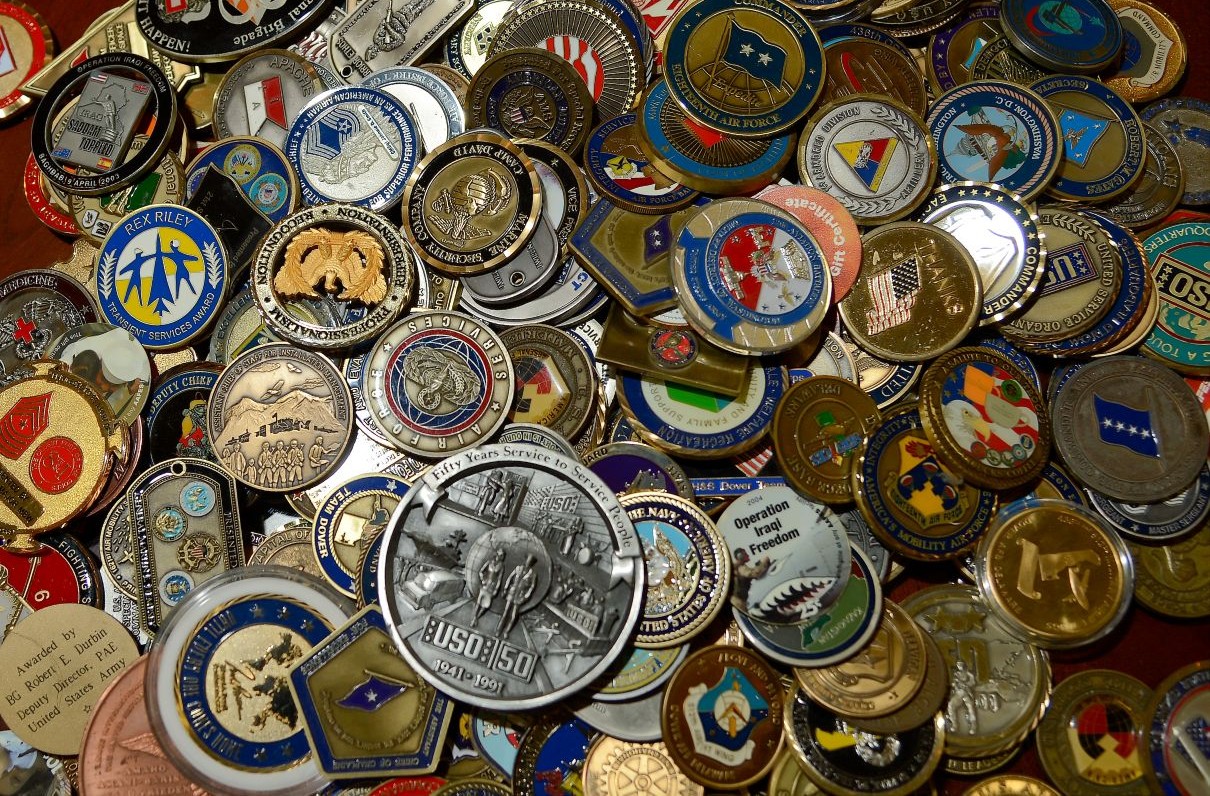
Challenge coins, designed to commemorate a vessel, unit, facility, or accomplishment, maintain a lineage spanning multiple centuries and cultures. Believed to have been first minted during the Roman Empire to reward soldiers who excelled in battle, these keepsakes proved meaningful to their recipients.
Today, these exonumia tend to confer bragging rights — and, in social settings, a round of beers — as much as they serve as a barometer of achievement. But even in an era where coin usage has decreased as a form of legal tender, the presentation and exchange of challenge coins remain a venerated military tradition.
“I think these are one of the simplest but most genuine ways to recognize somebody,” said Brig. Gen. Francis “Fran” Hendricks, USAF (Ret), a MOAA Life member. “It really comes across as very personalized when you give somebody a coin and tell them: ‘Thank you for a great job.’”
Over his 30-plus years of service, Hendricks has both received and given out challenge coins — the latter in the line of service, as head of MOAA’s Northwest Florida Chapter and as president of Mansfield University.
“The neat thing about coins is even though they’re small, you can put a lot of history on it,” he said.
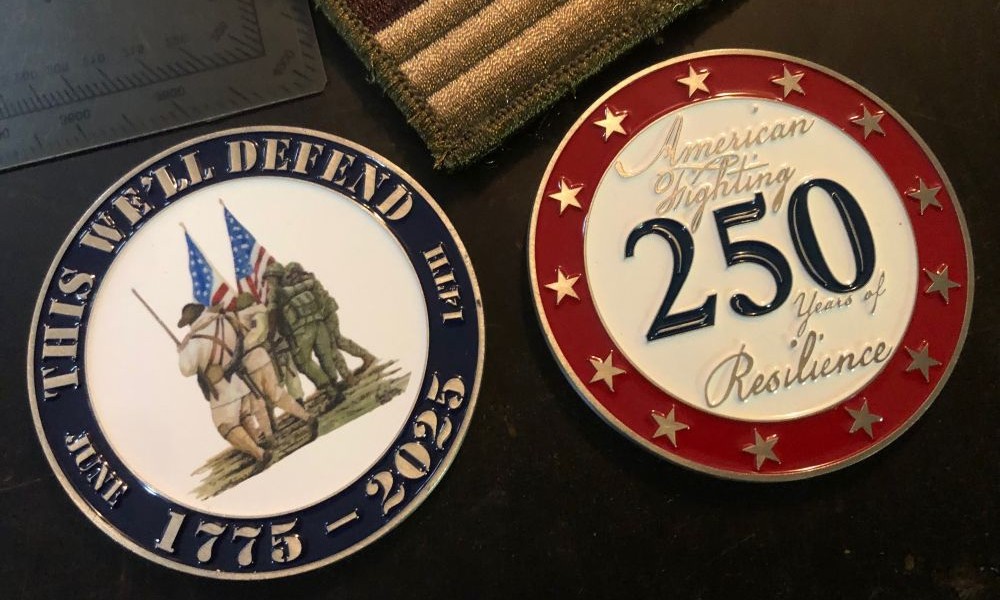
Artwork created by Col. Michael Solovey, USA, was used for a custom coin. (Photo courtesy of Col. Michael Solovey via DoW)
Regardless of an individual’s military status, recipients are marked for inclusion in a notable event, such as when Hendricks received his promotion to brigadier general. “I gave them out to my family members and people in the community who attended,” he said. “I just wanted them to know how important they were in my life.”
The earliest recorded production of U.S. challenge coins was during World War I. As one story goes, a wealthy lieutenant had ordered bronze medallions for his flying squadron, choosing to wear his in a pouch around his neck. Later on, after he was shot down over Germany, enemy forces captured the American officer and took away identifiable items to prevent his escape. Eventually, he ended up at a French outpost where he presented one of the coins bearing his squadron’s insignia as proof of his Allied bona fides.
During World War II, they were similarly issued by U.S. government agencies, such as the Office of Strategic Services, to verify allies in the field. The initial characterization of “challenge” — marking an individual’s or unit’s commitment to the challenge of their orders — stems from the Vietnam War era, when infantry-run saloons would force those in other branches to buy everyone there drinks, unless they could prove they’d been in combat. The coin became a means of proof.
“People were showing up at the bar saying they were in combat,” Hendricks said. “But if you weren’t part of the 10th Special Forces Group — that’s the Green Berets — they basically would throw you out.”
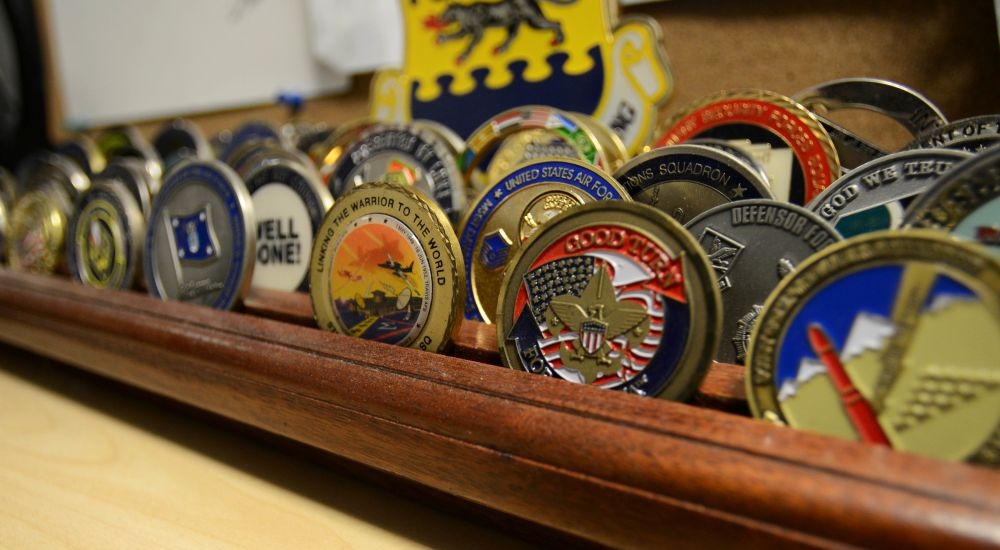
Challenge coins have come in many shapes and sizes throughout military history. (Photo by Airman 1st Class Deana Heitzman/Air Force)
Hendricks noted the look of a challenge coin is limited only by one’s artistic ability — “and I’m very limited,” he admitted. Companies that produce custom collectibles, like veteran-owned KidderCorp, do a lot of the heavy lifting in translating a designer’s vision into a freshly minted reality.
CEO Alex Kidder said acquiring permission to use images, insignia, and logos is facilitated either by those placing the order or by the long-term relationships maintained by the manufacturer.
“Most of the time, we work almost exclusively with the military or police, and what we find is organizations that hold the rights to various likenesses have no problem allowing our customers to basically have the right to make limited quantities,” Kidder said.
And the rarity is the point: While KidderCorp has produced as many as 25,000 coins for a single client, orders are commonly placed in much more limited quantities — usually 100 to 300.
The uptick in worldwide military activity this year has led to a spike in coin requests, Kidder said. “When there’s a conflict, especially when it involves a lot of naval ships, our business increases, usually quite dramatically because with everything that they’re doing, there are people there who will want to commemorate it with a coin.”
Air Force Lt. Col. Wade Morris, the deputy division chief for the design assessments division in the Strategy, Design, and Requirements directorate (A5/7), began collecting challenge coins 14 years ago after receiving a pyramid coin rack from a retired servicemember. Thanks to a career involving a variety of roles, including aide-de-camp to the Air Force secretary, he’s accumulated enough challenge coins that it’s about time to request a larger display.
“They’re just really good conversation pieces. You can swap war stories,” he said, noting it’s all part of honoring “an age-old tradition.”
Todd Gilchrist is a writer based in Los Angeles.
Military Officer Magazine
Discover more interesting stories in MOAA’s award-winning magazine.