
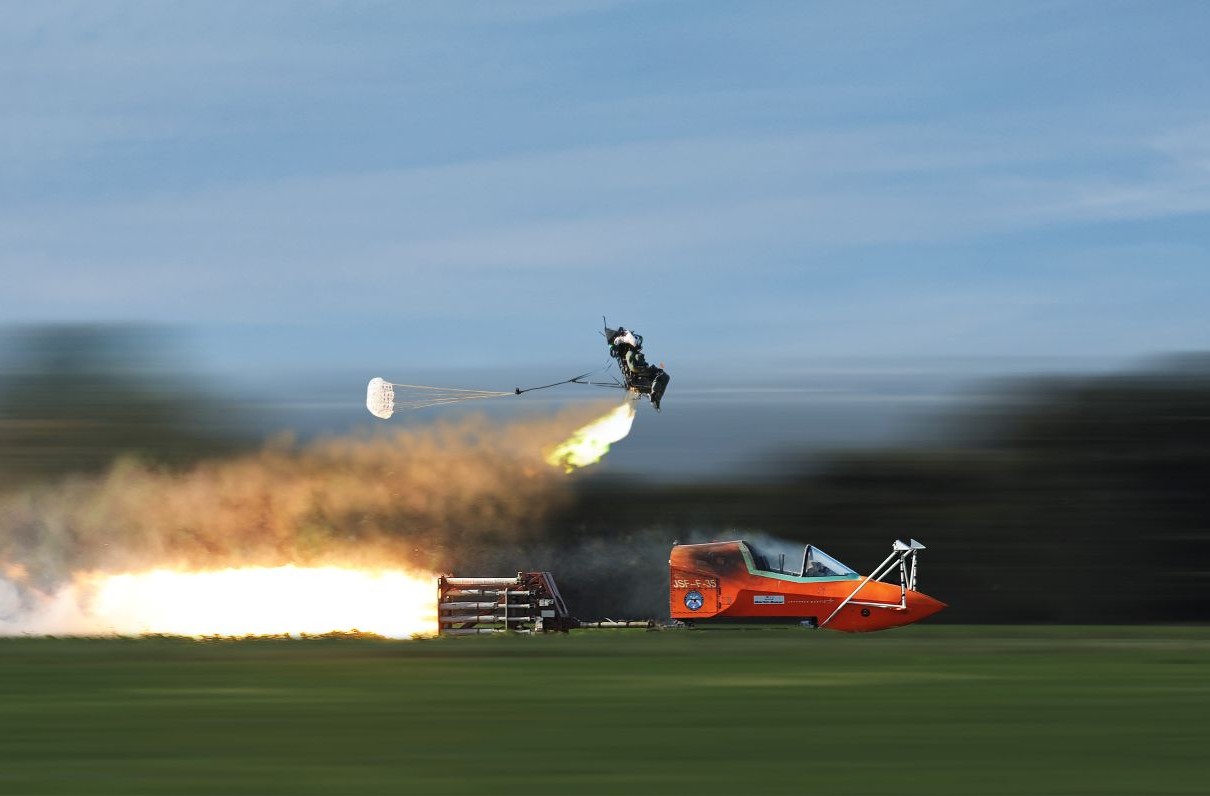
(This article by Col. Mickey Addison, USAF (Ret), originally appeared in the October 2026 issue of Military Officer magazine.)
Spectators at the Gunfighter Skies Air Show at Mountain Home AFB, Idaho, watched in horror May 17 as two Navy EA-18G Growlers collided during an aerial demonstration.
Moments later, four parachutes opened.
As the two $67 million aircraft plunged to the ground, all four aviators landed safely beneath those parachutes, with only one sustaining minor injuries.
They are alive because a family-run company in the U.K. has spent 80 years obsessing over pilot safety. That commitment gave rise to the Martin-Baker ejection seat and, for thousands of aviators, membership in one of military aviation’s most unusual organizations: the Martin-Baker Tie Club.
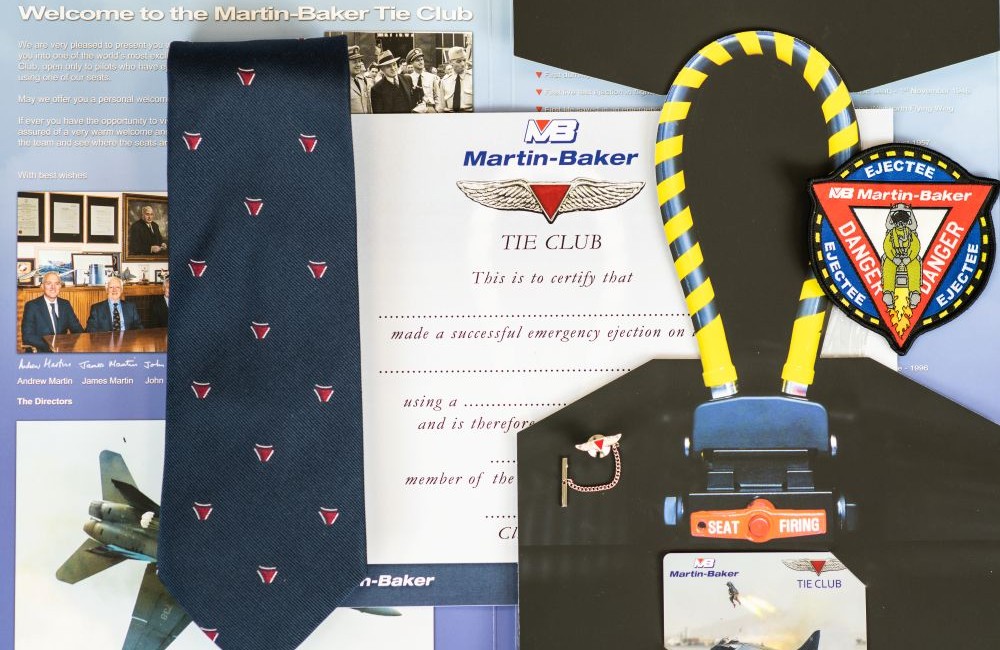
The first registered member of the Tie Club was a British Royal Air Force servicemember who ejected over what was then Rhodesia in January 1957. The Tie Club now has more than 6,000 members from air forces around the world, each receiving a certificate, a membership card, a patch, and the distinctive tie bearing the red triangle — the international danger symbol for an ejection seat.
Worn with civilian clothes, the tie symbolizes a bond that crosses ranks, services, and nations.
Courtesy of Martin-Baker Aircraft Co.
Welcome to the Club
Membership in the Martin-Baker Tie Club is reserved exclusively for aircrew whose lives were saved by a Martin-Baker ejection seat. Each new member receives a commemorative Tie Club pack that recognizes their place in this extraordinary community.
Tie Club membership includes:
- Personalized membership certificate
- Membership card with a unique Tie Club membership number
- Official Martin-Baker Tie Club necktie
- Tie Club lapel pin
- Embroidered Tie Club patch
- Exclusive opportunity to purchase the Bremont MBI ejectee timepiece (available only to Martin-Baker ejectees)
The club is now run by Andrew Martin, the grandson of James Martin, a founder of Martin-Baker Aircraft Co.
Born From Tragedy
James Martin and Capt. Valentine Baker, a World War I flying ace turned civilian test pilot, founded the British company after sharing a passion for designing and testing experimental aircraft in the 1930s. But that partnership ended Sept. 12, 1942, when Baker died during a test flight. The engine of a MB3 prototype seized during the aviation experiment, forcing an emergency landing where the aircraft cartwheeled.
After the fatal accident, Martin redirected the company’s entire mission toward one goal: ensuring pilots would not die simply because they could not escape their aircraft. The first real-world save came May 30, 1949, when British test pilot Jo Lancaster ejected from a stricken flying-wing prototype over Warwickshire.
According to the company, its technology has saved more than 7,800 lives. Here are three of those stories.
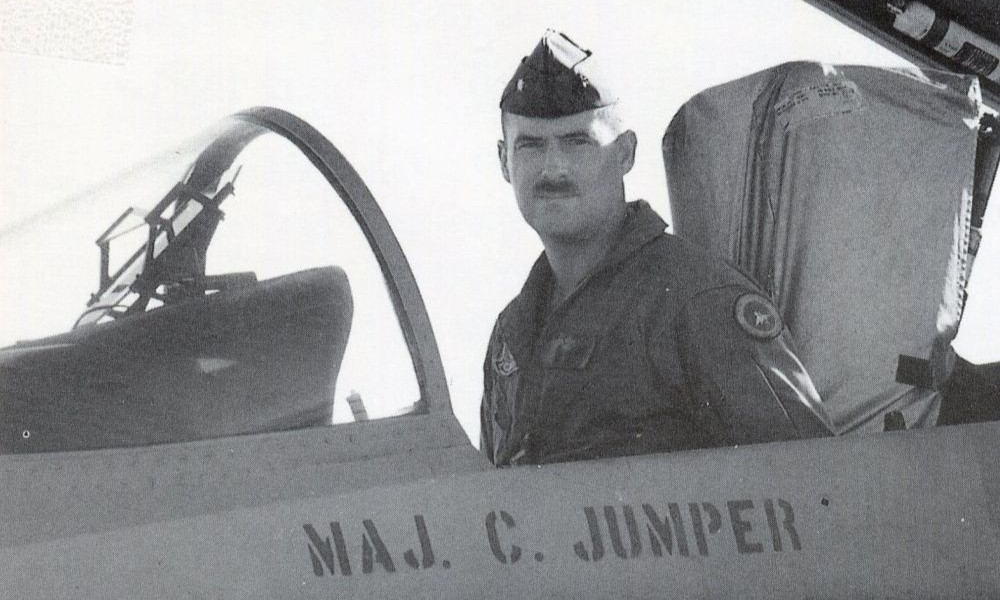
Tie Club member No. 4692: Col. Cal “Wookie” Jumper, USMC (Ret) (Courtesy photo)
Jumper’s Hornet
Col. Cal “Wookie” Jumper, USMC (Ret), a MOAA Premium member, can relate to the four EA-18G aviators at the air show, he said. On Dec. 17, 1993, he ejected from an F/A-18A Hornet at approximately 37,000 feet following a midair collision during a training exercise 145 miles southeast of Okinawa, Japan. At the time, this was the highest elevation recorded for a successful ejection from an F/A-18.
He rode his Martin-Baker seat down through 26,000 feet of storm clouds, his face pelted with ice, before the seat kicked him out at 11,000 feet.
“I grabbed my lower ejection handle with both hands and pulled hard when I thought I was pointed at blue sky. I guessed right, I suppose,” Jumper wrote in an article for Chattanoogan.com recalling his experience.
Still 2 miles above the South China Sea and out of oxygen, with fingers too numb to work his mask fittings, Jumper yanked the oxygen hose free just to breathe.
After pulling the hose, he hit the water amid 30-foot waves, fought his way into a survival raft, and spent nearly two and a half hours alone before a Japanese Air Self-Defense Force helicopter pulled him out. Jumper is Tie Club member No. 4692.
Names for the Kids
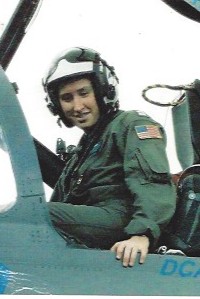 Former Navy Lt. Cmdr. Cynthia “Chick” Lisa, pictured, earned her Tie Club membership March 3, 2006.
She was flying an EA-6B Prowler at 500 feet and 450 knots through the high desert canyon country of southeastern Washington on a training flight out of NAS Whidbey Island when smoke and fumes filled the cockpit and the crew heard a whirring sound, followed by an uncontrolled roll to the right.
Climbing sharply to avoid rising terrain, the situation went from bad to worse. The right engine was on fire, and the flames were spreading. With every fire light but one flashing and alarm bells ringing in her helmet, she commanded her crew to eject — two back seaters, then the right seater, then her.
She described the wait after pulling the handle as “a very long 1.2 seconds.” All four landed safely, aided immediately for minor injuries by a farmer and a neighbor who happened to be an EMT. The crew was so grateful for being alive that they joked about naming their kids Martin and Baker, she told Military Officer.
Lisa, member No. 5475, is one of only four women in the Tie Club.
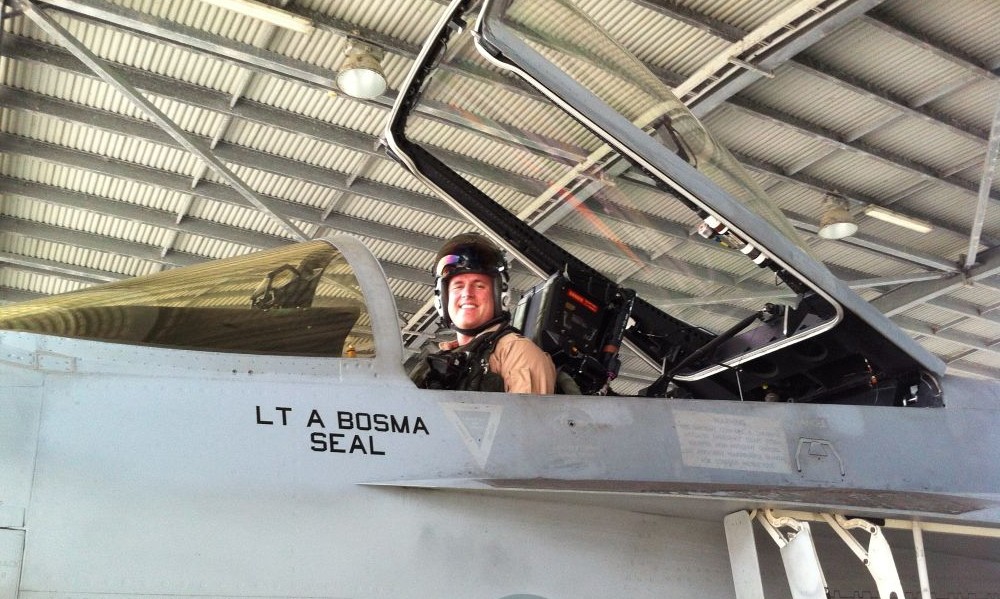
Tie Club member No. 6026: former Navy Cmdr. Adam “SEAL” Bosma (Courtesy photo)
‘A Fireball’
For former Navy Cmdr. Adam “SEAL” Bosma, the day began as a normal three-ship training flight out of NAS Meridian, Miss., when his T-45C ingested a turkey vulture through the left intake and immediately flamed out at less than 2,000 feet.
With his student observer in the back seat and warning lights ablaze, he turned back toward the airfield. Miraculously, he relit the engine and configured the jet for landing, but without any instruments.
His experience told him the aircraft wasn’t going to make the runway.
“I saw a fireball in my mind,” he said.
With seconds to spare, he initiated ejection for himself and his student. After landing in the grass, he watched the aircraft hit the runway overrun hard and burst into flames.
Bosma, a Premium member of MOAA and Tie Club member No. 6026, walked away with minor injuries and gratitude for “all the people I will never meet” who contributed to saving his life.
It is a sentiment shared by thousands of aviators whose lives have been saved by Martin-Baker ejection seats. Different aircraft. Different missions.
Different decades. One split-second decision.
One more chance to come home.
Col. Mickey Addison, USAF (Ret), is a published author and writer of military affairs.
Military Officer Magazine
Discover more interesting stories in MOAA’s award-winning magazine.