
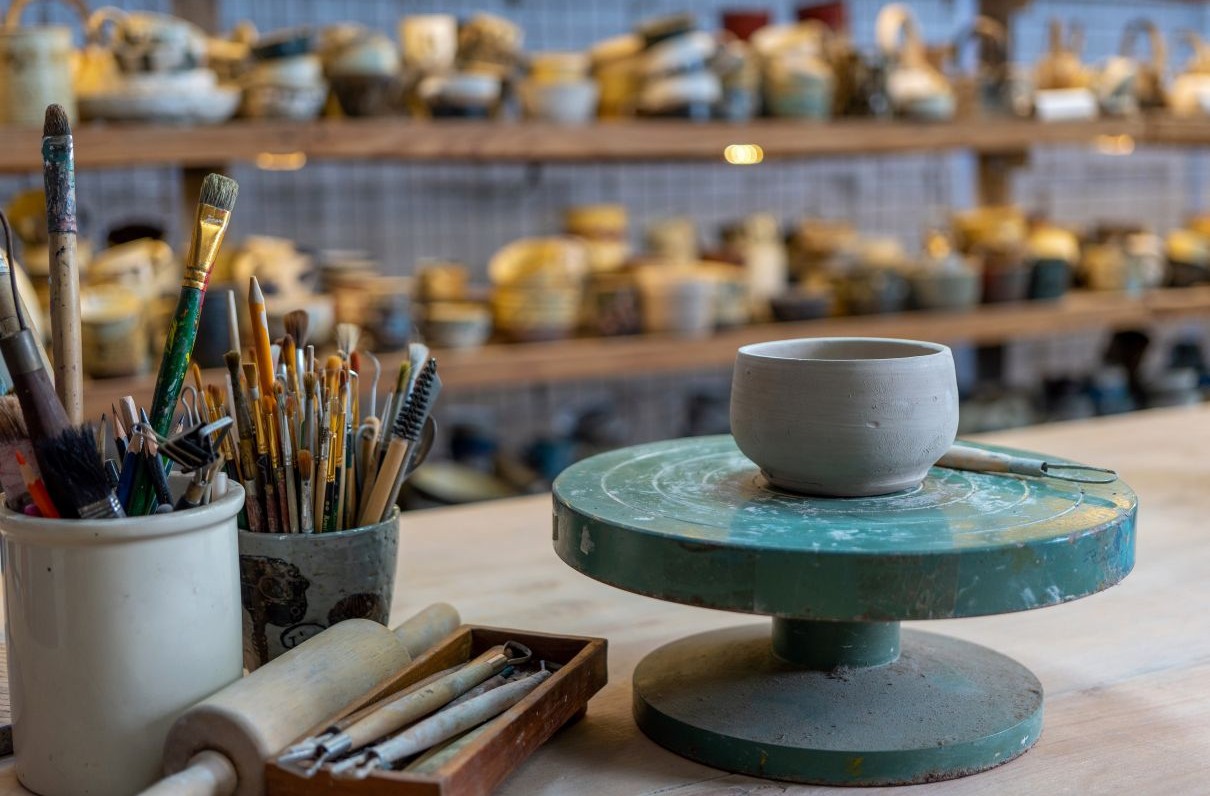
(This article by Kathie Rowell originally appeared in the August 2026 issue of Military Officer magazine.)
Over the past decade, U.S. Navy Chief Gunner’s Mate Alishia Prescott has endured more than her share of trauma. The chief petty officer’s voice fills with emotion when she recalls serving aboard a ship that responded to the 2017 collisions of USS Fitzgerald (DDG-62) and, later, USS John S. McCain (DDG-56) — two separate tragedies that claimed the lives of 17 sailors — as well as the challenges of a past personal relationship.
“I suffer from PTSD, nightmares, sleeplessness. It’s been a pretty wild ride,” she said.
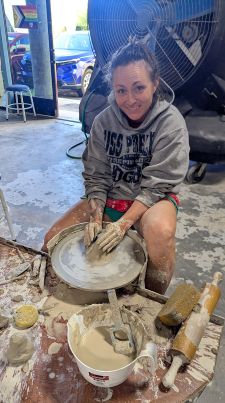 Prescott, pictured, who will retire in September after 20 years of service, is among a growing number of veterans turning to art as a path toward healing. A lifelong painter, in January she joined Veterans Art Project, a California-based nonprofit that offers free classes in ceramics, glass, woodworking, and bronze casting for veterans and their families and caregivers.
Yet, it isn’t painting that’s helping her heal. It’s the feel of clay in her hands.
“There’s something about pottery, the way that clay responds to every single little thing that you do. It’s so grounding,” she said. “Whether you’re hand building or you’re on the wheel, you’re almost in full control, and at the same time, you almost have no control because the wheel and the clay have a mind of their own. It’s incredible.”
The calming effects have translated into real progress in managing stress.
“I’m sleeping again,” Prescott said. “My anxiety is down. I just feel better. It’s directly correlated to just having my hands in clay and on the wheel.”
According to findings cited by the VA, participation in the arts can help veterans improve fine motor skills and cognitive functioning, manage stress and substance use challenges, cope with symptoms of PTSD and traumatic brain injury, and strengthen both self-esteem and overall well-being.
Steve Dilley, whose parents were in the Navy and who holds a Master of Fine Arts in ceramics, founded the Veterans Art Project in 2009 after recognizing the challenges servicemembers faced when returning home from deployments to the Middle East.
“After 9/11, it dawned on me that my artistic responsibility was to help people in my community through the only means that helped me, which was having access to nonverbal means of expression and process,” he said. “If you have a way of sharing, you have a means to not suppress or repress your thoughts, hopes, and fears.”
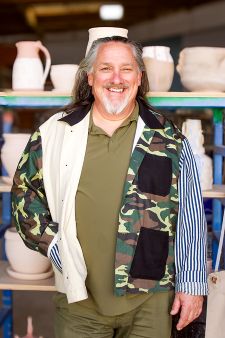 On the surface, creating pottery might not seem that transformative, said Dilley, pictured. But every decision — What shape? What kind of handle? What color glaze? — gives participants an opportunity to exercise choice and regain a sense of agency.
“I think it leads to a lot of other really beneficial things, and these are public health outcomes,” he said. “We can interrupt isolation or interrupt poor decision-making if we get them engaged with the general population, like we do with our pop-up art cafes. You have veterans who may have been practicing their art in their extra bedroom or on their dining room table, and now they’re in a park setting, and they might talk to 30 or 40 people about their paintings, and they may end up selling a piece or two. Even though the financial return may be modest, I think what it offers them is an opportunity to be seen and heard in a very important way.”
Dilley believes participating in the arts allows people to rebuild a deep sense of purpose.
“When you join the service, you have a sense of purpose. You know what you’re doing,” he said. “And, for many of our participants, through no fault of their own, that lifestyle in the military is taken away from them, either by injury or they come to their 20 years and they say: ‘Thank you very much.’ [The arts] are an opportunity to rebuild your identity, and it’s not like we’re taking away the service point. That’s always part of who you are, but the arts just add to it. They embellish it.”
While Veterans Art Project’s headquarters and many of its classes are in Vista, Calif., the nonprofit has expanded to several college campuses across the nation, where courses have become a gateway to further educational opportunities.
Plans are also in the works to expand into the New York City metro area.
Finding Healing in Clay
Prescott, who is participating in an internship at Veterans Art Project through the Pentagon’s SkillBridge program leading up to her retirement, says working with clay has been especially liberating after two decades in the structured environment of the military.
“I’ve always been a perfectionist,” she said. “With painting, I would overwork things and overwork things and overwork things, and paintings will let you do that. You can work on the same painting for eight months, and it’s fine. Pottery, you can’t. The clay will get too over-saturated, and it will quit on you, so it kind of forces you to let go a little bit and relax and just let things be, which has been very transformative for me.”
Learning to quiet her inner critic has been one of the biggest breakthroughs.
“Typically, in art, our harshest critic is ourselves, and you can learn to let that go,” she said. “Art is the first place I’ve felt safe in a long time.”
[RELATED: The Medicine That Brought Him Home]
More Than Making Art
Former Senior Airman Melvin Nix, who served six years in the Air Force, now works professionally as an artist, balancing visual effects work with a growing focus on fine art.
Previously working in oils, Nix explored watercolor through a boot camp offered by the Patriot Art Foundation. That nonprofit, founded in 2019 by artist Mary Whyte, offers free materials and education to veterans with the dream to give “veterans a way to express themselves when words can’t, and to provide a way to navigate a sometimes difficult world with creativity, purpose, and joy.”
During the program, he discovered a deep appreciation for watercolor.
“I felt that watercolor offers a flexibility,” he said. “I’ve seen many different presentations done with watercolor that don’t look like the same medium.”
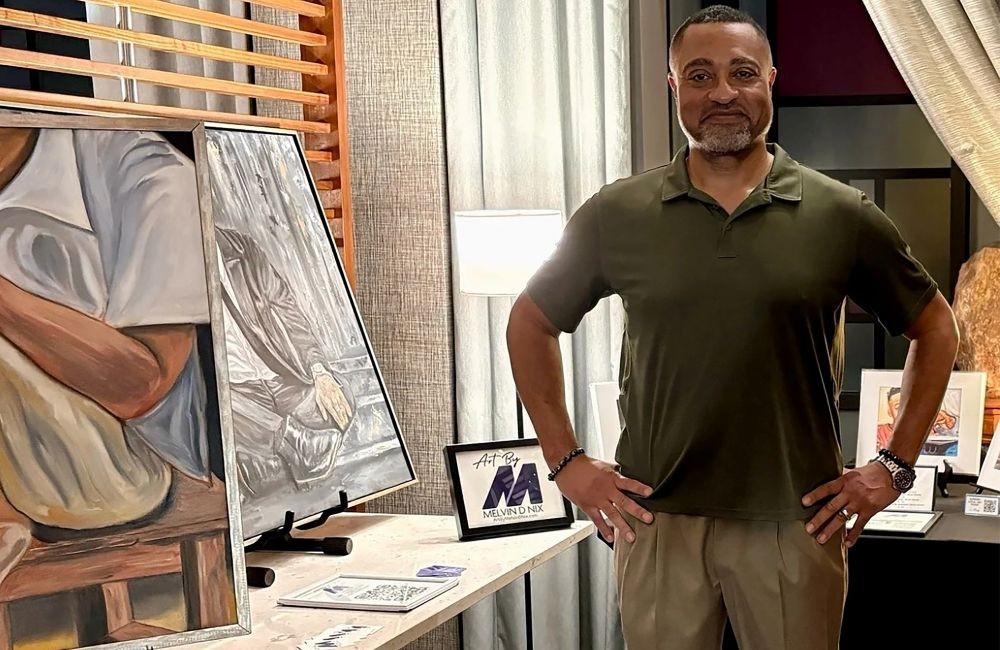
Melvin Nix became a professional artist after Air Force service. (Photo courtesy of Melvin Nix)
His goal is to become an independent artist and to talk to people about art.
“I’ve had many shows, and it’s been very enjoyable to connect with the public, and many times when I shared with them about the inspiration behind my work, it’s offered me an opportunity to see some healing take place, like right then and there in the gallery. That, for me, has been really refreshing and awesome, and I’d love to do more of that.”
The Patriot Art Foundation emerged from a Whyte exhibition titled “We the People: Portraits of Veterans in America,” a collection of 50 veteran portraits.
“From talking with veterans that came to see the show, I realized that art could be a way for them to find a means of connection and expression,” Whyte said. “Through the power of art, we have been able to give many servicemen and women a valuable path to whole health.”
The foundation’s finance committee chairman, Col. Michael Greenberg, USA (Ret), sees art as a practical yet powerful tool that meets veterans where they are and helps them build meaningful connections and confidence.
“[The Patriot Art Foundation] exists to give veterans purpose, expression, and connection through art, especially those who struggle to communicate their experiences in the traditional ways of speaking. It’s not just about art being created, but confidence, connection, and healing,” said Greenberg, a Life member of MOAA.
Greenberg, who deployed seven times, noted that military experience is different for everyone.
“Some people love to talk about it; some people hate to talk about it. But what I found is there is always some type of solution that can help you through whatever troubles you’re going through, and art’s one of them. We’re not just teaching art; we’re restoring connection.”
The foundation offers free art supplies; six-week introductory online courses in watercolor and drawing; eight-week classes in partnership with 25 VA hospitals nationwide; an annual Art of Valor veterans painting event; and Art Muster, a weekly virtual gathering for boot camp graduates.
‘From Isolation to Connection’
For many veterans, art becomes a bridge between isolation and community.
“Sometimes a paintbrush can unlock what words cannot,” said Greenberg, who shared the story of a veteran who struggled to communicate, even with his family, after leaving the military. “Through the art, he found a way to express what he couldn’t say in words, and it shifted him from isolation to connection, which is exactly why we exist.”
Greenberg said that while some veterans pursue additional art training after boot camp, the program isn’t intended to produce expert painters.
“It’s more about how do you put your emotions on paper, or potentially deal with any type of stressors you have.”
Nix, who said he grew up in poverty in the South, often returns to his roots for inspiration and finds satisfaction when his rural subjects connect with viewers.
“I had a painting of my grandfather’s house in Mississippi, where he had raised 14 children in a two-room home, titled ‘Don’t Despise Small Beginnings,’” he said. “A young lady teared up and was crying because the house reminded her of the town she came from, kind of the same message. I’ve seen how my art has touched other people, and it really blesses me like nothing else can. I think my purpose as an artist is to tell those narratives, to touch people. So when I see that happening, that gives me more than anything, more than money.”
Nix believes so strongly in the foundation’s mission that he has signed on as a volunteer. Although he did not serve in combat, Nix has experienced loss and understands what it feels like to wrestle with unspoken emotions.
“I know what it’s like to struggle … what it’s like to need an outlet to be able to express how you’re feeling, or to be able to talk about something, or to just let go of some things,” he said. “I think art is the perfect way of doing that because a person can sit down and have something on their mind and, without saying any words, they can let out their frustrations in a painting and never have to tell us what it is.”
Starting Your Own Creative Journey
You don’t need formal training, expensive supplies, or even artistic talent to begin creating. Sometimes the hardest part is simply giving yourself permission to start. Artist and Air Force veteran Melvin Nix recommends keeping it simple.
“Get the cheapest watercolor set and watercolor paper. Turn on some music, whatever puts you into a relaxing mood, and just sit down and play. Don’t take yourself seriously. When you’re mixing and blending colors, beautiful things happen on their own,” he said.
Ceramicist Steve Dilley offers similar advice. “Draw without an outcome,” he said. “Maybe you scribble. Maybe all you draw are circles. Through that process of discovery and investigation, you have a chance to dive deeper.”
The goal isn’t perfection — it’s exploration. As the veterans featured in this story discovered, the act of creating can be just as meaningful as the finished piece.
Veterans interested in arts programs can learn more through:
- Veterans Art Project
- Patriot Art Foundation
- Armed Services Arts Partnership
- Veterans and the Arts Initiative
- Creative Forces: NEA Military Healing Arts Network
Kathie Rowell is a writer in Louisiana.
Military Officer Magazine
Discover more interesting stories in MOAA’s award-winning magazine.