
(This article by Todd Gilchrist originally appeared in the October 2026 issue of Military Officer magazine.)
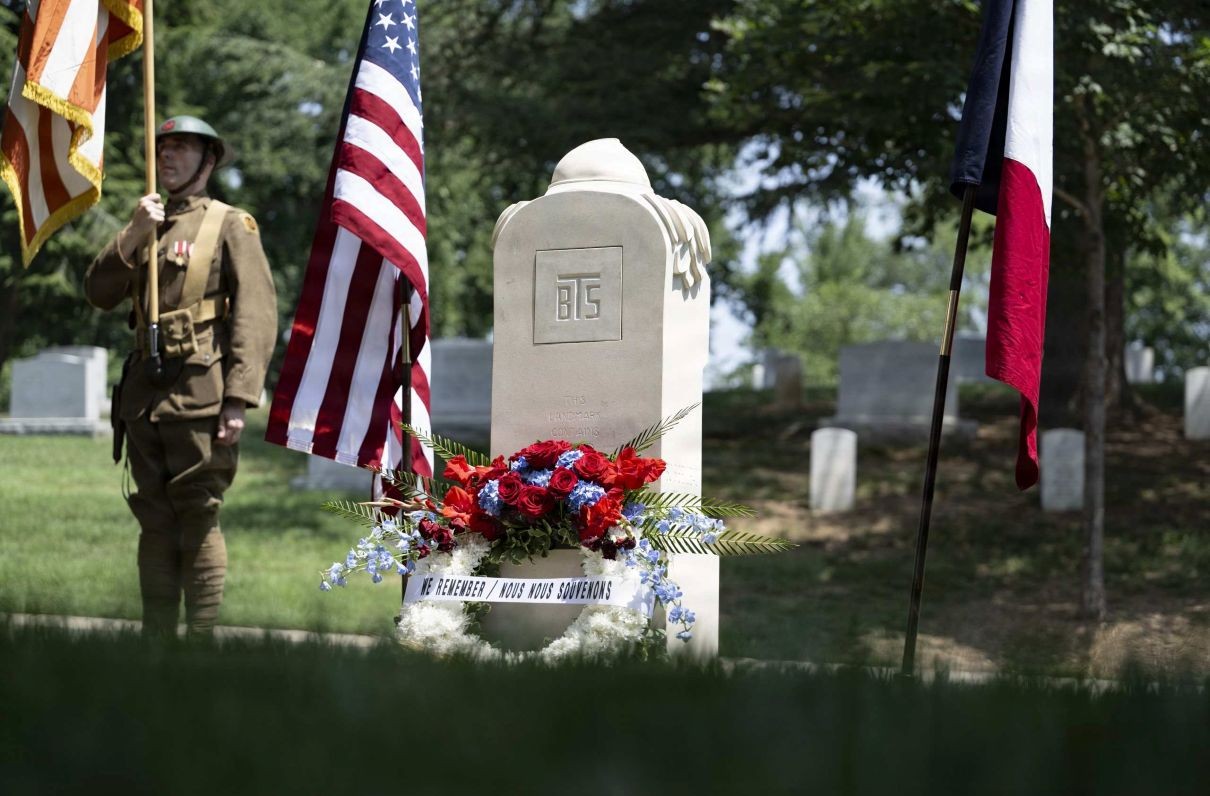
On July 5, a day after the U.S. marked its semiquincentennial anniversary, Arlington National Cemetery held a ceremony to honor servicemembers who died on European battlefields during World War I. The event included an unveiling and rededication of a soil marker first conceived by French veteran Gaston Deblaize in 1927 to pay tribute to the sacrifice of American forces and honor Franco-American relations.
Coordinated through a partnership between Ryan Hegg, who leads legacy and education efforts at the United War Veterans Council, and Andre Rakoto, a military historian, replacement of the soil marker began five years ago when Hegg reached out to Rose Duval, a Gold Star mother and representative of the Arlington Ladies.
The Arlington Ladies is a group of volunteers who attend services at the Virginia-based national cemetery to ensure no servicemember is buried alone.
“Ryan knew that [the original memorial] had a Gold Star mother connection,” Duval said. “I’d helped him back in 2021 when we laid pennies on the headstones of the World War I deceased who were buried at Arlington. And having been a member of the [now-disbanded] Arlington National Cemetery Advisory Committee, I knew the process of getting monuments approved.”
Found Again
The history of the memorial, dubbed borne de terre sacrée (paraphrased in English as “sacred soil marker”), goes back to World War I, when Deblaize, also a sculptor and decorator, visited French battlefields where American troops were laid to rest, often without funeral services.
The original soil marker was a ceramic memorial containing soil from the battlefield at Verdun, France, with versions of it sold to raise funds to help injured veterans, according to the American Battle Monuments Commission. A French delegation delivered a marker made specifically for the U.S. to Arlington National Cemetery, but this one began to deteriorate just a year after its placement in February 1929.
After its removal in 1938, the memorial site remained vacant for almost a century — until the July 5 ceremony. One reason for the delay was that virtually all records of its design were believed lost.
[RELATED: More Recommended Reads From MOAA]
“Then Ryan found there was a ceremony for it and found photographs of it, and he shared it with Arlington,” Duval said.
Another reason was bureaucratic red tape.
“Anything new requires an act of Congress,” Hegg said.
“But as long as it was identical, no problem,” added Duval. “So that’s what they did because they happened to find the blueprints and photographs of it.”
Taking into account the materials needed to ensure the memorial would not disintegrate again, Hegg moved forward with what qualified as a repair, thereby circumventing the administrative hoops they might otherwise have had to jump through.
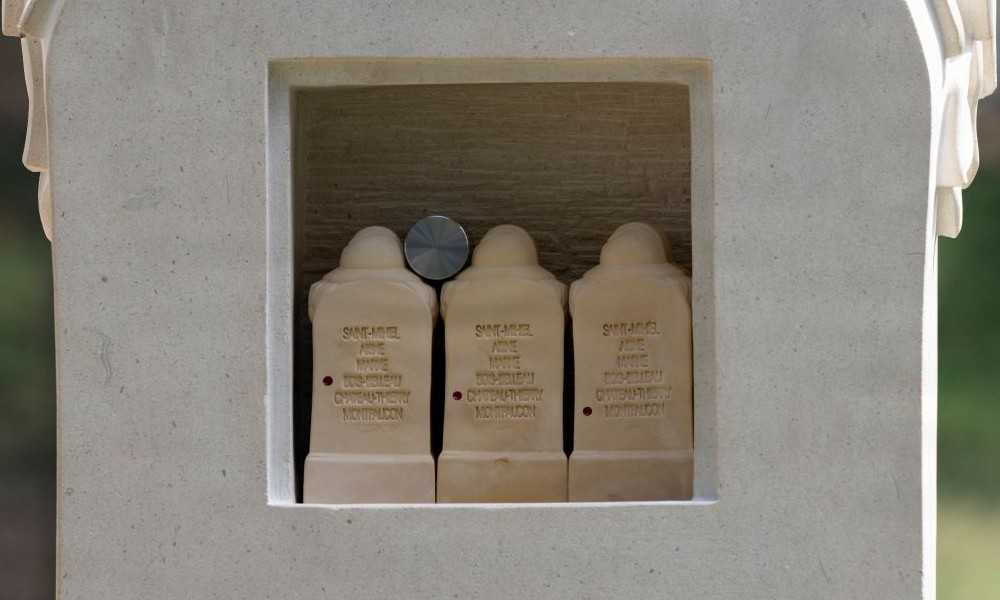
The new marker includes miniature monuments holding soil from each location. (Photo by Elizabeth Fraser/Army)
The Collection
While the memorial was outwardly identical, the team admitted minor changes were made to better hold soil from the battlefields, which are now cemeteries. Specifically, the group created miniature monuments to hold the soil from each location and then sealed those inside the larger marker.
In order to collect the soil beforehand, five Gold Star mothers visited the European sites — six from the original monument and 11 more for its 2026 counterpart — for a “Sacred Soil Tour” last spring. Duval was to be the sixth Gold Star mother on the trip, but a health emergency prevented her from traveling.
The tour was designed to retrace the Gold Star pilgrimages of the 1930s, when the U.S. government first transported mothers of servicemembers killed in World War I to the graves of their children. At each ceremony this year, Gold Star mothers traveled to specific grave sites linked to a particular branch of the armed forces.
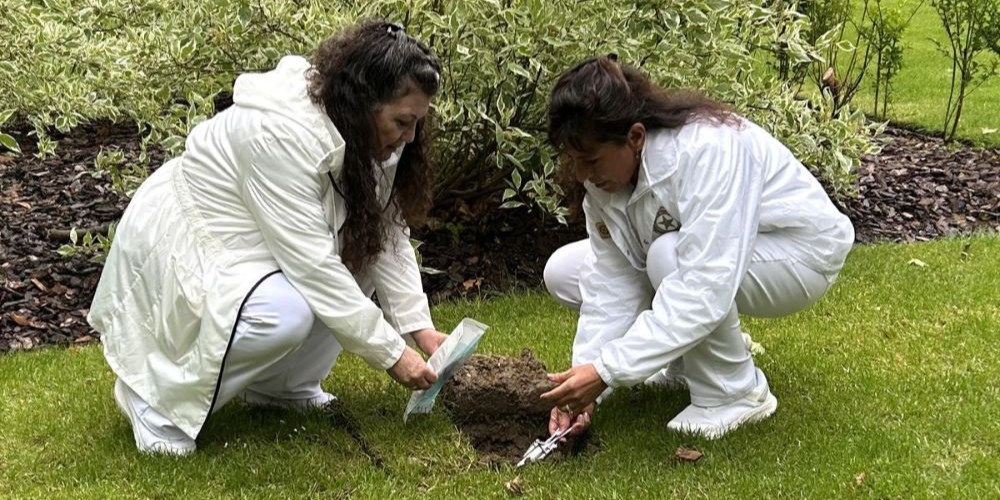
Gold Star mothers collect soil at Meuse-Argonne American Cemetery in France. (Photo courtesy of American Battle Monuments Commission)
“We had two Army, a Marine, and Navy represented, and each one of us was given somebody associated to our particular son,” Duval said. “My son, Scott Duffman, was an Air Force pararescueman, equivalent to a paramedic in the military, and the person that Ryan found for me was Andrew Connell, buried at St. Mihiel American Cemetery [in France], who was with the Army, with the 101st Ambulance Company.”
Renewing a nearly century-old symbol of remembrance, the July 5 ceremony served as a union between past and present, ensuring servicemembers who died in Europe during World War I are never forgotten. For Gold Star mothers and organizations like the Arlington Ladies, it also paves the way for them to honor the sacrifice of U.S. veterans for future generations.
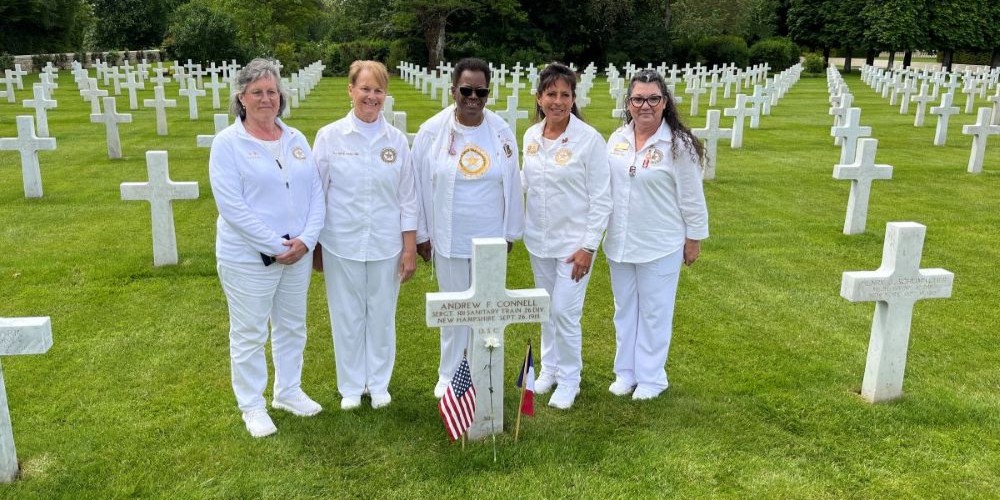
Gold Star mothers visit the grave of Sgt. Andrew Connell at St. Mihiel American Cemetery. (Photo courtesy of American Battle Monuments Commission)
“In the years to come, the goal is to send a delegation of Gold Star moms to each of the other [European] memorials for the ceremony as well,” Hegg said. “So we’re hopeful that this is not just a memorial looking backwards, but it really becomes like a living memorial space where people can come together and remember not just World War I but this story that we’re talking about right now.”
Todd Gilchrist is a writer based in Los Angeles.
Military Officer Magazine
Discover more interesting stories in MOAA’s award-winning magazine.