(This article originally appeared in the August 2026 issue of Military Officer magazine.)
The conflict in Vietnam had been raging for about a decade when George Stavropoulos enlisted in the U.S. Navy. He deployed to the war zone on April 23, 1967, and set out on his first patrol the next day.
“I was getting ready to go out on a search of a village,” Stavropoulos said. “I was scared to death, like anybody else was. I went out on that patrol, did the village sweep, didn’t see anything, didn’t find anything, went back to the landing zone to wait for the helicopters to ... take us back to base camp.
“And that’s when a sniper fired one round, and it went through my leg.”
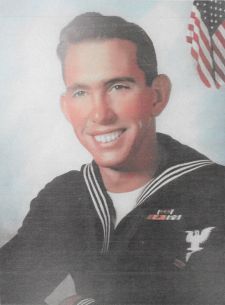 The military found Stavropoulos, pictured, eligible for the Purple Heart award, but he turned it down.
“I refused it — the reason being my mother didn’t even know I was in Vietnam yet, let alone wounded, and I didn’t want her to find out that way,” he said.
But this wouldn’t be the first time the military offered him the award. Stavropoulos would become a recipient of four Purple Hearts — a medal with a history dating back to the Revolutionary War.
Military Merit
Nearly a year after Britain surrendered and American independence was achieved, Gen. George Washington issued his general orders for Aug. 7, 1782, that would lead to the creation of the Badge of Military Merit — known today as the Purple Heart.
Negotiations toward a peace treaty would follow. In the meantime, Congress was struggling to meet the financial demands of war, including paying troops. Washington’s decision to award the Badge of Military Merit was a way of recognizing soldiers for their heroism without breaking the bank.
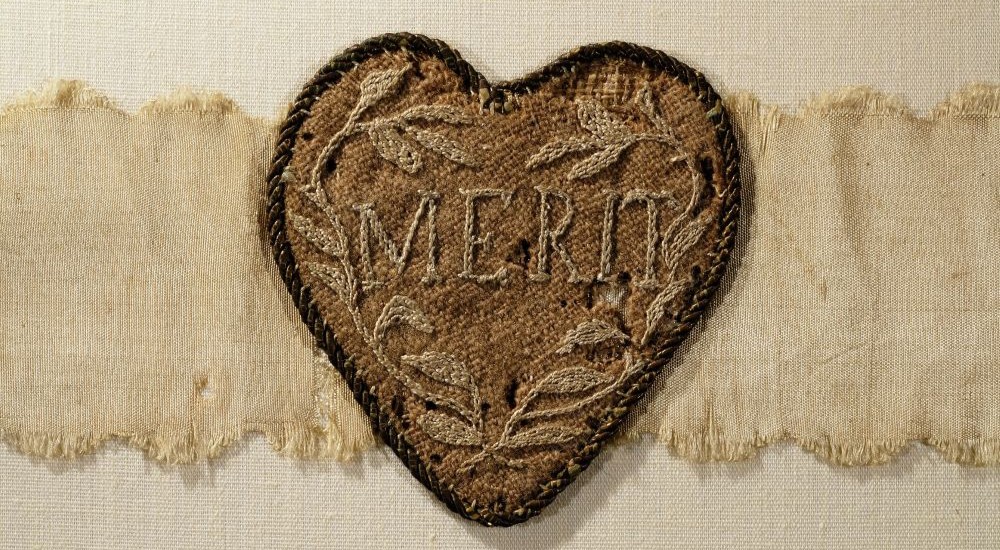
The Badge of Military Merit, created by Gen. George Washington, is the predecessor of the modern Purple Heart. (Photo by New York State Parks, Recreation, and Historic Preservation via DoW.)
Records show only three noncommissioned officers from Connecticut — Sgts. William Brown, Elijah Churchill, and Daniel Bissel — received the Badge of Military Merit, although some historians believe there could have been more.
It wasn’t until 1932 when this award in its modern form would again see the light of day.
[RELATED: Purple Heart Recipients Receive Honors During ‘the Trip of a Lifetime’]
A Modern Approach
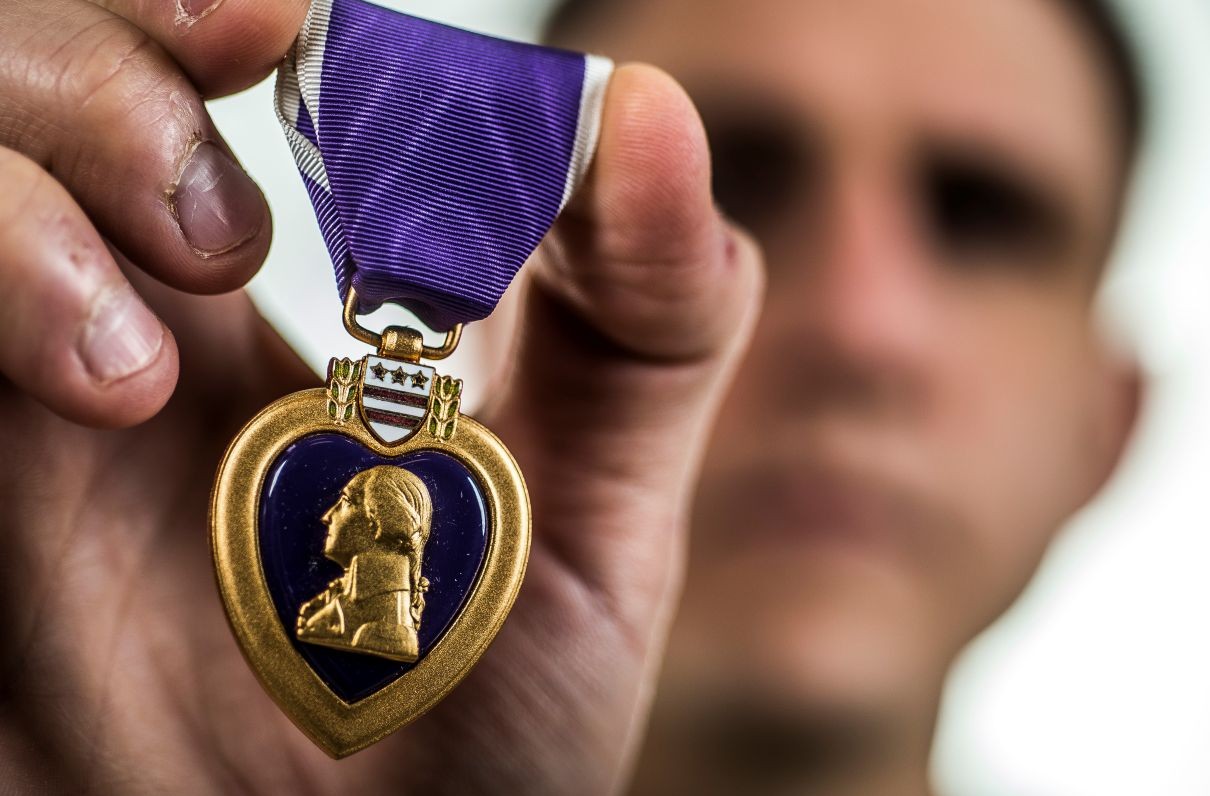
The Badge of Military Merit was a heart-shaped purple cloth with stitching that spelled out “merit” in all caps. Today, the Purple Heart is made up of a purple ribbon from which a bronze and purple heart-shaped medallion hangs.
The part metal, part plastic honorific features a left-facing profile of Washington as well as the shield from his coat of arms flanked by sprays of green leaves. The bronze-colored reverse side features the words “For Military Merit,” with space for the recipient’s name.
Recipients also receive a horizontal purple ribbon with white edges on both the left and right.
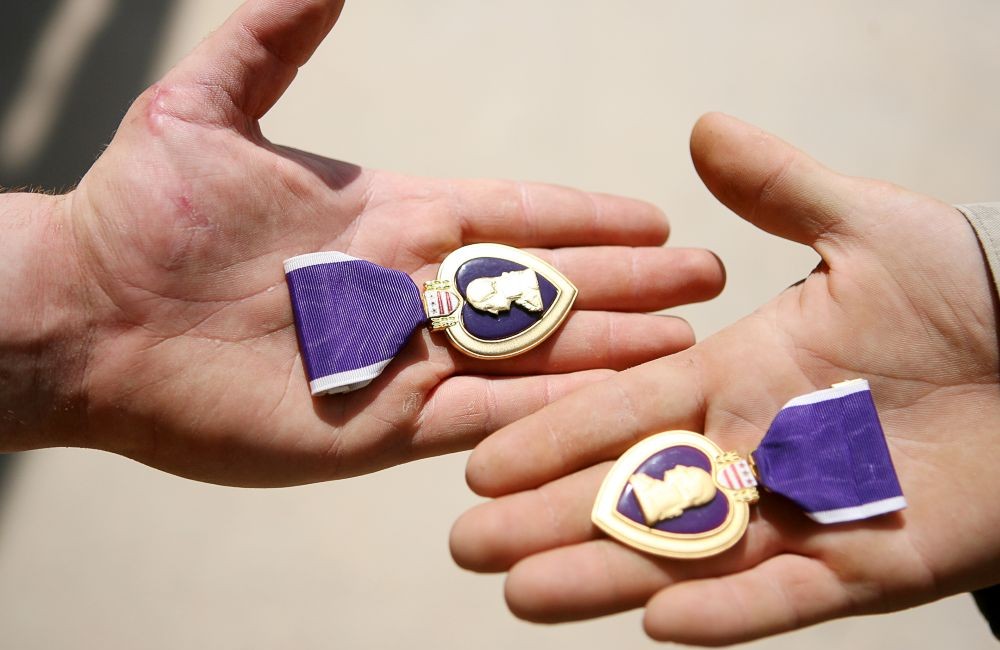
Purple Heart recipients from injuries sustained in Anbar Province, Iraq, display their medals. (Photo by Cpl. Daniel Redding/Marine Corps)
In October 1927, then-Army Chief of Staff Gen. Charles Pelot Summerall attempted to revive the Badge of Military Merit through a congressional bill. Three months later, the effort was considered dead. But in January 1931, revival efforts gained momentum, albeit secretively.
Summerall’s successor, Gen. Douglas MacArthur, began working behind the scenes to redesign the badge with the help of Elizabeth Will, a heraldic specialist with the Army’s Office of the Quartermaster General. This time, they were successful.
“By order of the President of the United States, the Purple Heart established by General George Washington at Newburgh, August 7, 1782, during the War of the Revolution, is hereby revived out of respect to his memory and military achievements,” MacArthur wrote in a February 1932 order.
There have since been updates to eligibility. For example, in September 1942, in the early stages of World War II, the War Department declared the Purple Heart would be exclusively used for wounds or deaths in combat. This move was partly driven by the creation of the Legion of Merit a few months earlier, awarded for meritorious service. In December that year, President Franklin D. Roosevelt expanded the Purple Heart medal — which had been awarded solely to soldiers — to all branches of the armed forces.
[RELATED: Burial at Sea Program Sees Growth]
In 1962, President John F. Kennedy ordered that any member of the armed forces or American civilian serving under those branches who is wounded or killed “while serving with friendly forces” or “as the result of an act of any hostile foreign force” shall be eligible for a Purple Heart. The wording was deliberate, given U.S. presence in Vietnam, where North Vietnamese troops were not officially considered enemies — not until American forces officially took on a combat role in the war in 1965, shortly before Stavropoulos deployed there.
Recipients’ Recollections
On May 14, about three weeks after the sniper incident, Stavropoulos was on patrol when his unit entered combat with North Vietnamese troops, during which he was hit by mortar shrapnel. Still, as a hospital corpsman, he attended to others’ wounds until medevac arrived and took him to a field hospital.
About a month later, on July 2, his unit moved to reinforce a sister company under ambush. While flying in by helicopter, “all I could see were dead bodies — dead Marines for probably a hundred yards,” he recalled.
About an hour into the firefight, he was hit in the left shoulder by an AK-47 round. “That was a devastating injury for me in particular because I’m trying to take care of other Marines and I just got shot in my dominant arm,” he said. “I had a couple Marines help me finish bandaging up that one Marine, and then we set about taking care of my wound.”
A couple hours later, he was shot again, this time through the knee. “That put me down. Now I can’t walk or use my arm very effectively.”
Shortly after, he was hit by shrapnel from enemy artillery, which entered the back of his legs and his lower back. (This time, his mother did find out about the injuries via telegram.)
[MORE FROM MOAA: Vietnam Unchronicled]
As is typical of other Purple Heart recipients, Stavropoulos is humble in the way he sees himself.
“I see someone who did their job,” he said. “I am grateful for what I received, but I would not have — I didn’t ever expect four Purple Hearts.”
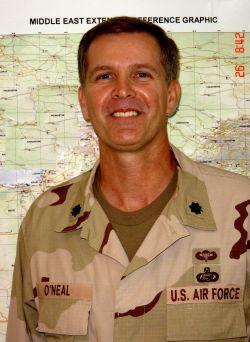 Lt. Col. Ed O’Neal, USAF (Ret), pictured, feels the same way about his Purple Heart. The MOAA Life member served 21 years in the Air Force and three in the Army. During a May 2004 attack by militants on a compound in Saudi Arabia, he helped lead a group to safety, despite being unarmed. But as he tried to open a gate — unaware it was locked — an insurgent opened fire with an AK-47.
Bullets ricocheted around O’Neal, with three hitting his hand, his arm, and his back. A fellow officer also assisting that day was also shot. About two hours later, they were rescued.
“It’s quite an experience — quite a terrifying experience to be in a situation like that,” he said. “My being here, receiving this Purple Heart, it was really evidence of God’s grace because that guy should’ve killed me.”
Both of these Purple Heart recipients attended an event last year at the White House, where President Donald Trump proclaimed Aug. 7 to be National Purple Heart Day.
“We like to say, relative to the Purple Heart, ‘All gave some, some gave all,’” said Col. Russell Vernon, USA (Ret), the executive director of the National Purple Heart Honor Mission, which helped organize the event. “And I think it’s important for Americans to understand that when we talk about the price of our freedoms, [it] wasn’t free.”
The New York-based nonprofit is contributing to that understanding by launching its Mobile Tribute and Education Center, which will collect and share stories like those of Stavropoulos and O’Neal.
Honoring Heroes
The organization’s original goal was to establish a museum dedicated to honoring Purple Heart recipients by highlighting their courage and sacrifices. In 1997, it began raising funds to build the museum in New Windsor, N.Y.
“In 2006, the Hall of Honor was open. In 2019, the hall underwent a major renovation to ensure all the services are properly represented,” Vernon said.
It’s now taking this mission on the road with the Mobile Tribute and Education Center. Housed in an expandable tractor-trailer, the center will feature exhibits and video testimonials from Purple Heart recipients across conflicts and generations.
“We bring every year one Purple Heart recipient and their guest from each state to New York to visit the museum, and we found out most of them had never been to New York, let alone being able to visit the museum,” Vernon said. “So we realized that in order to pay proper honor to Purple Heart recipients around the nation, to have the ability to record their stories, and to also educate the nation, we needed to bring the museum to them.”
The traveling museum is expected to visit 35-40 cities per year, with its first stop set for TotalForce+, MOAA’s annual conference next taking place Feb. 1-3, 2027, in National Harbor, Md.
The center will include a studio where Purple Heart recipients can record their stories to be preserved in perpetuity. Although recipients “are by and large very humble,” they deserve our attention, Vernon said. “All living Purple Heart recipients would tell you they’re not heroes — it’s those that didn’t make it home.”
Military Officer Magazine
Discover more interesting stories in MOAA’s award-winning magazine.