
(This article by Kathie Rowell originally appeared in the September 2026 issue of Military Officer magazine.)
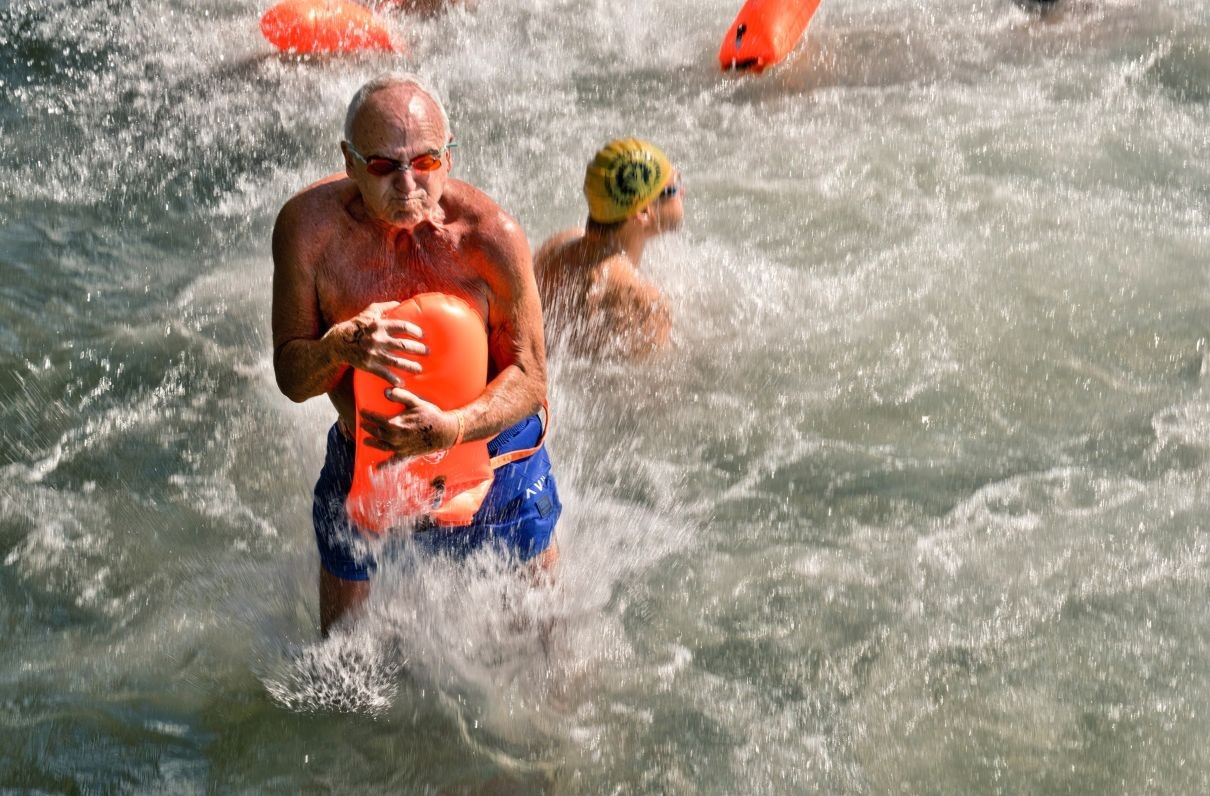
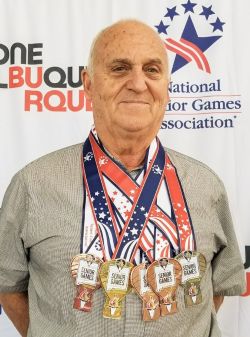 At 82 years old, most people are slowing down. MOAA Life member Lt. Col. Eliot Winokur, USA (Ret), was training to swim 3½ miles through New York City’s Hudson River. The retired Army officer and lifelong competitive swimmer was preparing for what would have been his fifth New York City SEAL Swim, an annual event honoring the fallen and supporting the Navy SEAL Foundation.
His physician ultimately urged him to sit out this year’s race because of concerns about the river’s water quality. Even so, Winokur’s record speaks for itself: Each year he has entered the race, he’s been the oldest swimmer in the water and one of the few to complete the course without fins.
“I had to prove to the fellow in charge, who is a veteran Navy SEAL lawyer, that I was up to the task by showing him a result from three and a half years ago, when I did the open-water lake swim in Hungary, which was 5 kilometers,” he said. “I sent him proof that I’d done that and my time was 2 hours and 14 minutes for the 3 ½ miles, so he accepted me into the swim.”
Winokur’s accomplishment is impressive, but he is far from alone. Across the uniformed service community, retirees are proving that staying active later in life is about much more than fitness. Whether through competitive swimming, adaptive sports, bodybuilding, or cycling, many veterans are finding renewed purpose, better health, and greater independence by continuing to challenge themselves long after leaving unifomed service.
[RETIREMENT GUIDE: How Scams Are ‘The Crimes That Keep Taking’ | Avoid These Tax Traps]
The Benefits of Staying Active
Both the physical and mental rewards of exercise become increasingly important with age, said Cory Scharwarth, a professional fitness trainer at the Cooper Fitness Center in Dallas.
“Physically, regular exercise helps you get stronger and maintain muscle, which naturally declines with age,” Scharwarth said. “It also improves bone density, helping reduce the risk of osteoporosis and fractures. Staying active can improve body composition by reducing body fat and supporting a healthy physique. It also improves endurance and stamina, making everyday activities like walking, climbing stairs, and carrying groceries easier.”
[HEALTHY LIVING: How to Mitigate Symptoms of Type 2 Diabetes]
The benefits extend well beyond physical health.
“Mentally, physical activity can build confidence and support a more positive outlook,” Scharwarth said. “It helps reduce stress and anxiety while improving overall mood.
Exercise can create more opportunities for social interaction, especially in group settings, and help build a sense of routine and purpose. Most importantly, it supports independence and allows individuals to continue doing the things they enjoy.”
That philosophy has guided Dr. Kenneth Cooper, founder of the fitness center’s sister organization Cooper Clinic. Now 95, the former Air Force flight surgeon continues to advocate for lifelong fitness.
“It’s never too late to begin exercising, but remember to listen to your body,” said Cooper, who is widely regarded as the father of aerobic exercise.
“I always tell my patients that no drug can replicate the benefits of an active lifestyle.”
Competing Against Himself
Winokur didn’t discover competitive swimming until age 40, after a knee injury ended a volleyball career that included selection to the All-Army volleyball team.
More than four decades later, he has recorded more than 100 top-10 swimming times nationally and several top-10 finishes internationally. He still trains three days a week, typically swimming 1½ miles in timed intervals.
“I get enjoyment out of competing with myself, looking at my times for each set,” he said.
[HEALTHY LIVING: Beat Back Pain With a Strong Core]
The training has paid dividends. Winokur’s blood pressure hovers around 110/70, and his resting heart rate is typically between 55 and 60 beats per minute.
“When I talk to people my age, they do not believe that I’m 82,” he said.
His journey hasn’t been without setbacks. Winokur has battled skin cancer, eye cancer, and non-Hodgkin lymphoma — illnesses he believes might be linked to breathing toxic air while serving at ground zero after the attacks of Sept. 11, 2001.
Still, he keeps returning to the pool.
“I guess you’ve heard of the runner’s high. There’s also swimmer’s high,” he said. “It clears out your mind. It clears out the clutter. When you do backstroke, and you’re outdoors, you can look up and see the sky and hear the birds. It’s just a way of meditation and mindfulness.”
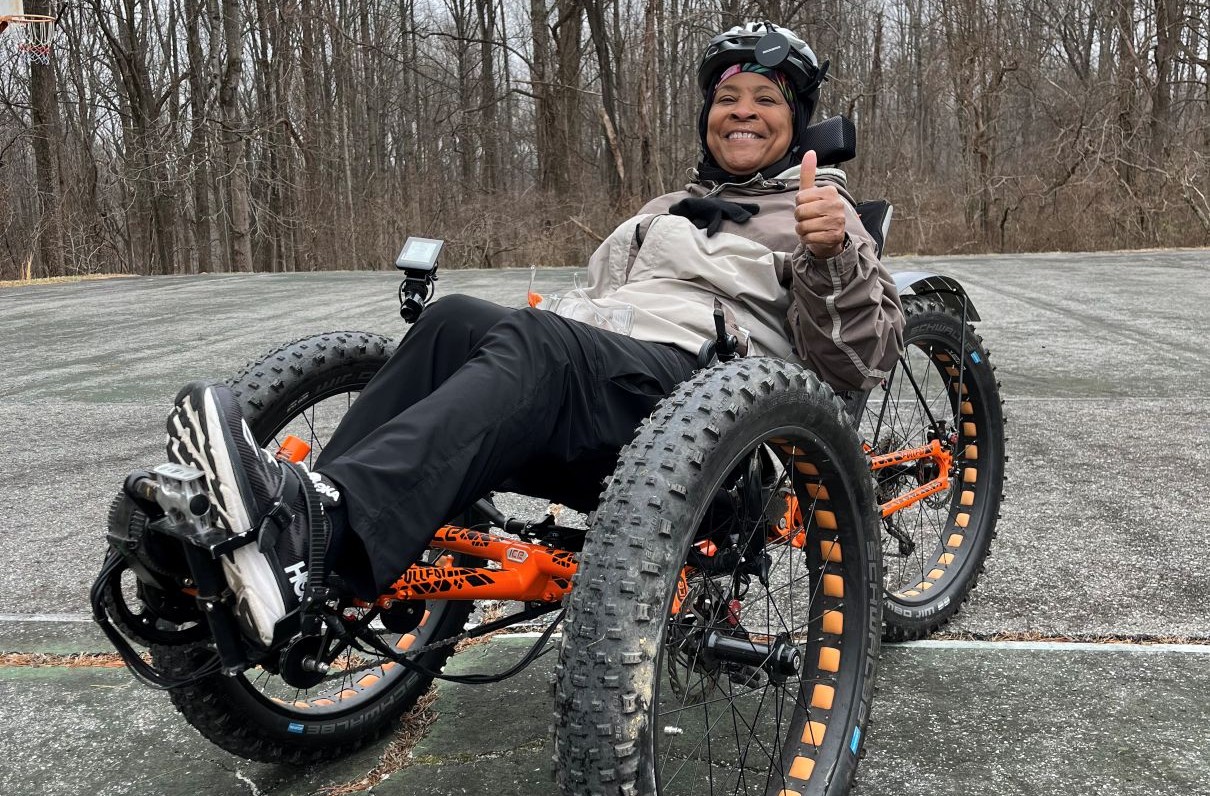
Lt. Col. Francine Patrick Goode, USAF (Ret), found healing through sports after the amputation of her right hand, all the toes on her right foot, and partial amputations of three fingers and three toes on her left side. (Photo courtesy of Francine Patrick Goode)
Finding Purpose Again
For MOAA Life member Lt. Col. Francine Patrick Goode, USAF (Ret), fitness became important for an entirely different reason.
After surviving a severe case of sepsis, Goode lost her right hand, all the toes on her right foot, and portions of several fingers and toes on her left side. The illness also ended her career at the National Security Agency.
Until then, her only fitness endeavor had been a somewhat haphazard walking routine.
“I was so blessed that I lived because they didn’t think I was going to,” she said.
The loss of independence took a toll on her mental health, but adaptive sports helped restore her sense of purpose.
“It just gives me something to wake up for because if you don’t have something to wake up for, sometimes you don’t want to get out of bed.”
Through the Wounded Warrior Project and VA programs, she tried adaptive cycling, skiing, surfing, shot put, and javelin throwing, and she competed in the National Veterans Golden Age Games.
“My fitness level has absolutely improved 100%,” she said.
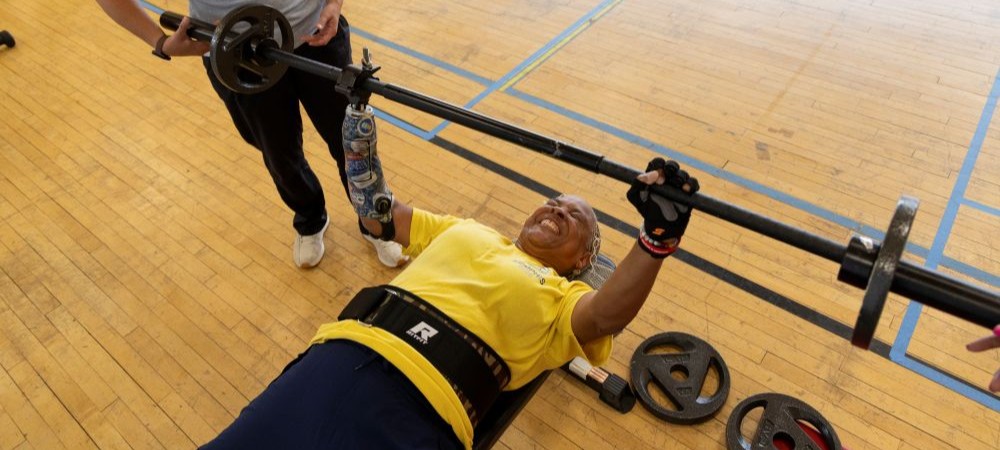
Through Wounded Warrior Project and VA programs, Lt. Col. Francine Patrick Goode, USAF (Ret), has been able to try and compete in a variety of adaptive sports, such as biking, skiing, surfing, shot put, and javelin throwing. (Photo by Mike Morones/MOAA)
Today, she’s setting new goals, including weightlifting with a newly fitted prosthetic.
“I want to keep trying whatever comes my way,” she said. “I feel like the sky is the limit.”
Always Ready for the Next Challenge
Col. Mike Buckley, USA (Ret), has spent much of his life chasing endurance challenges. He’s completed over 25 marathons, hiked the more than 800-mile Arizona Trail, and biked the approximately 2,700-mile Tour Divide from Canada to the Mexican border.
A few years ago, however, his wife inspired him to try something completely different: bodybuilding.
“We worked at it really hard,” Buckley said. “That training is at a different level than [if ] you just walk in and do four sets in the gym and walk out.”

Col. Mike Buckley, USA (Ret), and his wife, former Capt. Angi Buckley, USA, have found success on the bodybuilding circuit. (Courtesy photos)
Over the next year and a half, he and his wife, Angi, a former Army captain, competed in multiple bodybuilding competitions, earning several first-place finishes.
Today, he has returned to cycling while continuing a serious strength-training routine.
“As you age, it becomes the issue of loss of muscle mass, bone density problems, osteopenia, sarcopenia, and osteoporosis,” he said.
Angi continues to train for bodybuilding competitions and believes the effort is worthwhile, even if strength training isn’t always enjoyable.
“Being physically fit doesn’t make you better than anybody else, but it makes you better than your alternative self,” she said.
It’s Never Too Late
These veterans took different paths to fitness. One swims open-water competitions in their 80s. Another found healing through adaptive sports after a life-changing illness. A third discovered bodybuilding after decades as an endurance athlete.
What connects them is the belief that staying active isn’t about chasing youth — it’s about preserving strength, independence, purpose, and the ability to keep doing what matters.
As Winokur has learned after more than 40 years in the pool, the greatest competition isn’t always against someone else. Sometimes it’s simply showing up, one more day, and seeing what you’re still capable of doing.
Kathie Rowell is a writer in Louisiana.
 Check Out MOAA’s Digital Retirement Guide
Your retirement, your way, with help from a trusted source -- MOAA's Digital Retirement Guide brings you information on retirement living nationwide, including easy-to-search entries and retirement news you can use.