
(This article by Lt. Col. Nick Barringer, USA (Ret) originally appeared in the December 2026 issue of Military Officer magazine.)
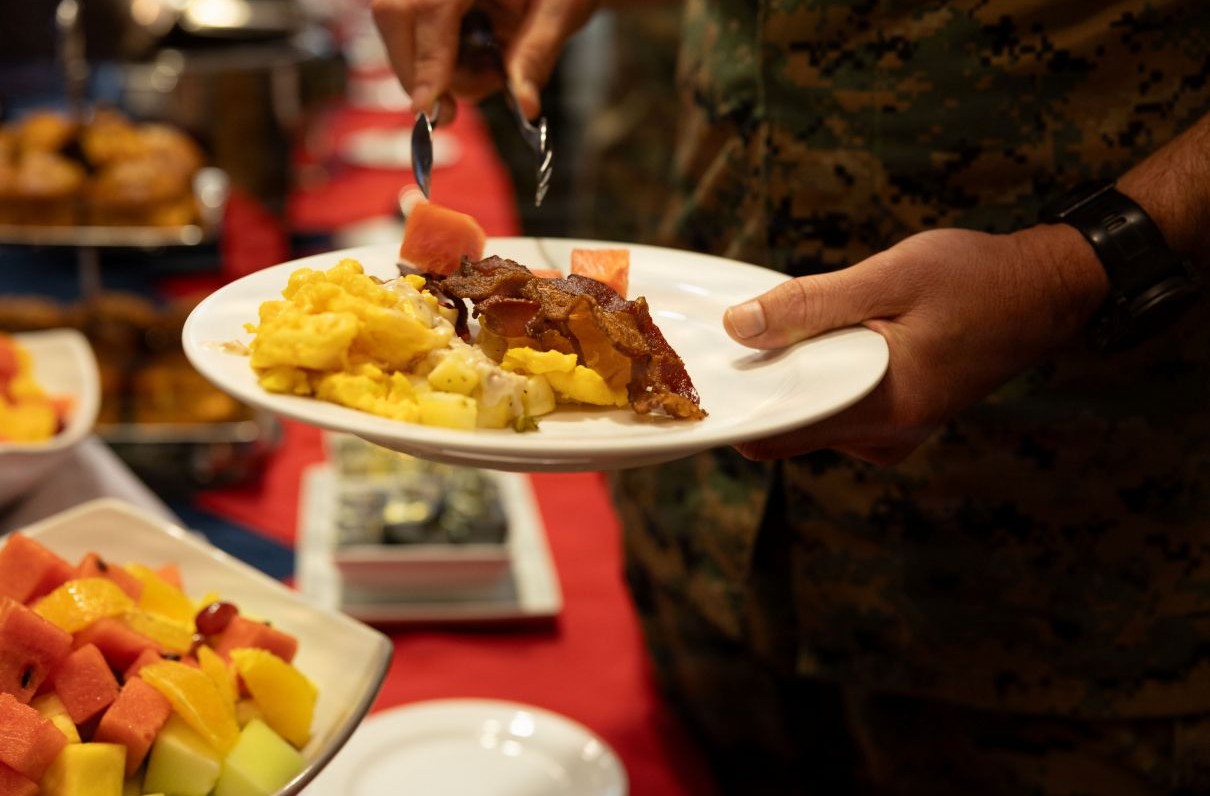
You probably remember the chow hall, or the DFAC, depending on your service or era.
You grabbed a tray, moved down the line, and ate as fast as you could. There was a formation to make, a range to reach, or a meeting you had to attend. On a compressed feeding timeline, the goal was simple: Get enough fuel in to make it through the day, then get out.
That habit served us well. In basic training, at sea, or in the field, eating fast was a survival skill. Sadly, those habits are probably hurting us in the long term.
There is a better model, and it comes from the Japanese island of Okinawa, famous for one of the world’s longest-lived populations.
Before a meal, many older Okinawans recite a short phrase: “hara hachi bu,” which essentially means “eat until you are eight parts full.” No calorie counting. No forbidden foods. Just stop before you’re stuffed.
[HEALTHY LIVING: Skip the ‘Biohacks’ and Build Better Basics]
Military feeding was built for the mission, not for moderation. We were taught to eat quickly and never leave fuel on the tray. Even today, basic trainees get about 10-15 minutes to eat a meal. Daily physical training, rucks, and field duty burned off the big portions.
Then we took off the uniform.
The activity dropped, but the habits stayed: the fast pace, the full plate, and the reflex to finish whatever is in front of us. Hara hachi bu asks us to unlearn exactly what we were trained to do.
Tips and Tricks
A rough translation of hara hachi bu comes across as “belly, eight parts (of ten).” It is closely tied to Okinawa, one of five so-called blue zones that author Dan Buettner identified as having an extraordinarily high number of people living to at least 100. He recommends eating slowly, using smaller plates, and turning off screens during meals.
[RELATED: More About Blue Zones]
In Okinawa, residents serve their portion, put the rest of the food away, and then sit down to eat, meaning going back for seconds requires a deliberate decision, according to dietitian Alexis Cole.
Fullness signals take time to register in the brain. The popular figure is 20 minutes, although one brain-imaging study put the main signal closer to 10. Either way, eat fast until you feel full, and you’ll likely overeat. But stopping at “no longer hungry” lets the signals catch up.
As Buettner notes, most of us gain weight not through binges but by eating a little too much each day without noticing. Slightly trimming each meal shrinks that daily surplus.
The Evidence
According to the Organisation for Economic Co-operation and Development, only 5% of Japanese people 15 years and older were obese in 2023. In contrast, that figure was 41% for their counterparts in the U.S. But traditional Okinawans ate plenty of vegetables, stayed active, and kept strong social ties, so that no single habit can claim the credit.
A 2008 study of 3,287 Japanese adults, published in the BMJ, found that those who ate quickly and ate until full had about three times the odds of being overweight as those who did neither. That is the pattern from our chow hall.
In addition, a 2015 Japanese study, published in the journal Eating Behaviors, found that men who always stopped at 80% full ate about 450 fewer calories a day than men who rarely or never did.
[HEALTHY LIVING: Beat Back Pain With a Strong Core]
While one can’t establish a cause and effect relationship given the other variables, the evidence points to a low-risk practice with a potential significant reward of weight control without the need to count calories.
The 80% Rule
Hara hachi bu won’t replace good food choices, sleep, or exercise. But it fills a gap most diets leave open: the moment near the end of a meal when we decide whether to keep eating.
For those of us trained to clear the tray and move out, the new mission is simpler: Stop a little early and let your body catch up.
Here’s how to practice the 80% rule:
- Change the question from “Am I full?” to “Am I still hungry?” When the answer is no, stop.
- Serve yourself once. Plate your food, put the rest away, then sit down.
- Slow down. No one is timing you anymore. Set your fork down between bites, and let the meal last at least 20 minutes.
- Cut the distractions. Eat away from the TV and phone.
- Skip the guilt. If you overshoot, notice it and move on.
Notably, anyone with a history of disordered eating should talk with a clinician before adopting any rule about portions.
The military taught us to eat for the mission. Hara hachi bu might help with your next mission — a long and healthy life.
Lt. Col. Nick Barringer, USA (Ret), is a founder of human performance consultancy Enkrateia.
Military Officer Magazine
Discover more interesting stories in MOAA’s award-winning magazine.