
|
 |
| OBSERVATION POST |
| Wartime Is No Time To Cut Military Pay |
|
By Tom Philpott
October 2003
|
"Ignore the man behind the curtain," urges the Wizard of Oz after Dorothy discovers the mechanical trickery behind his power.
That line from the 1939 movie classic has become a cliché for officialdom trying awkwardly try to hide what's real and tout what's not. It came to mind again following a mid-August Pentagon press conference
where defense officials tried to end a political firestorm over their own budget documents, that asked Congress not to extend recent special pay raises for deployed forces beyond Sept. 30.
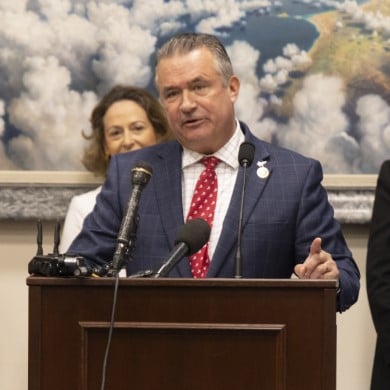
On their face, the Bush administration budget papers would support a drop in pay for hundreds of thousands of service members including 150,000 U.S. troops in Iraq and Afghanistan. But David Chu, under secretary of
defense for personnel and readiness, and Larry Di Rita, acting Defense Department spokesman, were sent forth Aug. 14 to explain to a skeptical press corps that the administration planned all along to protect actual
combatants from the pay drop through a more targeted pay initiative. It was "absurd" to think otherwise, Di Rita said.
The pair said there was no reason to unveil the administration's real plan sooner because Congress had not decided yet to follow administration guidance and decline to extend $225 a month in Imminent Danger Pay (IDP) and Family Separation Allowance (FSA) beyond Sept. 30.
Congress enacted the special last April. The $150-a-month increase in FSA and $75 in IDP, made retroactive to October 2002, were to show appreciation for deployed troops, particularly those in Iraq and Afghanistan. The increases were to expire Sept. 30 unless Congress voted to extend them.
The Bush administration opposed that idea. The raises were not budgeted by the services. They also were inefficient, going to many more service members than were at risk in Iraq and Afghanistan.
FSA, which was raised from $100 a month to $250, is paid to any service member forced to live away from family for more than 30 days. Before the Iraq war, roughly 200,000 members drew FSA including married
sailors and Marines on routine sea deployments.
Likewise IDP, which jumped from $150 a month to $225,is paid to anyone serving in scores of designated danger areas around the world. At least 250,000 drew IDP before the Iraq war.
Chu said the increases were like "using a sledgehammer to hit a small
nail."
Yet the Senate version of the defense bill would make the increases permanent. The House would keep them only for participants in Operation Iraqi Freedom and Operation Enduring Freedom in Afghanistan.
Defense officials had advised against either alternative but did so without political consequence until early August when Army Times focused anew on administration opposition. A front-page headline said the department wanted to "slash" danger and separation pay. This sparked other news articles, which lead to critical newspaper editorials and finally words of outrage by Democratic presidential candidates.
Chu said he was "startled" by the uproar. Still, there was circumstantial evidence that the Bush administration would have been satisfied just to allow the April pay increases to expire, regardless of the pay consequences to troops serving in war zones.
First, neither Chu nor Di Rita could explain in detail how U.S. occupation forces would avoid a pay cut if Congress followed the administration's advice. "There is an open issue about how we're going to do
that," Chu conceded. He referred to an increase in hazardous duty pay or to use of new assignment incentive pay. But both presumably would require swift passage of implementing legislation or at least funding in 2004.
Second, why didn't DoD raise this targeted alternative at the same time the administration urged Congress to allow the April increases to expire? Wouldn't that have shielded troops in the war on terrorism from rumors of a pay cut? Wouldn't that have helped persuade Congress to oppose extending the broader IDT and FSA increases?
Third, weeks after Defense officials described the absurdity of the pay flap, the White House's Office of Management and Budget still had not approved whatever replacement pay plan DoD tossed together, nor had DoD made pay experts available to discuss their pay initiative.
Turn away, Dorothy. Turn away.
Tom Philpott is a freelance writer and syndicated news columnist. His column, "Military Update," appears in 48 daily newspapers throughout the United States and overseas. His book, Glory Denied: The Saga of Jim Thompson, America's Longest-Held POW (W.W. Norton & Co., 2001), now is available in paperback (Plume, 2002).
|
 |
|