



November 21, 2011
Lt. Gen. Tom Bostick, USA, Speaks to MOAA Council Leaders
Vice Adm. Norb Ryan Jr., USN-Ret., MOAA President (left) presents a MOAA coin to Lt. Gen. Tom Bostick, USA, as a token of appreciation after the Council President's Seminar Luncheon. Photo by Steve Barrett.
Watch a replay of the Council President's Seminar Luncheon online.
MOAA Council Presidents’ Seminar participants and their spouses were treated to a special keynote speaker at a seminar luncheon. Lt. Gen. Tom Bostick, USA, deputy chief of staff of Personnel for the Army, opened by addressing the importance of the U.S. military community and fighting for them to keep the benefits they earned through repeated deployments or careers of service to their country.
“People are not in the Army,” Bostick said. “They are the Army.”
“Our whole military – the Army, Air Force, Navy, Marines, our Coast Guardsmen and women and their families – have done remarkable work in 10 years of combat,” Bostick continued. “My main message here today is to thank you for your advocacy, to thank you for what you do for … all of our military and their families … and for the retired community and the civilians [who] support us.”
Bostick addressed why the Army needed on the 22,000 temporary end-strength increase, or TESI.
“If [the U.S. Army] didn’t have those 22,000 additional soldiers, and we just reached the 22,000 this last month, we wouldn’t be accomplishing our mission,” Bostick said. “We need it because of our non-deployable soldiers, those soldiers who cannot deploy with units, and we need it because of stop-loss.”
But he now is tasked with figuring out how to draw down those 22,000 soldiers, which is scheduled to begin in March 2012 and end by September 2013. In 2014, the Army is going to try to hold its end-strength to 547,000, the total after the 22,000-troop drawdown. In 2015 and 2016, the Army will be down to 520,000 soldiers.
“What we’re betting on is that the demand is going to come down in Iraq and Afghanistan,” Bostick said. “In 2015 and 2016, we’ll have to take 27,000 soldiers out of the force, and about 5,000 of them will be officers, and that’s going to be a big cut. … So we’ve got our work cut out for us. We’ve got to go through and take a look at our structure, take a look at how we’re organized and how we fight.”
The Army is at a crossroads, Bostick said. “We are going to be engaged … in conflict for the next decade, and we’re doing this at a time when the country has significant economic challenges. … How do we balance it to make sure we can draw down the Army but still meet the requirements of this nation?”
Recruiting new soldiers can be a struggle, although this year, Bostick said, recruiters finished the whole yearly mission in March. “But when you look at America, 1 percent of Americans wear any type of military uniform, and this is a select bunch of young Americans that are coming in today, but they’re not all qualified to serve.”
According to Bostick, less than three out of 10 young Americans – 17 to 24 years old – can even join the military because of medical, physical, and behavioral factors. But, he says, the Army is working to try to help those other seven out of 10 who don’t qualify for the military, “whether it’s ROTC or other programs to help with discipline, but we feel we owe that to the country.”
Bostick concluded with an anecdote about how the perception and the treatment of servicemembers have evolved since Vietnam. It changed from a time where, according to his father, no one should leave an Army base wearing their uniforms because people would throw things at them and yell at them, to the present conflicts, when a stranger in an airport might offer a servicemember a hug with tears in her eyes as she thanks him or her for serving.
“You’re lucky,” Bostick recalled saying to his 25-year-old aide. “It hasn’t always been this way, where regardless of what’s going on in this country, America supports their men and women in uniform – and we don’t take that for granted.”
Council Presidents' Seminar Focuses on Membership Recruiting and Retention
On Thursday, April 14, council leaders from across the country gathered to exchange ideas and share best practices at MOAA's 2011 Council Presidents' Seminar, held at the Crowne Plaza Old Town Hotel in Alexandria, Va.
Col. Lee Lange II, USMC-Ret., MOAA Council and Chapter Affairs director, opened the daylong event with a working breakfast where he highlighted the importance of recruiting new chapter members.
Following the working breakfast, leaders convened for the first of the day's general sessions, where members of MOAA staff and board of directors outlined the association's goals.
Council and Chapter Affairs Committee member Capt. William E. Knehans, USN-Ret., opened the first general session by introducing Adm. Steve Abbot, USN-Ret., chair of MOAA's board of directors, who outlined just how important the association's council and chapter system is now more than ever. Council and chapter leaders are the grassroots supporters of national MOAA's legislative goals, and with cuts to defense spending and military retired benefits on the table, the association is counting on them to educate their congressional representatives on how important it is to secure a strong national defense and ensure retired servicemembers receive the benefits they were promised when they signed up for a career of service.
"Our collective voice at MOAA is more important this year than any other year I've been involved with MOAA," Abbot said, before introducing MOAA President Vice Adm. Norb Ryan Jr., USN-Ret., who welcomed attendees.
"You are all the bedrock, the foundation, of everything [MOAA does]," Ryan said. "You are our bedrock because we all know being in the military … that leaders make a real difference. … When we get the right leader in the right position, things happen."
Col. Mike Jordan, USAF-Ret., director of MOAA's Contract Services and Marketing, highlighted MOAA's ongoing and upcoming marketing and membership initiatives. Capt. Bud Schneeweis, USCG-Ret., director of Benefits Information and Financial Education, outlined the importance of making sure chapter members know what benefits and services the association provides, including benefits counseling, financial education, active duty transition seminars, Post-9/11 GI Bill presentations, and retiree activity days. To close out the session, Col. Dick Crampton, USA-Ret., director of MOAA's TOPS career-transition program, updated seminar participants about the benefits of using TOPS as a recruiting tool and the importance of having a TOPS networking liaison in each chapter who also belongs to national MOAA's TOPS networking program.
The second general session of the morning featured a brief by Auxiliary Member Advisory Committee member Joyce Harte, who stressed the importance of having an appointed auxiliary liaison in each chapter and updated leaders on the committee's Cell Phones for Soldiers initiative. Through the program, each unused cell phone collected translates into 60 minutes of free talk time for a deployed servicemember. Harte also pointed out the impact auxiliary members can have on a MOAA and its chapter system.
"The auxiliary members … have a tremendous voice," Harte said. "They helped you in your career for many years and have added a lot of value to the way you've been able to do things. They can also add their voices to MOAA and help in the recruiting and the retention. There's no better way than to engage them actively."
Lange held a presentation of the Communications Award to contest winners. Ryan was on hand to present the awards to MOAA chapter members who proved to be great communicators in at least one of the following categories — print newsletter, e-newsletter, website, best legislative coverage (print), best legislative coverage (website), best recruiting brochure, and unique communication.
Before wrapping up for lunch, Col. Dale Yonker, USAF-Ret., president of the Illinois Council of Chapters, presented a check for $5,000 on behalf of the council to Ryan for The MOAA Scholarship Fund.
In the afternoon's general sessions, seminar attendees were briefed on ways to meet the membership challenge, including appointing a membership chair and a chapter TOPS liaison in each chapter.
"We need new, younger members," said attendee Lt. Col. Buddy Guidry, USAR-Ret., Louisiana Council of Chapters president. "That's what we need to keep bringing into our chapters to keep them going."
Participants received the opportunity to ask questions of MOAA staff and other council leaders about how to effectively run a council. Leaders discussed chapter-management and recruiting techniques and gained ideas to help keep their councils and chapters going in a successful direction.
Rep. Buck McKeon (R-Calif.) Addresses MOAA Council Leaders
Rep. Buck McKeon (R-Calif.) addressed MOAA leaders at the annual Council Chairmans' Dinner. Photo by COL Warren Lacy.
Watch a replay of the Council President's Dinner online.
On Wednesday, April 13, MOAA council presidents and their spouses joined national association staff for the MOAA Council Presidents’ Dinner with keynote speaker Rep. Buck McKeon (R-Calif.).
Before dinner, Adm. Steve Abbot, USN-Ret., chair of MOAA's board of directors, addressed the nearly 150 attendees who had taken to Capitol Hill earlier that day to lobby their congressional representatives on issues important to the military community.
“We just had a terrific day over on the Hill,” Abbot said. “I want to thank all of you who participated – board members, council and chapter presidents, spouses, and … MOAA staff.”
“This is a year where the country is facing significant legislative and fiscal challenges,” Abbot continued. “But we got the opportunity today to go [to Capitol Hill] and see our individual legislators and talk to them about the issues that are important to our currently serving troops and their families and to those who are retired and dependent on TRICARE and concerned about [fee] increases being fairly computed, and also continuing to do the right thing for our widows and widowers of military personnel and disabled retirees and [guardmembers and reservists] who have served so valiantly over the past 10 years of this conflict.”
Abbot introduced McKeon, chair of the House Armed Services Committee, pointing out McKeon has been a champion for a strong national defense and for the women and men of the armed forces and their families since he began serving in Congress in 1993.
McKeon has worked to bridge the gap between industry and military leaders to ensure servicemembers on the ground continue to receive the support they need and deserve when they return from combat. He has worked to strengthen missile-defense programs, support funding for the F-22, and provide enhancements to effective, lighter-weight body armor and mine-resistant vehicles.
“I appreciate the opportunity to talk to you about our national security and the way forward in a changing, volatile world,” McKeon said. “Since 1929, MOAA has been a voice that America trusts. You have worked tirelessly on behalf of our men and women in uniform. … You serve those who continue to serve us.”
McKeon cited difficulties facing the U.S. military, including such problems as national security; the “staggering pace” of evolution of warfare since the first Gulf War; U.S. military involvement in conflicts in the Middle East, specifically Afghanistan, which he says remains a “tough fight that’s demanding both men and materials,” and Iraq, “though largely stabilized, still requires a responsible presence of American forces; the “real danger” of Tehran, Iran, going nuclear; and a cutback of troops “that places additional strain on our military members and military families.”
“Because you, as military officers and veterans, are so good at what you do,” he said, “you are asked to perform missions beyond the normal scope of military operations. The attack of Sept. 11, 2001, taught us that instability in remote regions of the world can pose an imminent danger to the United States. Today our fighting forces combat that instability by … treating disease in Africa; training … militaries in Asia, Eastern Europe, and Latin America; and performing humanitarian relief operations in Japan.”
“The lesson here is obvious,” McKeon continued, “as military operations expand in size, scope, and seriousness, this is not the time to be cutting defense spending. It’s not the time to be shrinking our force. And it’s not the time to be shortchanging our men and women in uniform.”
McKeon ended by saying MOAA and other advocacy organizations “must continue their dialog [with members of Congress]. We must continue working together to find fiscally responsible solutions to problems facing our military community. On issues such as TRICARE adjustment and veterans’ pay, my door will always be open to you. For decades, MOAA has maintained a strong relationship with the House Armed Services Committee. This will not change during my tenure as chairman.”
MOAA Leaders Storm the Hill
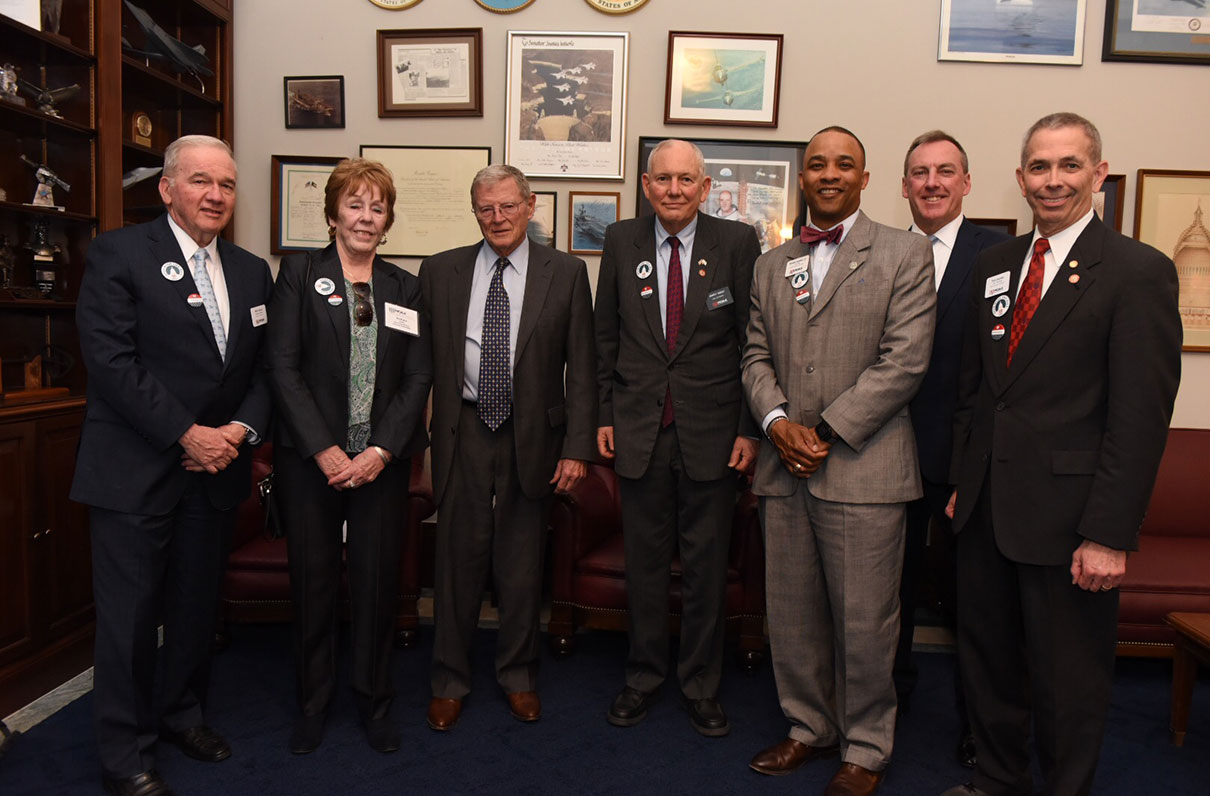
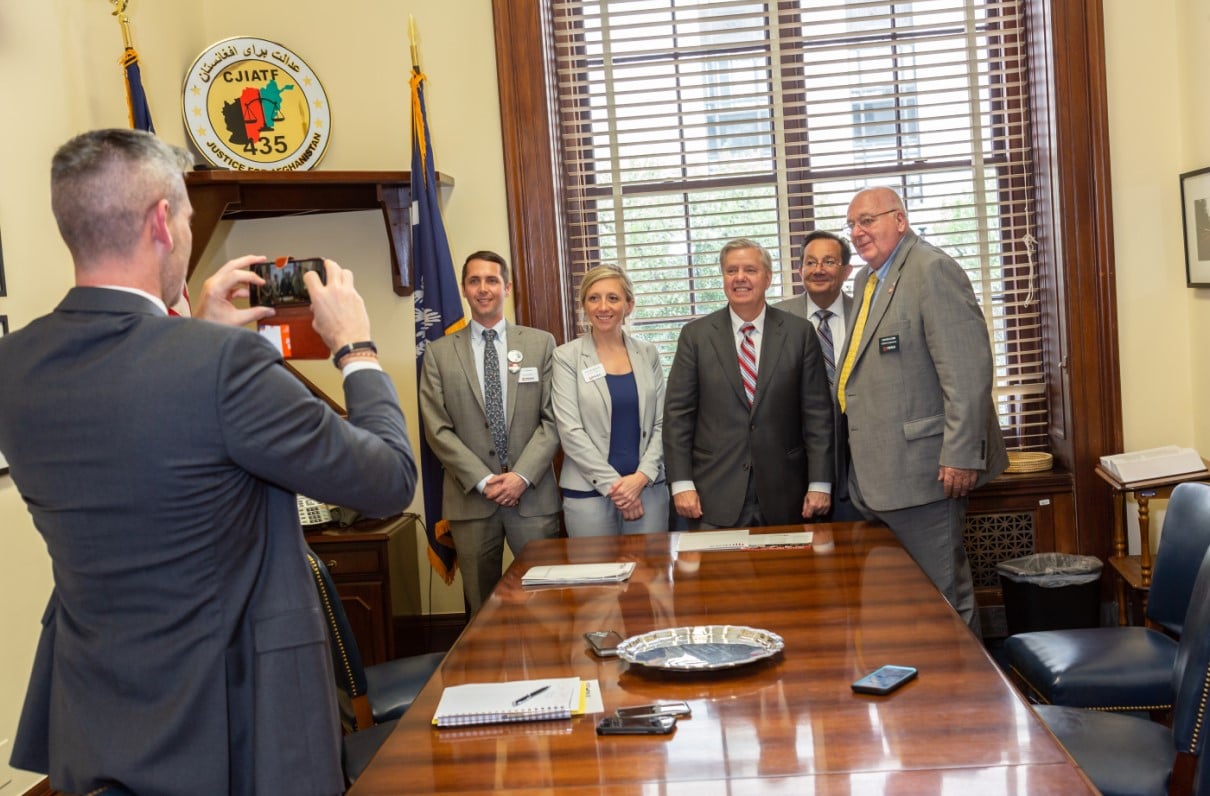
Col. Sharon I. Richie-Melvan, USA-Ret., MOAA Board Director (left) and Rear Adm. Daniel B. Lestage, USN-Ret., MOAA Board Director (front right), and Gen. Charles T. Robertson, Jr., USAF-Ret. MOAA board Director (right, background) met with Rep. Miller (R-Fla.) and his staff to discuss MOAA legislative priorities for 2011. Photo by Sean Shanahan.
About 140 MOAA leaders stormed Capitol Hill Wednesday, April 13 for the association’s annual lobbying event in Washington, D.C.
MOAA state council and chapter leaders, national board members, headquarters staff, and members of MOAA’s Currently Serving Advisory Council, Currently Serving Spouse Advisory Council, and Auxiliary Member Advisory Committee made up about 65 Hill-storming teams.
The teams visited congressional representatives from each state to urge them to support some of MOAA’s legislative goals, including:
capping future TRICARE fee increases at the COLA percentage;
protecting troops against manpower and pay cuts; and
fixing the compensation inequities for disabled retirees, survivors, and recalled guardmembers and reservists.
2011 Marix Awards
Sesame Street Workshop, represented at the award ceremony by CEO Gary Knell and Cookie Monster (left and center), was a recipient of the Distinguished Service Award. Pictured above with MOAA Board Chairman Adm. Abbott. Photo by Steve Barrett.
MOAA recognized six individuals and two organizations that support the military community at a ceremony in the Cannon House Office Building on Capitol Hill Tuesday, April 12.
Sen. Daniel Akaka (D-Hawaii) and Rep. Joe Wilson (R-S.C.) received the Col. Arthur T. Marix Congressional Leadership Award. Army Reserve Lt. Gen. Jack Stultz; William P. Hite, general president of the United Association of Plumbers, Pipe Fitters, Welders and HVACR Technicians (UA); Dollar General Corp.; and Sesame Street Workshop were the recipients of the Distinguished Service Award. Congressional staffers Kim Lipsky and Jacob Parker each received the Col. Paul W. Arcari Meritorious Service Award.
Akaka was recognized for championing passage of two important bills in 2010 — one to improve benefits for and female veterans and caregivers of wounded warriors and one that makes significant improvements to the Post-9/11 GI Bill.
Akaka congratulated Wilson and all of the other award recipients for their work for the military. “I want to commend MOAA for all they’ve done to help those in the military,” he said, adding that he looks forward to working with MOAA in the future.
Wilson, ranking member of the House Armed Services Committee’s the House Military Personnel subcommittee, was honored for his support of manpower and pay-raise plus-ups and for being the lead sponsor for Survivor Benefit Plan, concurrent receipt, and Guard/Reserve retirement fixes. Wilson, who served in the Army Reserve from 1972-75 and in the South Carolina Army National Guard, retiring as a colonel, pointed out that military service is part of his family. His grandfather, father-in-law, nephew, and four sons all served in the military. He thanked MOAA for the award. “MOAA is so important to me,” he said. “What you do is so incredible.”
Hite, general president of UA, was honored for his work with UA’s Veterans in Piping Program, which started in 2008 and recruits and trains men and women exiting the military for careers in the pipe trades. “The program is our chance to say thanks to the men and women laying it on the line every day,” Hite said. “I can’t say enough about the quality and dedication of those who have participated.”
Stultz, chief of the Army Reserve, has regularly proven to be a strong MOAA supporter. He was honored for his initiatives in the Army Reserve, including the Employer Partnership Program, which works to link servicemembers with U.S. employers, and for a virtual installation program to support Reserve families. “I accept this award for the hundreds of thousands serving,” Stultz said. “I’ve got the best job in the world, and there’s no better place to be.”
Dollar General Corp., represented by Executive Vice President and Chief People Officer Bob Ravener, received a Distinguished Service Award for Dollar General’s dedication to being a military-friendly employer. It was named a top “Military Friendly Employer” by G.I. Jobs in 2010 and a military-spouse-friendly employer by Military.com. The company also provides benefits and salary differentials to its National Guard and Reserve employees who are deployed for 12 months or more. “Dollar General is proud to support the men and women serving in uniform,” Ravener said.
Sesame Street, represented by President and CEO Gary Knell and Cookie Monster, is a key champion of military families. They have partnered with the USO to visit more than 90 military bases to support families dealing with deployment hardships. They also created outreach materials to help military families deal with injuries and grieving. “This award really belongs to the 800,000 preschool children of active duty and Guard and Reserve members,” Knell said.
Lipsky, staff director for the Senate Veterans’ Affairs Committee, has been the go-to person on VA caregiver legislation, and Parker, legislative assistant to Rep. Tom Latham (R-Iowa) worked with MOAA and The Military Coalition to promote initiatives in support of the Guard and Reserve.
Teams Meet Up for Pre-Storming the Hill Brief
Members of the Connecticut Hill-Storming team attended the pre-brief on Tuesday to learn more about the key issues MOAA is bringing to Congress. Photo by Steve Barrett.
MOAA’s Storming the Hill teams, comprised of national MOAA staff, board members, and council and chapter leaders from across the country, met April 12 for an overview of the issues they will lobby congressional leaders on behalf of servicemembers as MOAA takes over Capitol Hill for the day April 13. MOAA Director of Government Relations Col. Steve Strobridge, USAF-Ret., briefed teams on issues they’ll be taking to the Hill:
- Cap future TRICARE fee increases at the annual COLA percentage, rather than the proposed 6.2-percent-a-year cost growth index, which would dramatically exceed retired pay growth over time and fails to recognize servicemembers’ prepaid premiums of 20 to 30 years of service and sacrifice over and above what they pay in cash;
- Protect troops against manpower and pay cuts. MOAA is concerned a budget crunch might cause push for premature force or pay-raise cuts when servicemembers and their families have borne 100-percent of the national wartime sacrifice for the past 10 years and an overstressed force doesn’t deserve additional deployment or pay penalties; and
- Fix inequities that remain for disabled servicemembers, survivors, and recalled guardmembers and reservists. Congress already has approved partial fixes, but thousands in these categories still are being severely penalized.